QME Medical Record Review: Software, AI and Best Practices
3 October 2026
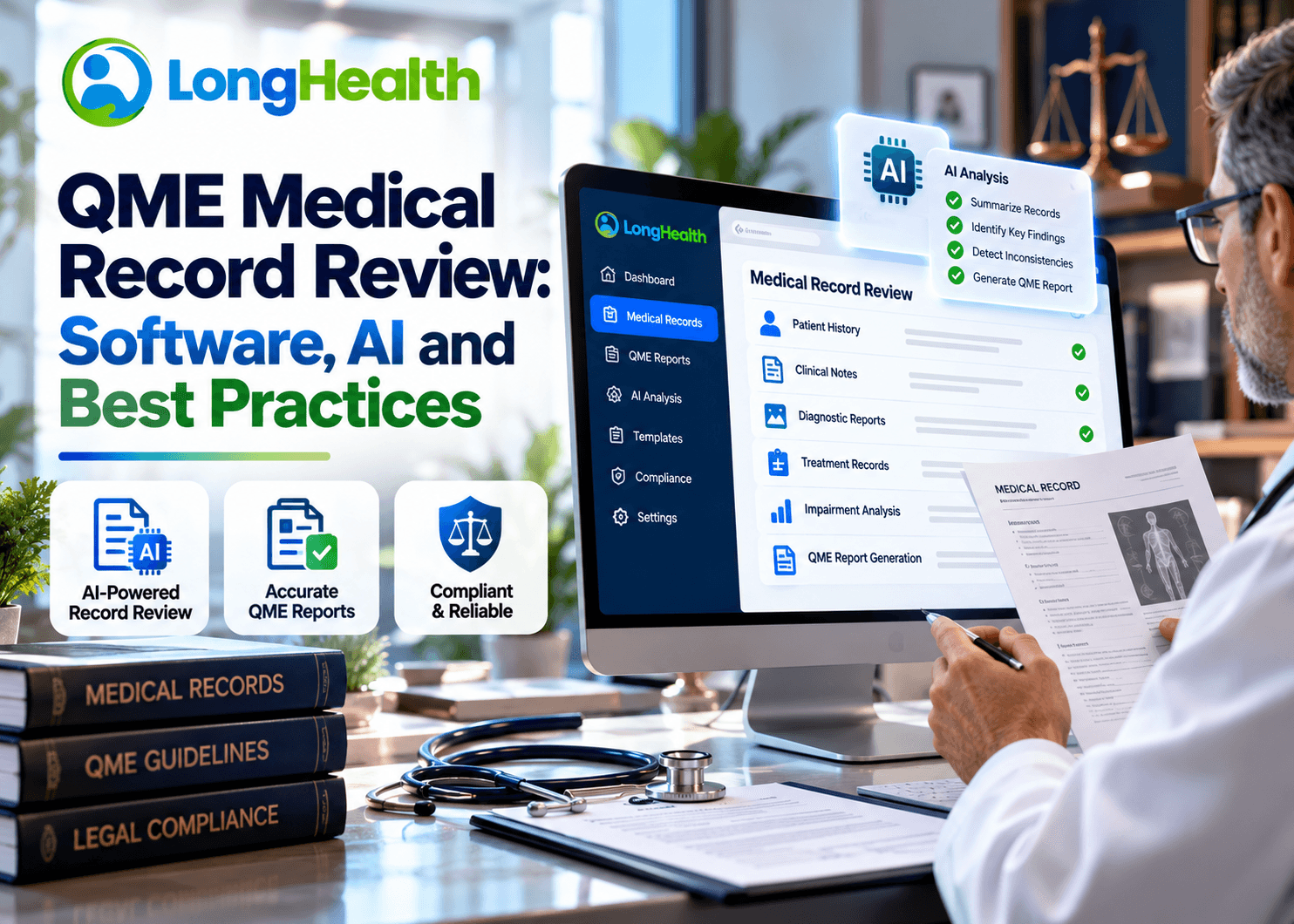
QME medical record review is the process of reviewing and organizing medical documentation relevant to a Qualified Medical Evaluator's medical-legal evaluation.
For many cases, the challenge is not simply accessing the records. A QME may need to work through information from multiple providers, dates, procedures, diagnostic studies, treatment episodes, and clinical encounters before preparing an evaluation.
AI-assisted medical record review software can help organize this information by extracting relevant clinical details, identifying events, creating chronologies, and making information easier to locate and verify.
However, medical record review is not the same as automated medical-legal judgment.
The software can assist with finding and organizing information. The evaluator remains responsible for reviewing the underlying records and applying professional judgment to the medical-legal evaluation.
For organizations evaluating QME medical record review software, the key question is therefore:
Can the technology help an evaluator move from a large, complex record set to a structured, traceable understanding of the documented medical history?
What Is QME Medical Record Review?
QME medical record review in California is the systematic examination of medical documentation relevant to a Qualified Medical Evaluator's evaluation.
The records may contain information about:
- Injury history
- Symptoms
- Diagnoses
- Treatment
- Medications
- Procedures
- Imaging
- Laboratory testing
- Specialist consultations
- Follow-up visits
- Physical examinations
- Clinical findings
- Previous medical history
- Functional information
- Other relevant documentation
The purpose of the review is to help the evaluator understand the documented history and identify information relevant to the medical-legal evaluation.
In California, the Division of Workers' Compensation administers the Qualified Medical Evaluator program and provides resources relating to QME medical-legal evaluations and reports.
Because applicable requirements can change, organizations should verify current requirements directly with the California DWC when developing or modifying their workflows.
Why QME Medical Record Review Matters
Medical-legal cases can contain information spread across many documents.
A single case may involve records from:
- Primary-care providers
- Specialists
- Hospitals
- Imaging centers
- Physical therapists
- Surgeons
- Laboratories
- Emergency departments
- Other healthcare organizations
The evaluator may need to determine how these records fit together chronologically.
For example:
Injury
↓
Initial Evaluation
↓
Diagnostic Testing
↓
Treatment
↓
Follow-Up
↓
Specialist Consultation
↓
Procedure
↓
Subsequent Evaluation
A structured medical-record review helps organize this information before the evaluator reaches the professional conclusions required for the case.
What Information Is Typically Relevant During Medical Record Review?
The exact information required depends on the case and evaluation.
However, a medical-record review workflow may organize information such as:
| Information Type | Examples |
|---|---|
| Dates | Visits, procedures, testing |
| Diagnoses | Diagnoses documented by providers |
| Symptoms | Symptoms recorded in clinical notes |
| Treatment | Therapy, medications, procedures |
| Imaging | X-rays, MRI, CT, ultrasound |
| Laboratory data | Documented laboratory results |
| Procedures | Surgical or other procedures |
| Providers | Physicians and other treating professionals |
| Clinical findings | Findings documented during encounters |
| Follow-up | Subsequent evaluations and treatment |
| Functional information | Documented limitations or capabilities |
| Source documents | Records supporting individual entries |
The purpose of organizing this information is not to create an independent medical opinion.
It is to make the documented information easier for the evaluator to review.
How Does QME Medical Record Review Work?
A structured workflow can be divided into several stages.
Step 1: Record Intake
The first stage is collecting the medical records associated with the case.
Records may arrive in different formats and may come from multiple sources.
A digital workflow can organize documents by:
- Case
- Date
- Document type
- Provider
- Source
- Record category
The objective is to create an organized record set before detailed review begins.
Step 2: Document Processing
Medical records can contain both digitally generated and scanned documents.
A record-review platform may use technologies such as:
- Optical character recognition
- Natural-language processing
- Document classification
- Information extraction
- AI-assisted summarization
The exact capabilities depend on the software.
The important consideration is whether the platform can reliably process the types of records used by the organization.
Step 3: Clinical Information Extraction
After documents are processed, software can help identify relevant information.
For example, an AI-assisted system may identify:
- Diagnoses
- Medications
- Procedures
- Imaging
- Laboratory results
- Dates
- Clinical encounters
- Providers
- Treatment events
The extracted information can then be organized into a structure that is easier for the evaluator to review.
This is different from allowing the software to independently interpret the medical-legal significance of the information.
Step 4: Medical Chronology
One of the most useful outputs of structured medical-record review is a clinical chronology.
A chronology organizes relevant medical events according to date.
For example:
| Date | Event | Key Information | Source |
|---|---|---|---|
| January 10 | Initial evaluation | Symptoms and documented findings | Clinical note |
| January 18 | Imaging | Imaging performed | Imaging report |
| February 3 | Follow-up | Treatment documented | Follow-up note |
| March 15 | Procedure | Procedure documented | Procedure record |
| April 20 | Subsequent evaluation | Later findings documented | Clinical note |
The chronology can give the evaluator a high-level view of the record while still allowing review of the underlying documentation.
Why Medical Chronology Is Important
A large medical record can make it difficult to understand the sequence of events.
Chronology helps answer:
- What happened first?
- When was the condition initially documented?
- When was diagnostic testing performed?
- What treatment occurred afterward?
- Which providers were involved?
- What changed over time?
- What information was documented at subsequent visits?
A chronology should not replace review of the underlying records.
Instead, it should function as a structured navigation and review tool.
Source Traceability in QME Medical Record Review
Source traceability is one of the most important considerations when using AI-assisted medical-record review.
Suppose software generates this statement:
“The patient underwent a procedure in March.”
The evaluator should be able to determine:
- Which document supports the statement?
- What date is documented?
- Which provider or facility recorded it?
- What exactly does the source record say?
- Was the information extracted correctly?
This is why a strong record-review workflow should connect structured information back to the underlying source.
A useful model is:
Extracted Information
↓
Source Document
↓
Professional Verification
Rather than:
AI Output
↓
Automatically Accepted as Fact
Source traceability gives the evaluator a practical mechanism for checking the information before relying on it.
Can AI Review Medical Records for a QME?
AI can assist with processing and organizing medical records, but AI-assisted review should not be confused with autonomous medical-legal evaluation.
AI can potentially help with:
- Finding relevant information
- Extracting clinical events
- Organizing dates
- Creating chronologies
- Summarizing documentation
- Identifying diagnoses documented in records
- Identifying procedures
- Organizing treatment history
- Retrieving information from large record sets
The evaluator should still review the underlying records and determine how the information should be used within the evaluation.
This distinction is particularly important in high-consequence workflows.
AI Medical Record Review vs. Manual Review
Both approaches have different workflow characteristics.
| Area | Manual Review | AI-Assisted Review |
|---|---|---|
| Document reading | Primarily manual | Technology-assisted |
| Information extraction | Manual | AI-assisted |
| Chronology | Manually constructed | Can be AI-assisted |
| Information retrieval | Manual searching | Search and AI-assisted retrieval |
| Source verification | Professional review | Professional review remains important |
| Interpretation | Professional | Professional |
| Final conclusions | Professional | Professional |
AI-assisted software does not necessarily eliminate manual review.
Instead, it can move the professional's effort toward reviewing, validating, interpreting, and using the information.
What Are the Benefits of AI-Assisted QME Medical Record Review?
The benefits depend on the specific platform, record volume, workflow, and implementation.
Potential benefits include:
Faster Information Retrieval
Structured information can make it easier to locate relevant events within large record sets.
Better Organization
A chronology can provide a structured overview of the documented clinical history.
Reduced Repetitive Work
Automation can assist with repetitive information extraction and organization.
Easier Review of Large Records
Search, extraction, and structured summaries may help reviewers navigate extensive documentation.
Source-Based Verification
When extracted information is connected to source documents, reviewers have a clearer way to verify it.
More Consistent Processes
Organizations can establish repeatable workflows for:
Intake → Review → Chronology → Verification → Evaluation
These should be treated as workflow considerations rather than guaranteed time or cost savings.
What Should QME Medical Record Review Software Do?
When evaluating software, focus on the complete workflow.
1. Document Ingestion
The platform should be evaluated against the actual records your organization receives.
Questions include:
- What file formats are supported?
- Can scanned documents be processed?
- How are documents organized?
- Can large record sets be handled?
2. Information Extraction
Ask:
- What information can be extracted?
- How are dates identified?
- How are diagnoses identified?
- How are procedures identified?
- Can users search extracted information?
3. Clinical Chronology
Ask:
- Can the system create a chronology?
- Can chronology entries be edited?
- Can entries be traced to source documents?
- How does the platform handle conflicting information?
4. Source Verification
Ask:
- Can reviewers open the source document?
- Can extracted information be checked?
- Can incorrect information be corrected?
- Can users distinguish source information from AI-generated summaries?
5. Professional Review
Ask:
- Where does human review occur?
- Can evaluators modify outputs?
- Can users add information?
- Can the evaluator control the final report?
QME Medical Record Review Workflow
A practical technology-supported workflow can look like this:
1. Collect
Gather the medical records associated with the case.
2. Process
Convert and organize the records into a reviewable digital format.
3. Extract
Identify relevant clinical information.
4. Organize
Group information by date, event, provider, diagnosis, treatment, and other relevant categories.
5. Build Chronology
Create a timeline of documented medical events.
6. Verify
Review extracted information against source documents.
7. Evaluate
The QME applies professional judgment to the relevant information.
8. Document
Relevant findings and evaluation information are recorded.
9. Prepare Report
The reviewed information can support preparation of the medical-legal report.
This workflow separates information processing from professional judgment.
Common Problems in Medical Record Review
Organizations evaluating QME record-review software should understand the limitations of medical documentation.
Records can contain:
Duplicate Documents
The same report may appear more than once.
Conflicting Dates
Different documents may contain different dates for related events.
Missing Information
Not every relevant event will necessarily appear in the available record.
Scanned Documents
Some records may require OCR before they can be searched or analyzed.
Ambiguous Terminology
Medical abbreviations and terminology can create challenges for automated extraction.
Documentation Errors
Source records themselves may contain errors or inconsistencies.
Complex Clinical Context
A short statement in one record may require surrounding documentation to understand its context.
These issues reinforce the importance of professional verification.
Why Human Review Remains Important
AI-assisted medical-record review should be built around a human-in-the-loop workflow.
A responsible process looks like:
Medical Records
↓
AI Processing
↓
Structured Information
↓
Source Verification
↓
Professional Review
↓
Medical-Legal Evaluation
The professional remains responsible for determining how the information should be interpreted and used.
The technology assists with information processing.
It does not independently establish the evaluator's professional conclusions.
QME Medical Record Review and Report Preparation
Medical-record review is usually one component of a larger medical-legal workflow.
Once the records have been reviewed and organized, the resulting information can support later stages such as:
- Clinical chronology
- Examination documentation
- Impairment-related workflow
- Report organization
- Medical-legal report preparation
This creates a relationship between record review and report preparation.
However, the two should not be treated as identical search topics.
QME medical record review in California focuses on understanding and organizing the records.
QME report software focuses on the technology used to prepare reports.
QME report automation focuses on automating the broader workflow.
Keeping these functions distinct can help organizations evaluate technology more precisely.
How LongHealth Fits the QME Medical Record Review Workflow
LongHealth's EvalPath is designed around medical-legal workflows that include AI-assisted medical-record review and clinical chronology.
The documented workflow also includes:
- AI-assisted examination documentation
- Impairment-rating support
- Physician-editable medical-legal report preparation
This allows medical-record review to function as part of a broader workflow rather than as an isolated summarization tool.
A simplified workflow is:
Medical Records
→ AI-Assisted Review
→ Clinical Chronology
→ Examination Documentation
→ Impairment Support
→ Report Preparation
→ Physician Review
The evaluator retains control over the professional review and final output.
How to Evaluate QME Medical Record Review Software
Before selecting a platform, organizations should test it using representative records.
A practical evaluation framework includes the following.
Accuracy and Verification
Determine whether extracted information can be verified against source documents.
Record Handling
Test the platform using the types and volumes of records your organization actually processes.
Chronology Quality
Check whether clinical events are organized in a useful chronological structure.
Search and Retrieval
Determine how easily users can find specific information.
Editing Controls
Evaluate whether professionals can correct and modify AI-generated information.
Workflow Fit
Determine whether the platform fits the existing QME process rather than requiring unnecessary workflow changes.
Security and Privacy
Review the vendor's documented security controls, data handling practices, access controls, retention policies, and applicable contractual requirements.
Do not assume that a general security or compliance statement automatically addresses every organization's specific requirements.
QME Medical Record Review Software Evaluation Checklist
| Evaluation Area | Questions |
|---|---|
| Record intake | Can the platform handle the records we receive? |
| File formats | Are our common document formats supported? |
| OCR | Can scanned records be processed? |
| Extraction | What clinical information can be extracted? |
| Search | Can reviewers quickly find relevant information? |
| Chronology | Can the platform organize clinical events by date? |
| Source traceability | Can entries be verified against source documents? |
| Editing | Can users correct extracted information? |
| Human review | Where does professional review occur? |
| Security | How is sensitive healthcare data handled? |
| Integration | Can it fit our existing systems and processes? |
| Scalability | Can it support our case volume? |
| Reporting | Can reviewed information flow into report preparation? |
| Governance | How are AI outputs reviewed and controlled? |
What Is the Difference Between Medical Record Review and Medical Record Summarization?
The terms are related but should not automatically be treated as interchangeable.
Medical record summarization generally focuses on condensing information.
Medical record review is broader.
A review workflow may include:
- Finding relevant information
- Understanding chronology
- Identifying source documentation
- Checking consistency
- Organizing information
- Verifying extracted information
- Determining relevance to the evaluation
A summary can be one output of a review process.
It does not necessarily constitute the complete review.
For QME workflows, this distinction is important.
What Is the Difference Between AI Extraction and Professional Interpretation?
AI extraction focuses on identifying information present in documentation.
For example:
Source: “MRI performed on March 12.”
Extraction: MRI — March 12.
Professional interpretation involves determining the significance of that information within the medical-legal evaluation.
Those are different tasks.
A well-designed system should make this distinction clear.
Security Considerations for QME Medical Record Review
Medical records contain sensitive healthcare information.
Organizations evaluating software should examine:
- Data storage
- Data transmission
- Encryption
- Access controls
- Authentication
- User permissions
- Auditability
- Data retention
- Vendor agreements
- Data deletion policies
- Security documentation
- Applicable privacy obligations
Organizations should assess these factors based on their own legal, contractual, operational, and security requirements.
Avoid assuming that a platform's general statement about healthcare security or HIPAA automatically answers every organizational compliance question.
QME Medical Record Review and California
QME is particularly relevant to California's workers' compensation medical-legal system.
The California Division of Workers' Compensation provides QME resources, regulations, forms, and medical-legal report guidance through its Medical Unit.
California requirements can address aspects of medical-legal evaluation and reporting, including procedures surrounding reports and evaluator responsibilities.
Because regulatory requirements can change, organizations should verify current requirements with official California DWC resources when designing or updating a QME workflow.
Software should support the workflow; it should not be treated as the source of legal or regulatory advice.
Questions to Ask a QME Medical Record Review Software Vendor
Before purchasing a platform, consider asking:
Record Processing
- What record formats can the system process?
- Can it process scanned records?
- How does it handle large record sets?
- How are duplicate records handled?
AI
- What information does the AI extract?
- How are AI-generated summaries created?
- Can users verify information against source documents?
- How are errors corrected?
Chronology
- Can the system create a clinical chronology?
- Can chronology entries be edited?
- Can each entry be traced to its source?
Workflow
- How does record review connect with examination documentation?
- Can reviewed information support report preparation?
- Can professionals edit generated content?
Security
- Where is information stored?
- What access controls are available?
- What data retention policies apply?
- What security documentation is available?
Implementation
- How does implementation work?
- What training is required?
- What support is available?
- How does the platform scale with case volume?
Conclusion
QME medical record review in California is a critical information-processing stage in a medical-legal evaluation workflow.
When records contain information from multiple providers, dates, procedures, diagnostic studies, and treatment episodes, organizing the information can become a significant part of the evaluator's workflow.
AI-assisted software can help by:
- Processing medical records
- Extracting relevant information
- Organizing clinical events
- Creating medical chronologies
- Improving information retrieval
- Connecting information to source documents
- Supporting later report preparation
But automation should not be confused with professional medical-legal judgment .
The most appropriate model is:
AI-assisted information processing
Source verification
Professional review
Medical-legal judgment
For organizations evaluating QME medical record review software, the most important consideration is therefore not simply whether a platform can summarize a medical record.
The better question is:
Can it help the evaluator find, organize, verify, and work with the relevant information while maintaining professional control over the evaluation?
LongHealth's EvalPath is designed around this type of workflow, connecting AI-assisted medical-record review and clinical chronology with examination documentation, impairment-related support, and physician-editable medical-legal report preparation.
If your organization is evaluating QME medical record review technology, the next step is to compare the platform against your actual record types, case volume, verification requirements, security requirements, and existing medical-legal workflow.
Discuss your QME medical-record review workflow with LongHealth.
Frequently Asked Questions
What is QME medical record review?
QME medical record review in California is the structured review and organization of medical documentation relevant to a Qualified Medical Evaluator's medical-legal evaluation.
Can AI help with QME medical record review?
Yes. AI-assisted software can help extract and organize information from medical records, create clinical chronologies, and make relevant information easier to locate. Professional review remains important.
What does QME medical record review software do?
Depending on the platform, it can support document processing, clinical information extraction, medical chronology, search, record organization, source verification, and other parts of the medical-legal workflow.
Can AI summarize QME medical records?
AI can assist with summarizing documented information. However, a summary should not automatically be treated as a complete medical-legal review or professional interpretation.
Why is source traceability important?
Source traceability allows the evaluator to verify extracted information against the original documentation before relying on it.
Can QME software review scanned medical records?
Capabilities vary by platform. Organizations should verify whether the software supports OCR and test it with representative scanned records before implementation.
Does AI medical record review replace the QME?
No. AI-assisted review can support information processing and organization, but it does not replace the evaluator's professional judgment or responsibility.
What should I look for in QME record-review software?
Important areas include document handling, information extraction, chronology, source traceability, search, editing controls, human review, security, integration, scalability, and workflow fit.
How does medical chronology help a QME?
A chronology organizes documented medical events by date, making it easier to understand the sequence of evaluations, diagnoses, treatments, procedures, imaging, and follow-up information.
Can medical-record review software prepare a QME report?
Some platforms can connect medical-record review with later report-preparation workflows. The extent of automation varies by platform, and the evaluator should retain control over professional review and finalization.
Does LongHealth support QME medical-record review?
LongHealth's EvalPath is documented as supporting AI-assisted medical-record review and clinical chronology as part of a broader medical-legal workflow that also includes examination documentation, impairment-rating support, and physician-editable report preparation.

HIPAA Compliant
We follow the highest standards of data protection, fully aligned with HIPAA regulations, to safeguard your medical records with uncompromising privacy and trust.

HITRUST
We are proud to be HITRUST Risk-Based, 2-Year (r2) Certified, demonstrating our commitment to the highest standards of data security and compliance.
Trusted Partners
Our trusted vendors are fully compliant with HIPAA and hold prestigious certifications.
Data Encryption
Longhealth secures your sensitive information with advanced encryption, safeguarding data both during transmission and while stored.
DxF - Data Exchange Framework
Improve care coordination, transparency, and access to real-time patient data across systems like EHRs, health plans, and providers.

Data Exchange Simplified

HIPAA Compliant