QME Report Software for Medical Legal Evaluations
20 September 2026
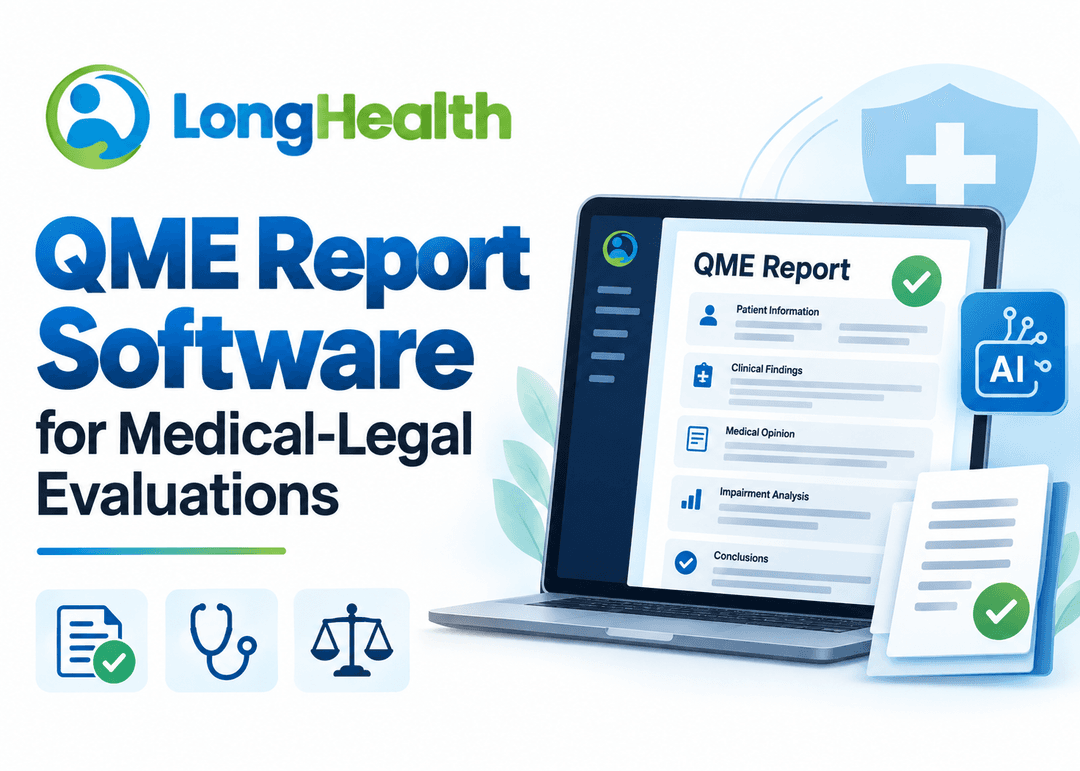
QME report software is designed to help Qualified Medical Evaluators and medical-legal organizations manage the work involved in reviewing records, organizing clinical information, documenting evaluations, and preparing medical-legal reports.
The most useful QME software is not simply a document generator. A medical-legal evaluation can involve large volumes of records, multiple document formats, chronological reconstruction of injuries and treatment, examination findings, impairment-rating considerations, and detailed report preparation. Software should therefore support the workflow around the report—not attempt to replace the professional responsible for the evaluation.
For organizations evaluating QME report software, the key questions are whether the platform can organize medical records, surface relevant information, create a reviewable chronology, support examination documentation, assist with impairment-related workflows, and provide editable outputs that a qualified professional can verify before finalization.
LongHealth's EvalPath is designed around this type of medical-legal workflow, combining AI-assisted medical-record review, clinical chronology, examination documentation, impairment-rating support, and physician-editable report preparation.
QME report software in California is technology designed to support the preparation and management of medical-legal evaluation reports produced by Qualified Medical Evaluators.
A QME evaluation involves more than writing a narrative. The evaluator may need to review extensive medical documentation, understand the patient's relevant history, identify important events, assess examination findings, address applicable medical-legal questions, and prepare a report that accurately represents the evaluator's professional conclusions.
In California, the Division of Workers' Compensation describes QMEs as qualified physicians and other qualified professionals who examine injured workers to evaluate disability and write medical-legal reports. The DWC also provides report-writing resources and regulatory requirements that apply to QME workflows.
This means QME software should be evaluated as a workflow technology rather than simply as an AI writing tool.
- Medical-record intake
- Document organization
- Medical-record review
- Clinical information extraction
- Chronology generation
- Examination documentation
- Impairment-rating support
- Report drafting
- Professional review and editing
- Final report preparation
- Document storage and retrieval
The exact workflow depends on the evaluator, organization, jurisdiction, case type, and technology being used.
Why QME Report Software Preparation Can Be Time Intensive
Medical-legal cases can involve records from multiple providers and facilities. Relevant information may be distributed across clinical notes, imaging reports, laboratory records, operative reports, consultations, treatment records, and other documentation.
The challenge is not only the amount of information.
The evaluator also needs to understand how the information relates across time.
A useful workflow therefore needs to help answer questions such as:
- What happened?
- When did it happen?
- Which provider documented it?
- What diagnosis was recorded?
- What treatment was provided?
- What imaging or testing was performed?
- What findings were documented?
- Which information is relevant to the evaluation?
- Where did a particular piece of information come from?
This is one reason medical chronology can be an important component of QME software.
What Should QME Report Software Include?
Organizations should evaluate QME report software based on the complete workflow rather than a single feature.
The software should help users process and review the records associated with a case.
Useful capabilities can include:
- Document ingestion
- OCR for scanned documents
- Structured information extraction
- Search and retrieval
- Diagnosis identification
- Medication identification
- Procedure identification
- Imaging information
- Laboratory information
- Relevant dates
- Provider information
- Clinical event identification
The objective is not to remove professional review.
Instead, the objective is to make relevant information easier to locate and organize.
2. AI Medical Chronology
Chronology is particularly useful when a case contains records spanning multiple providers, dates, and episodes of care.
AI-assisted chronology can organize clinical events into a timeline so the evaluator can review the sequence of: Injury > Evaluation > Diagnosis > Treatment > Follow-up > Imaging > Procedures > Subsequent Findings
A strong chronology workflow should also make it possible to trace information back to the underlying source material.
This is important because a timeline should be treated as an aid to review, not as an independent medical conclusion.
3. Source Traceability
Source traceability is one of the most important considerations when evaluating AI-assisted QME software.
An evaluator should be able to determine where information came from.
For example:
| Information | What the reviewer should be able to verify |
|---|---|
| Diagnosis | Source record and relevant documentation |
| Treatment | Original treatment documentation |
| Imaging | Imaging report or source document |
| Clinical event | Relevant date and source |
| Examination finding | Examination documentation |
| Patient history | Underlying record |
| Chronology entry | Supporting source material |
Source-linked workflows can make it easier for professionals to verify AI-generated summaries and chronologies before using them in a medical-legal workflow.
4. Examination Documentation
Record review is only one part of the evaluation process.
The evaluator may also need to document information gathered during the examination.
An AI-assisted workflow can help capture dictated observations or examination information and turn them into structured documentation for review.
The important distinction is that software should assist documentation rather than independently determine the evaluator's medical conclusions.
The professional remains responsible for reviewing, correcting, and finalizing the information.
5. Impairment Rating Support
Some medical-legal workflows require impairment-related calculations and documentation.
Software may assist by organizing relevant medical information and examination findings and providing tools that support the evaluator's impairment-rating workflow.
However, impairment-rating support should not be interpreted as autonomous professional judgment.
The evaluator must determine the appropriate conclusions and verify the information used to reach them.
6. Medical Legal Report Preparation
Once the relevant information has been reviewed, organized, and verified, the next stage is report preparation.
Useful QME report software in California may help assemble information into a physician-editable report structure.
A practical workflow can look like: Medical Records > AI-Assisted Review > Clinical Chronology > Examination Documentation > Impairment-Rating Support > Draft Report > Physician Review & Editing > Final Medical-Legal Report
This workflow keeps AI in an assistive role while maintaining professional review.
Can AI Write a QME Report?
AI can assist with portions of QME report preparation, but it should not be treated as a replacement for the QME's professional judgment.
AI can potentially assist with:
- Extracting information from records
- Organizing clinical events
- Creating chronologies
- Summarizing documentation
- Structuring information
- Converting dictated information into text
- Preparing editable draft content
The evaluator still needs to review the underlying information and determine the appropriate medical-legal conclusions.
This distinction matters because a medical-legal report can have significant consequences. The software should therefore support a human-in-the-loop workflow rather than treating generated text as automatically authoritative.
QME Software vs. Generic AI Summarization
Not every AI medical-record tool is QME software.
A generic summarization platform may answer: "What does this medical record contain?"
A medical-legal workflow may need to answer a much more specific set of questions:
- What are the relevant events?
- When did each event occur?
- Which records support each event?
- How did the condition or injury progress?
- What examinations were performed?
- What information is relevant to the evaluation?
- How should the information be organized for professional review?
- How can the evaluator efficiently prepare the final report?
This distinction is important when evaluating vendors.
| Capability | Generic AI Summarization | QME-Oriented Workflow |
|---|---|---|
| Document summarization | Often | Yes |
| Clinical chronology | May vary | Important |
| Source traceability | May vary | Important |
| Examination documentation | Usually limited | Relevant |
| Impairment workflow | Usually absent | Potentially relevant |
| Medical-legal report preparation | Usually limited | Core workflow |
| Physician review | Important | Essential |
| Case-specific workflow | Limited | Central consideration |
The right solution depends on the organization's actual workflow and requirements.
How LongHealth's EvalPath Fits the QME Workflow
LongHealth's EvalPath is positioned around medical-legal evaluation workflows.
Its documented workflow includes:
- Reviewing medical records with AI assistance
- Building a clinical chronology
- Capturing examinations with AI-assisted documentation
- Supporting impairment-rating calculations
- Preparing physician-editable medical-legal report content
- Reviewing, editing, and finalizing the report
This approach connects the major information-processing stages instead of treating report generation as an isolated task.
For organizations evaluating QME report software in California, that distinction can be important.
The value of a platform is not simply whether it can generate text. The larger question is whether it can fit into the complete process from record intake through professional review and final report preparation.
Medical Record Review for QME Cases
One of the biggest opportunities for workflow automation is medical-record review.
LongHealth's medical-record workflows describe AI-assisted extraction and organization of information such as:
- Diagnoses
- Medications
- Allergies
- Procedures
- Laboratory results
- Imaging
- Clinical encounters
- Dates
- Treatments
- Symptoms
For medical-legal workflows, the information can then be organized into a chronology for professional review.
This can be especially useful when the record contains information from multiple providers or document types.
However, the quality of the workflow depends on the quality of the underlying records and the ability of the reviewer to verify the resulting output.
Why Human Review Matters
AI-assisted QME software should not eliminate professional review.
Medical records can contain:
- Missing information
- Conflicting dates
- Duplicate documentation
- Poor-quality scans
- Ambiguous terminology
- Incomplete clinical context
- Documentation inconsistencies
- Errors in source records
An AI system may identify patterns and organize information, but the evaluator must determine whether the output is accurate and appropriate for the case.
A responsible workflow is therefore: Records > AI Processing > Structured Information > Professional Review > Final Report
rather than: Records > AI > Final Medical-Legal Opinion
This distinction should be part of any QME software evaluation.
What Are the Benefits of QME Report Software?
The benefits depend on the software, implementation, case volume, and workflow.
Potential operational benefits include:
Faster Information Retrieval
Instead of manually searching every document for a specific diagnosis, procedure, date, or treatment, users may be able to retrieve relevant information through structured search and AI-assisted interfaces.
More Organized Case Review
A chronology can give the evaluator a structured view of events across the record.
Reduced Administrative Work
Automation can assist with repetitive information-processing tasks, allowing professionals to focus their time on activities requiring their expertise.
More Consistent Workflows
A standardized digital process can help organizations establish repeatable procedures for record intake, review, chronology, documentation, and report preparation.
Better Record Traceability
When generated information is connected to source documentation, reviewers have a clearer path for verification.
Scalable Medical-Legal Operations
Organizations handling larger case volumes can evaluate whether software can help increase processing capacity without simply adding the same amount of manual administrative work.
These should be treated as workflow considerations rather than guaranteed outcomes.
Before selecting a platform, create a practical evaluation framework.
1. Record Handling
Ask:
- What document formats are supported?
- Can scanned records be processed?
- How are large record sets handled?
- How are duplicate documents handled?
2. Chronology
Ask:
- Can the platform create clinical timelines?
- Can entries be traced to source documents?
- Can reviewers edit chronology entries?
- How are conflicting dates handled?
3. AI Transparency
Ask:
- What does the AI generate?
- What does it extract?
- Can users verify generated information?
- How are corrections made?
- What human-review controls exist?
4. Report Preparation
Ask:
- Can physicians edit generated content?
- Can the output fit existing report workflows?
- Can templates be supported?
- Can finalized reports be exported?
5. Medical-Legal Workflow
Ask whether the platform supports the specific stages your organization actually uses:
- Case intake
- Record review
- Chronology
- Examination documentation
- Impairment-related workflow
- Report drafting
- Review
- Finalization
6. Security and Privacy
When evaluating healthcare software, organizations should carefully examine how protected health information is handled.
Consider:
- Data encryption
- Access controls
- Data storage
- Data retention
- Auditability
- Vendor agreements
- Security certifications
- Organizational security policies
Do not assume that a security certification or HIPAA-related claim by itself answers every security question. The organization's own compliance and risk requirements still need to be evaluated.
QME Report Software Evaluation Checklist
Use this checklist when comparing platforms:
| Evaluation Area | Questions to Ask |
|---|---|
| Medical records | Can the platform process the records used in our cases? |
| Document formats | Does it support our common file types? |
| AI extraction | What information can be extracted? |
| Chronology | Can clinical events be organized chronologically? |
| Source traceability | Can information be verified against source records? |
| Examination | Can examination information be captured efficiently? |
| Impairment | Does the workflow support impairment-related documentation? |
| Report preparation | Can physicians edit generated content? |
| Templates | Can outputs fit our existing report format? |
| Human review | Where does professional review occur? |
| Security | What technical and organizational safeguards are available? |
| Integration | Can the platform fit existing systems and workflows? |
| Scalability | Can it support the organization's case volume? |
| Governance | How are AI outputs reviewed and managed? |
Is QME Report Software a Replacement for a QME?
No.
QME report software in California should be understood as workflow technology.
It can assist with information processing, organization, documentation, and report preparation, but it does not replace the evaluator's professional responsibility.
The evaluator remains responsible for reviewing the information, applying professional judgment, making appropriate medical-legal determinations, and finalizing the report.
This human-review principle is particularly important when AI is used in high-consequence healthcare or medical-legal workflows.
QME Report Software and California Requirements
California has specific rules governing Qualified Medical Evaluators and medical-legal reports.
The California Division of Workers' Compensation provides guidance and regulations covering areas including report preparation, service, evaluator responsibilities, record retention, and timeframes.
For example, California regulations require comprehensive medical-legal evaluation reports to be served according to applicable procedures, while QME record-retention requirements include retaining copies of comprehensive medical-legal reports for five years.
The DWC also specifies requirements relating to report-writing education and provides voluntary report-writing resources for QMEs.
Because requirements can change, organizations should verify current regulatory requirements directly with the California Division of Workers' Compensation rather than relying solely on software documentation or third-party summaries.
What Makes a QME Software Platform Different?
A meaningful QME software platform should be evaluated according to the workflow it supports.
A useful platform should ideally connect: Records > Review > Chronology > Examination > Impairment Workflow > Report Preparation > Professional Review
The closer the technology fits the actual workflow, the more useful it may be operationally.
The objective should not be to automate professional judgment.
The objective should be to automate or streamline repetitive information-processing work around that judgment.
Why Workflow Matters More Than an AI Feature List
When evaluating healthcare AI software, it can be tempting to compare products based on the number of AI features they advertise.
That can be misleading.
For QME organizations, the more important questions may be:
- Does the system fit the existing case workflow?
- Can reviewers verify the output?
- Can source information be located quickly?
- Can the evaluator control the final report?
- Can the organization manage sensitive records appropriately?
- Does the platform support the specific medical-legal use case?
A platform with a smaller but workflow-specific feature set may address a medical-legal organization's needs differently from a general-purpose AI platform.
LongHealth and AI Assisted Medical Legal Workflows
LongHealth combines AI-powered healthcare workflows with healthcare data and interoperability capabilities.
For medical-legal use cases, EvalPath provides a workflow focused on:
- Medical-record review
- Clinical chronology
- AI-assisted examination documentation
- Impairment-rating support
- Medical-legal report preparation
- Physician review and editing
LongHealth also documents healthcare interoperability capabilities involving technologies such as HL7, FHIR, and APIs, which can be relevant when medical-record workflows need to connect with broader healthcare technology environments.
The right implementation depends on the organization's workflow, technical environment, record sources, security requirements, and medical-legal use case.
Conclusion
QME report software in California should be evaluated as a complete medical legal workflow solution not simply as an AI writing tool.
The most useful capabilities can include medical-record review, structured information extraction, clinical chronology, source traceability, examination documentation, impairment-rating support, and physician-editable report preparation.
For organizations evaluating these technologies, the central question is not simply: "Can AI write a report?"
A better question is: "Can the technology help our evaluators move from complex medical records to a structured, reviewable, professionally finalized medical-legal report?"
That requires a workflow built around information quality, source verification, professional oversight, security, and practical usability.
LongHealth's EvalPath is designed around this broader medical-legal workflow, combining AI-assisted record review and chronology with examination documentation, impairment-rating support, and report preparation.
If your organization is evaluating QME report software, the next step is to map the platform against your actual case workflow, record volume, review requirements, reporting process, and technology environment.
Talk with LongHealth to discuss how an AI-assisted medical-legal evaluation workflow could fit your organization's requirements.
FAQ
What is QME report software?
QME report software is technology designed to support Qualified Medical Evaluators and medical-legal organizations with tasks such as medical-record review, chronology, examination documentation, impairment-related workflows, and report preparation.
Can QME software generate a medical-legal report?
Some platforms can generate physician-editable draft content as part of a medical-legal workflow. The evaluator should review and finalize the report rather than treating AI-generated content as an independent medical-legal opinion.
Can AI create a medical chronology for a QME?
AI can assist with extracting and organizing clinical events into a chronological timeline. The resulting chronology should be reviewed against the source records before it is used in a medical-legal evaluation.
Does QME report software replace a physician?
No. Software can support documentation and information-processing tasks, but it does not replace the evaluator's professional judgment.
What should I look for in QME report software?
Important evaluation areas include medical-record handling, chronology, source traceability, examination documentation, impairment-related workflows, report preparation, human review, security, integrations, scalability, and governance.
Can QME software process large medical records?
Capabilities vary by platform. When evaluating a solution, organizations should test it using representative records and document volumes from their actual workflow rather than relying only on a vendor's general claims.
What is AI medical chronology?
AI medical chronology is the use of AI-assisted technology to extract and organize clinical events into chronological order. In a medical-legal workflow, it can help a professional understand the sequence of injuries, diagnoses, treatments, examinations, imaging, and other documented events.
Does LongHealth offer software for medical-legal workflows?
LongHealth's EvalPath solution is documented as supporting medical-legal evaluation workflows, including AI-assisted medical-record review, clinical chronology, examination capture, impairment-rating support, and physician-editable report preparation.
Should AI-generated QME information be reviewed by a professional?
Yes. AI-generated information should be reviewed against the underlying records and evaluated by the appropriate professional before being relied upon for a consequential medical-legal purpose.

HIPAA Compliant
We follow the highest standards of data protection, fully aligned with HIPAA regulations, to safeguard your medical records with uncompromising privacy and trust.

HITRUST
We are proud to be HITRUST Risk-Based, 2-Year (r2) Certified, demonstrating our commitment to the highest standards of data security and compliance.
Trusted Partners
Our trusted vendors are fully compliant with HIPAA and hold prestigious certifications.
Data Encryption
Longhealth secures your sensitive information with advanced encryption, safeguarding data both during transmission and while stored.
DxF - Data Exchange Framework
Improve care coordination, transparency, and access to real-time patient data across systems like EHRs, health plans, and providers.

Data Exchange Simplified

HIPAA Compliant