AI Medical Chronology in California: How It Works and Who It's For
27 August 2026
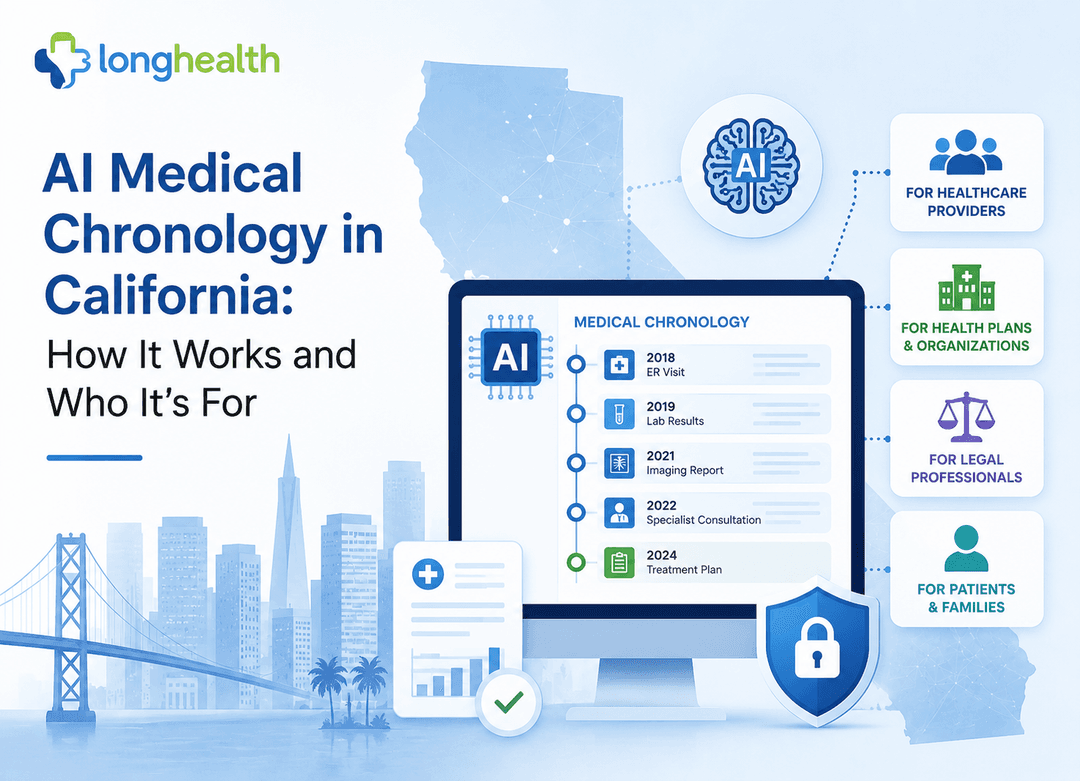
California's medical legal system runs on paper thousands of pages of clinical notes, imaging reports, and specialist consults that someone has to read, sequence, and summarize before a QME, AME, or attorney can make a decision. AI medical chronology in California is the technology-assisted process of automatically extracting, dating, and organizing every clinical event from a patient's medical records into a single chronological timeline, cutting review time from days to hours. For California healthcare organizations, IPAs, and workers' compensation practices drowning in disconnected EHR exports, an AI medical chronology isn't a convenience; it's becoming the baseline standard for medical-legal evaluation and complex-case review.
This guide explains exactly how AI medical chronology in California works, what separates a credible platform from a superficial one, and how California organizations should evaluate a vendor before committing.
What Is an AI Medical Chronology?
A medical chronology is a chronological, event by event summary of a patient's entire medical history every visit, diagnosis, treatment, imaging result, and provider note arranged in date order so a reviewer can understand the clinical story at a glance. An AI medical chronology applies machine learning and natural language processing to build that timeline automatically from raw, unstructured medical records instead of requiring a paralegal or nurse reviewer to build it by hand.
In practice, an AI medical chronology in California typically serves three groups: medical-legal evaluators (QMEs and AMEs) preparing impairment ratings, workers' compensation and personal injury attorneys building case files, and healthcare organizations that need to consolidate a patient's history across multiple disconnected EHR systems before a clinical or legal review.
How AI Medical Chronology Differs From a Manual Chronology
A manually built medical chronology depends on a human reviewer reading hundreds or thousands of pages, extracting relevant dates and events, and typing them into a timeline document, a process that commonly takes 8 to 20+ hours per case depending on record volume. An AI medical chronology in California performs the same extraction and sequencing work in minutes to hours, using optical character recognition (OCR) for scanned records, natural language processing to identify clinical events, and date-normalization logic to resolve inconsistent or conflicting date formats across providers.
The output is not a replacement for clinical judgment; it's a structured, reviewable draft that a QME, AME, or legal reviewer verifies and finalizes, which is why accuracy, auditability, and human-in-the-loop review remain essential to any credible AI medical chronology platform.
How AI Medical Chronology Works, Step by Step
Understanding the underlying mechanism, not just the benefit, matters when evaluating any AI medical chronology in California, because the quality of the output depends entirely on what happens at each stage.
Record Ingestion and Normalization
The process begins with ingesting records from every source: PDFs, faxed documents, EHR exports, and scanned paper charts. A credible AI medical chronology platform runs OCR on scanned and image-based documents, converts every file into machine readable text, and normalizes formatting differences between EHR systems so that a note from one provider's system and a lab result from another can be processed the same way.
Chronological Sequencing and Event Extraction
Once records are normalized, the AI medical chronology engine uses natural language processing to identify discrete clinical events, visit dates, diagnoses, procedures, medication changes, imaging findings, and provider recommendations and extracts each one with its associated date, provider, and source document. This is the step where AI medical chronology software has to resolve real-world messiness: duplicate records, conflicting dates, illegible handwriting in scanned notes, and inconsistent terminology across specialties. The events are then sequenced into a single, continuous timeline spanning the full record set, regardless of how many separate providers or systems the records originated from.
Structured Output for QME, AME, and Legal Review
The final stage converts the sequenced timeline into a structured, physician or attorney ready document typically organized by date with source citations back to the original page, so every entry in the AI medical chronology can be independently verified against the underlying record. For medical-legal use cases, this structured output feeds directly into impairment-rating workflows and QME/AME report preparation, which is where a platform purpose-built for medical legal evaluation like EvalPath differs meaningfully from a generic document-summarization tool.
Why California Practices and Legal Teams Are Adopting AI Medical Chronology
The California Workers' Comp and Personal Injury Context
California's workers' compensation system places heavy documentation demands on QMEs and AMEs, who are required to review the complete relevant medical record before issuing an impairment rating or medical legal opinion. As California's provider landscape becomes more fragmented with patients seeing multiple specialists across different EHR systems before a case ever reaches evaluation the record volume behind a single case has grown substantially. AI medical chronology in California directly addresses this by compressing the record-review bottleneck that has historically slowed down QME scheduling, AME report turnaround, and case resolution timelines statewide.
The Interoperability Gap AI Medical Chronology Solves
California healthcare data is notoriously fragmented across EHR systems that don't natively communicate with one another. A patient's chronology often has to be assembled from records pulled out of three, four, or more separate systems, each with its own formatting and date conventions. This is the same interoperability gap that California's CalHHS Data Exchange Framework (DxF) is designed to close at the infrastructure level and it's precisely why a health data exchange company already built around California interoperability is well positioned to deliver AI medical chronology as a natural extension of that same record-consolidation infrastructure.
AI Medical Chronology in California: Manual vs. AI Assisted Comparison
| Factor | Manual Chronology | AI Medical Chronology (California) |
|---|---|---|
| Typical turnaround (500-page record) | 8–20+ hours | Minutes to a few hours |
| Consistency across cases | Varies by reviewer | Standardized process every time |
| Source traceability | Manual page-flagging | Automatic citation back to source page |
| Handling scanned/handwritten records | Slow, error-prone | OCR-assisted extraction |
| Scalability for high case volume | Limited by staff headcount | Scales without added headcount |
| Human clinical/legal review required | Yes | Yes AI drafts, human verifies |
| Best fit | Very small, low-volume practices | QMEs, AMEs, IPAs, legal teams, high-volume review |
Myths and Misconceptions About AI Medical Chronology
Myth: An AI medical chronology replaces the QME's or attorney's judgment. An AI medical chronology in California organizes and sequences the record; it does not issue a medical opinion, an impairment rating, or a legal conclusion. Every AI-generated chronology still requires human review and sign-off before it's used in an evaluation or case file.
Myth: AI medical chronology tools can't handle scanned or handwritten records. Modern AI medical chronology platforms use OCR specifically to process scanned, faxed, and even handwritten medical documents, converting them into structured, searchable text before extraction begins.
Myth: Using an AI medical chronology means losing control over how a case is presented. A well-built AI medical chronology in California is fully editable and source cited reviewers can adjust, annotate, or reorder entries before the chronology is finalized, and every entry links back to its source document for verification.
How to Evaluate an AI Medical Chronology Vendor in California
- Source traceability: Does every entry in the AI medical chronology cite the exact source document and page?
- OCR accuracy on scanned records: Can the platform reliably process faxed, scanned, and handwritten records common in California medical-legal case files?
- Security certifications: Is the vendor HITRUST r2 certified and HIPAA compliant, with encryption in transit and at rest?
- California-specific experience: Does the vendor understand QME/AME workflows and California workers' compensation and personal injury documentation requirements?
- Human-in-the-loop review: Does the workflow require and support clinical or legal review before finalization, rather than presenting AI output as a finished opinion?
- Turnaround time at scale: Can the platform maintain accuracy and speed across high case volumes, not just single-case demos?
- Integration with existing systems: Does the AI medical chronology platform connect with the EHR systems and record sources your organization already uses?
Case Example: A California IPA's Medical-Legal Backlog
A mid-sized California IPA supporting workers' compensation evaluations found its QME scheduling backlog growing month over month. Each case file arrived as a mix of scanned faxes, EHR exports, and imaging reports from an average of five different provider systems, and building a single chronology manually took reviewers most of a business day per case. The IPA adopted an AI medical chronology workflow to ingest and normalize records automatically, sequence clinical events into a source cited timeline, and hand reviewers a structured draft instead of a stack of disconnected PDFs. Reviewers still verified and finalized every chronology, but the time spent on initial record assembly dropped sharply, allowing the same review staff to move through a substantially larger case volume without expanding headcount directly reducing the QME scheduling backlog that had been the organization's core bottleneck.
Long Health's Approach to AI Medical Chronology in California
Long Health is a California based health data exchange and AI healthcare technology company, and a designated Qualified Health Information Organization (QHIO) and Carequality implementer under California's CalHHS Data Exchange Framework. That interoperability infrastructure built to consolidate patient records across disconnected California EHR systems is the same foundation behind Long Health's approach to AI medical chronology in California.
Through EvalPath, Long Health's AI platform for medical legal evaluations, California QMEs, AMEs, and legal teams get an AI medical chronology built specifically for medical-legal workflows: record ingestion and OCR processing, chronological event extraction with source citation, and a structured, physician-ready output that feeds directly into impairment rating and report-preparation workflows. For healthcare organizations that need broader record consolidation beyond medical legal use cases, Medical Record Summarization applies the same AI-driven extraction to surface key clinical insights from long, complex patient histories.
Long Health is HITRUST r2 certified, HIPAA compliant with encryption in transit and at rest, a member of NVIDIA Inception, and connects directly to the Carequality network with direct-messaging fallback for gap records not yet available through network lookup giving California organizations a single, security-vetted source for both data exchange and AI medical chronology.
Key Takeaways
- An AI medical chronology in California automatically extracts, dates, and sequences clinical events into a single, source cited timeline.
- It compresses a process that manually takes 8–20+ hours into minutes to hours, without removing the need for human clinical or legal review.
- California's fragmented EHR landscape and heavy QME/AME documentation demands make AI medical chronology especially valuable for medical-legal case review.
- Evaluate vendors on source traceability, OCR accuracy, security certifications (HITRUST, HIPAA), and California-specific medical-legal experience.
- AI medical chronology drafts must still be verified by a qualified reviewer — it assists judgment, it doesn't replace it.
- Long Health's EvalPath platform delivers AI medical chronology in California built specifically for QME, AME, and legal medical-record review workflows.
Conclusion and Next Steps
AI medical chronology in California is becoming the practical standard for organizations that can no longer afford the time cost of manually assembling medical-legal record timelines from fragmented EHR sources. The technology doesn't remove the evaluator or attorney from the process, it removes the hours of manual record assembly that used to stand between them and the case itself. For California QMEs, AMEs, IPAs, and legal teams evaluating an AI medical chronology vendor, the differentiators that matter are source traceability, security certification, and genuine California medical legal experience.
Long Health brings all three, backed by the same CalHHS Data Exchange Framework infrastructure the company was built on. Talk to our team to see how EvalPath's AI medical chronology can fit into your California case review workflow.
FAQ
What is an AI medical chronology?
An AI medical chronology is an automatically generated, chronological timeline of a patient's medical events, visits, diagnoses, treatments, and imaging — built by AI from raw medical records instead of a manual reviewer, with source citations back to the original documents.
Who uses AI medical chronology in California?
QMEs, AMEs, workers' compensation and personal injury attorneys, and California healthcare organizations that need to consolidate patient records across multiple disconnected EHR systems for clinical or legal review.
Does an AI medical chronology replace a QME's medical opinion?
No. An AI medical chronology in California organizes and sequences the record only; it does not issue an impairment rating or medical-legal opinion, which still requires the evaluator's clinical judgment and sign off.
How long does an AI medical chronology take compared to a manual one?
A manual chronology on a large record set commonly takes 8–20+ hours; an AI medical chronology can produce a structured draft in minutes to a few hours, with human review still required before finalization.
Can AI medical chronology tools process scanned or faxed records?
Yes. Credible AI medical chronology platforms use OCR to convert scanned, faxed, and handwritten records into structured, searchable text before building the timeline.
Is Long Health's AI medical chronology platform secure?
Yes. Long Health is HITRUST r2 certified and HIPAA compliant, with encryption in transit and at rest, and connects directly to the Carequality network for record exchange.

HIPAA Compliant
We follow the highest standards of data protection, fully aligned with HIPAA regulations, to safeguard your medical records with uncompromising privacy and trust.

HITRUST
We are proud to be HITRUST Risk-Based, 2-Year (r2) Certified, demonstrating our commitment to the highest standards of data security and compliance.
Trusted Partners
Our trusted vendors are fully compliant with HIPAA and hold prestigious certifications.
Data Encryption
Longhealth secures your sensitive information with advanced encryption, safeguarding data both during transmission and while stored.
DxF - Data Exchange Framework
Improve care coordination, transparency, and access to real-time patient data across systems like EHRs, health plans, and providers.

Data Exchange Simplified

HIPAA Compliant