Patient Record Retrieval API in California: How Compliant Data Exchange Works Under CalHHS DxF
7 September 2026
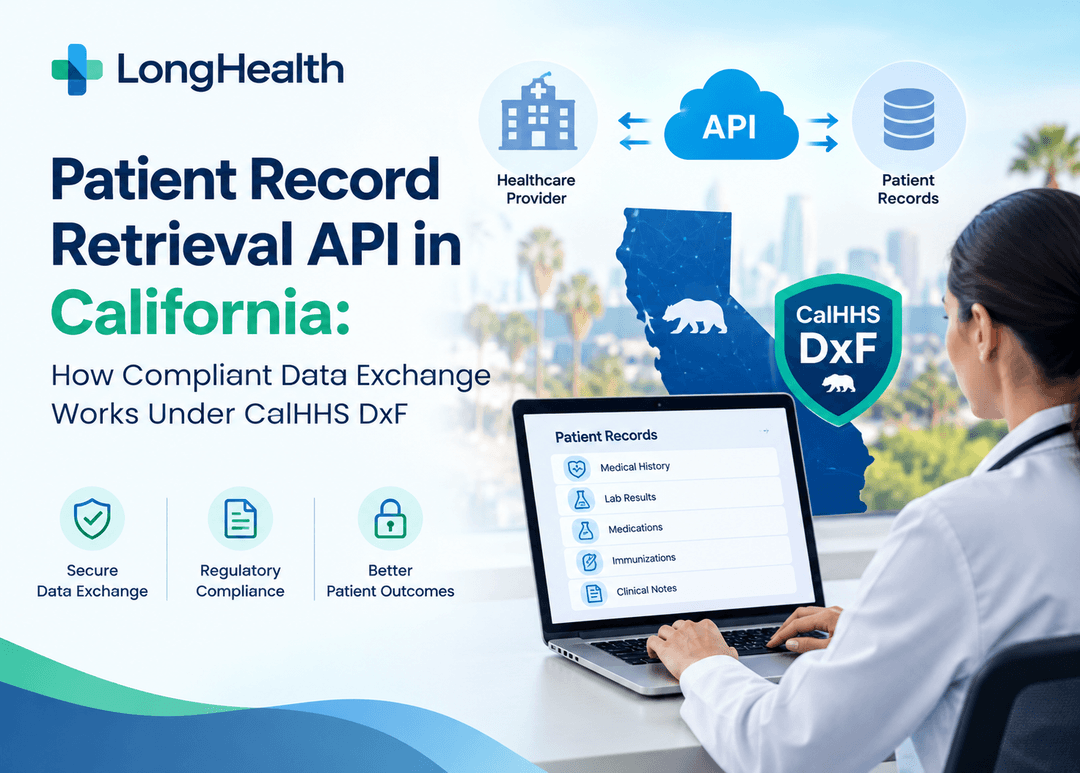
California's Data Exchange Framework has been law since 2022, and its core deadlines have already come and gone; most hospitals, medical groups, and health plans were required to start exchanging patient data by January 31, 2024, and smaller practices by January 31, 2026. For a California healthcare organization, a Patient Record Retrieval API in California is the technical mechanism that turns that legal obligation into a working system: a secure, programmatic way to pull a patient's records from outside organizations the moment they're needed, instead of chasing down a fax or a phone call.
This guide explains how a Patient Record Retrieval API in California works in practice, what California's DxF mandate actually requires, and how to evaluate whether to build this capability in-house or connect through a Qualified Health Information Organization (QHIO).
What Is a Patient Record Retrieval API?
A Patient Record Retrieval API in California is a secure software interface that lets a healthcare organization's EHR or clinical system request and receive a patient's records from another organization's system, without manual data entry or faxing. Instead of a staff member calling another clinic for records, the API sends a structured query typically using the FHIR standard and returns a consolidated, machine-readable record in seconds. In California, this capability is increasingly tied to CalHHS DxF compliance, because the framework requires signatories to exchange or provide access to health information with other mandated organizations in near real time.
The distinction that matters for California providers: a Patient Record Retrieval API in California is not the same thing as an EHR. It's the connective layer that lets EHRs from different vendors, at different organizations, talk to each other.
Why California Providers Need This Now The DxF Deadlines Have Already Passed
Most articles about California's data exchange mandate treat it as something on the horizon. It isn't. The compliance dates are already behind most of the healthcare system, which changes the urgency for any organization still relying on fax-based record requests.
Who Was Required to Comply, and When
Under AB 133 and the CalHHS Data Exchange Framework, signatories were required to sign the Data Sharing Agreement (DSA) by January 31, 2023, and then begin actively exchanging health and social services information by one of two dates:
- January 31, 2024 — general acute care hospitals, physician organizations and medical groups with 25 or more physicians, skilled nursing facilities, clinical laboratories, health plans, and acute psychiatric hospitals.
- January 31, 2026 — physician practices with fewer than 25 physicians, rural general acute care and critical access hospitals under 100 beds, rehabilitation hospitals, long-term acute care hospitals, and nonprofit clinics with fewer than 10 providers.
Both deadlines have now passed. A smaller California practice that hasn't yet stood up a real patient record retrieval workflow is already out of compliance with its data exchange obligation, not just behind on a future requirement.
What Happens to Practices That Still Aren't Exchanging Data
The enforcement mechanism is public accountability, not an immediate fine. Starting January 1, 2027, the Department of Health Care Access and Information (HCAI) is required to publish and maintain a public list of entities it identifies as non-compliant with the DSA execution requirement. For a practice, an IPA, or a medical group, appearing on a state-published non-compliance list carries reputational and referral-network risk well beyond the regulatory exposure itself — payers, hospital systems, and larger medical groups increasingly expect their network partners to be DxF-compliant before routing patients or data to them.
This is the practical reason a Patient Record Retrieval API in California has moved from "nice to have" to a near-term operational requirement for California providers of every size.
How a Patient Record Retrieval API Actually Works
The mechanism is worth explaining plainly, because most of the confusion around DxF compliance comes from treating "data exchange" as an abstraction rather than a specific technical process.
Carequality Record Lookup vs. Direct Messaging
There are two primary paths a patient record retrieval API uses to pull records, and a well-built system uses both.
Carequality record lookup works by querying a shared national network. When your API sends a request for a specific patient — matched by demographics like name, date of birth, and often a patient identifier — Carequality-connected organizations across the country that hold records for that patient respond automatically, without a person on either end manually locating and sending the file. This is how a California provider can pull a patient's history from an out-of-state hospital system without a phone call.
Direct messaging is the fallback for organizations not yet connected to Carequality or a similar network. It functions more like secure, structured email between provider organizations — still faster and more reliable than fax, but requiring the sending organization to actively push the record rather than responding to an automated query. A patient record retrieval API that only supports Carequality lookup will hit gaps; one that combines both methods closes them.
From API Query to Consolidated Patient Record
A typical patient record retrieval sequence looks like this:
- A clinician or intake staff member triggers a record request inside the EHR (often automatically, at scheduling or check-in).
- The API sends a patient-matching query across the Carequality network and any direct-messaging partners.
- Responding organizations return available records — visit summaries, medication lists, lab results, imaging reports.
- The API normalizes and reconciles the incoming data, resolving duplicate entries and conflicting formats.
- A consolidated patient record is delivered into the clinician's existing EHR workflow, without requiring staff to log into a separate portal.
The value isn't just speed — it's that the record arrives structured and matched to the correct patient, reducing the manual reconciliation work that otherwise falls on clinical staff.
Building an In-House API vs. Connecting Through a QHIO
California providers generally have two paths to a working patient record retrieval capability: build direct API connections themselves, or connect through a Qualified Health Information Organization (QHIO) that already maintains those connections.
| Factor | Build In-House | Connect Through a QHIO |
|---|---|---|
| Time to first working connection | 6–18 months typical | Weeks, in most cases |
| Carequality network access | Requires separate onboarding and certification | Included via QHIO's existing connection |
| DxF Data Sharing Agreement support | Legal and compliance burden sits fully with the practice | QHIO typically supports DSA execution and ongoing compliance |
| Ongoing maintenance | Internal IT team must maintain uptime, security patches, format updates | Maintained by the QHIO as part of the service |
| Security certification | Practice must independently pursue and maintain HITRUST/HIPAA posture | Inherits the QHIO's certified security infrastructure |
| Best fit for | Large health systems with dedicated interoperability engineering teams | Practices, medical groups, and IPAs without in-house integration engineering |
For most California physician practices, medical groups, and IPAs, the in-house path isn't a realistic use of clinical or administrative budget — the engineering lift to build and maintain Carequality-grade connections rivals what a dedicated health IT vendor already runs at scale.
What to Evaluate in a Patient Record Retrieval API Vendor
Before selecting a vendor for patient record retrieval, verify the following:
- HITRUST r2 or equivalent certification — confirms the vendor's security controls have been independently audited, not just self-attested.
- HIPAA compliance with encryption in transit and at rest — the baseline for any system handling protected health information.
- Direct Carequality network connection — ask whether the vendor connects natively or routes through a third party, which can add latency and points of failure.
- A fallback method for records outside the Carequality network — direct messaging or equivalent, so gaps in network coverage don't become gaps in patient records.
- Support for CalHHS DSA execution — whether the vendor helps the practice sign and maintain its Data Sharing Agreement, or leaves that entirely to internal staff.
- Integration path with your existing EHR — confirm the record delivery method fits into current clinical workflow rather than requiring a separate login.
Myths & Misconceptions About Patient Record Retrieval APIs
"DxF compliance only applies to hospitals." It doesn't. Physician organizations, medical groups, skilled nursing facilities, clinical labs, and even smaller physician practices with fewer than 25 physicians are named signatories under the framework, just on a later implementation timeline.
"Connecting to a data exchange network means losing control of patient data." A patient record retrieval API doesn't grant blanket access to a practice's records — it responds to specific, matched patient queries under the terms of the DxF Data Sharing Agreement and applicable consent rules, not open data sharing.
"A patient portal already covers this requirement." A patient-facing portal lets an individual view their own records; it doesn't fulfill the organization-to-organization exchange obligation the DxF mandates, which requires systems to respond to other providers' queries automatically.
Case Example: A Mid-Sized California Medical Group Consolidates Three EHRs
A mid-sized California medical group — roughly 20 physicians across three locations — had grown through acquisition and inherited three separate EHR systems, none of which communicated with each other or with outside hospital systems. Staff manually requested outside records by fax, with a typical turnaround of three to five business days, and the group had signed its DSA but had no functioning method to actually exchange data ahead of its January 2026 implementation deadline.
After connecting through a QHIO-based patient record retrieval API, the group's clinicians began receiving consolidated outside records — visit summaries, medications, and recent labs — within the existing EHR workflow at the point of scheduling, typically before the patient's visit rather than days afterward. Administrative staff time previously spent chasing records by phone and fax was redirected to other intake work, and the group's DxF implementation was brought current without hiring additional IT staff. The specific gains will vary by practice size and record volume, but the pattern — fragmented systems consolidated into one automated retrieval workflow — is typical of what a QHIO connection resolves.
How Long Health's Platform Delivers Patient Record Retrieval in California
Long Health is a California-based, HITRUST r2 certified health data exchange company and designated Qualified Health Information Organization (QHIO), built specifically around the state's own CalHHS Data Exchange Framework rather than adapted from a generic national platform. Its patient record retrieval API connects directly to the Carequality network, with direct-messaging as a fallback for records outside that network, and the platform is HIPAA compliant with encryption in transit and at rest.
Beyond raw record retrieval, Long Health assists California practices with CalHHS Data Sharing Agreement execution and supports organizations working through their DxF implementation obligations. The company is a member of NVIDIA Inception, reflecting its focus on applying AI to the harder problem sitting downstream of record retrieval: reconciling and structuring the records once they arrive. That capability connects naturally to Long Health's broader product set AI Scribe for real-time clinical documentation, and AI-driven medical record summarization for organizations retrieving large patient histories and needing them distilled into a usable clinical summary rather than a stack of disconnected documents.
Key Takeaways
- California's DxF deadlines for data exchange have already passed — January 2024 for larger organizations, January 2026 for smaller practices.
- A patient record retrieval API is the technical layer that fulfills the DxF's data exchange requirement; signing the DSA alone does not.
- Carequality record lookup and direct messaging together close the gaps that either method leaves on its own.
- Building direct API connections in-house is a realistic option mainly for large health systems with dedicated interoperability engineering teams.
- Starting January 1, 2027, HCAI will publish a public list of non-compliant entities, adding reputational risk to the compliance requirement.
- A QHIO connection typically gets a California practice exchanging patient records within weeks, with security certification and DSA support included.
Conclusion
For California healthcare organizations still relying on fax and phone calls to move patient records, the compliance clock isn't ahead of them anymore — it's behind them. A patient record retrieval API, connected through a QHIO like Long Health, closes that gap without requiring a practice to build and maintain its own Carequality infrastructure.
FAQ
Does a patient record retrieval API replace the need to sign the CalHHS Data Sharing Agreement?
No. The DSA is the legal commitment to exchange data under CalHHS's framework; the API is the technical mechanism that fulfills that commitment. A practice needs both — the signed agreement and a working retrieval system — to be fully DxF-compliant.
How is a patient record retrieval API different from a health information exchange (HIE)?
An HIE is typically a regional network that organizations join to share data locally. A patient record retrieval API can query an HIE, but it can also query the broader Carequality network nationally, giving a California practice access to records from organizations well outside any single regional HIE's footprint.
Can a small physician practice with fewer than 25 physicians use the same API infrastructure as a hospital?
Yes. QHIO-based platforms are typically priced and configured to serve practices of any size, since the underlying Carequality connection and compliance infrastructure is shared across all connected organizations rather than built separately per client.
What happens if a patient's records exist at an organization not connected to Carequality?
A well-built patient record retrieval API includes a direct-messaging fallback, allowing the requesting organization to send a structured request directly to the holding organization even without a live Carequality connection.
Is patient consent required before records are retrieved through the API?
Retrieval for treatment, payment, and healthcare operations generally follows existing HIPAA permitted-use rules rather than requiring new patient authorization for each request, though practices should confirm consent handling specifics with their compliance counsel and vendor.
How long does it take a California practice to get a working patient record retrieval API in place?
Through a QHIO connection, most practices are exchanging data within weeks of onboarding, compared to the six-to-eighteen-month timeline typical of building direct Carequality connections in-house.
HIPAA Compliant
We follow the highest standards of data protection, fully aligned with HIPAA regulations, to safeguard your medical records with uncompromising privacy and trust.
HITRUST
We are proud to be HITRUST Risk-Based, 2-Year (r2) Certified, demonstrating our commitment to the highest standards of data security and compliance.
Trusted Partners
Our trusted vendors are fully compliant with HIPAA and hold prestigious certifications.
Data Encryption
Longhealth secures your sensitive information with advanced encryption, safeguarding data both during transmission and while stored.
DxF - Data Exchange Framework
Improve care coordination, transparency, and access to real-time patient data across systems like EHRs, health plans, and providers.

Data Exchange Simplified
HIPAA Compliant