Healthcare Interoperability API in California: What It Is and What CalHHS DxF Requires
26 August 2026
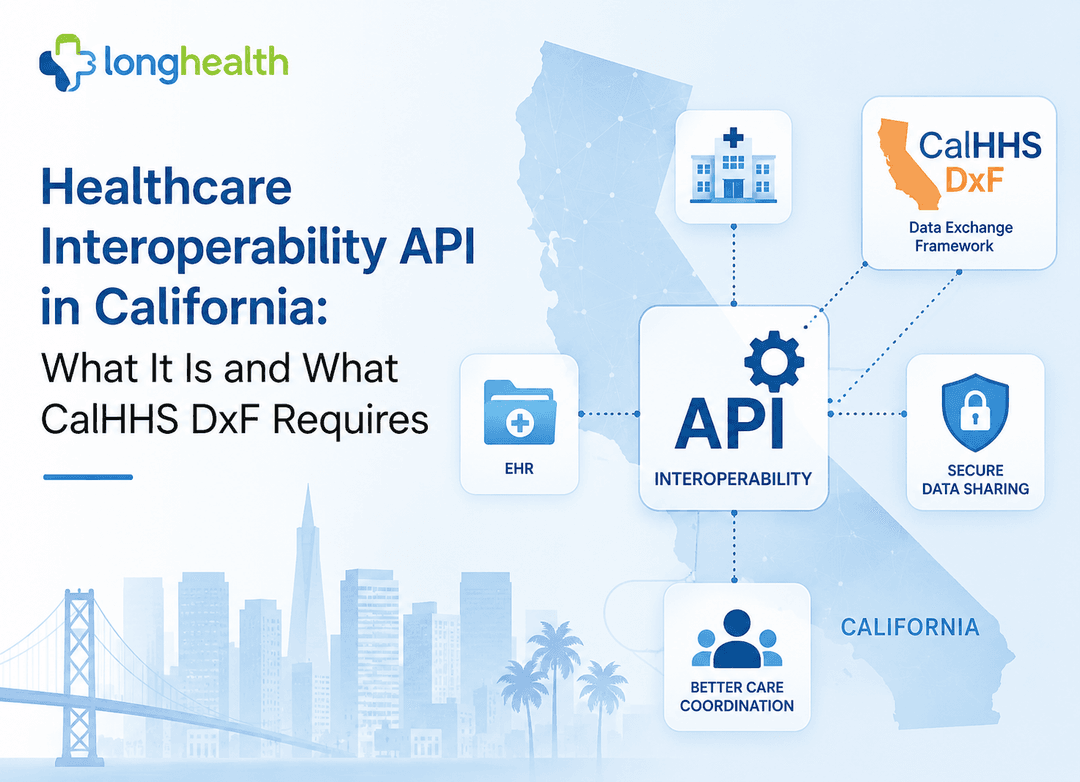
California providers searching for a healthcare interoperability API in California are usually trying to solve two problems at once: technical data exchange between disconnected EHR systems, and compliance with the state's Data Exchange Framework (DxF) under CalHHS. A healthcare interoperability API in California is the technical layer that lets a provider's EHR request, send, and receive patient records from other connected organizations but on its own, a healthcare interoperability API is not the same thing as DxF compliance.
Compliance requires that a healthcare interoperability API in California run on a Qualified Health Information Organization (QHIO) network, backed by a signed Data Sharing Agreement (DSA) with CalHHS. This distinction API as plumbing, QHIO as the compliant network the plumbing runs on is the piece most vendor comparisons skip, and it's the one that actually determines whether a California practice meets its legal obligation when adopting a healthcare interoperability API in California.
What Is a Healthcare Interoperability API?
A healthcare interoperability API is a standardized set of technical protocols — typically built on FHIR (Fast Healthcare Interoperability Resources) that allows one healthcare system to request and receive patient data from another system in a structured, machine-readable format. A healthcare interoperability API in California, specifically, has to operate inside the state's DxF governance layer, not just the technical FHIR spec.
In practice, this means a California clinic's EHR can query a hospital's system for a patient's recent labs, medication history, or discharge summary without manual faxing or phone calls, using a healthcare interoperability API in California that's connected to the right network. The API itself defines how data moves; it does not by itself guarantee who is authorized to exchange that data, under what consent rules, or whether a given healthcare interoperability API in California satisfies a state mandate like DxF. That governance layer sits on top of the API, which is why most healthcare organizations connect to a healthcare interoperability API in California through a QHIO rather than building point-to-point API integrations themselves.
California's Data Exchange Framework (DxF) and Why an API Alone Isn't Compliance
California's Data Exchange Framework, administered by CalHHS, requires most healthcare entities operating in the state to sign a single, standardized Data Sharing Agreement and exchange patient data electronically through participating networks; the regulatory backdrop every healthcare interoperability API in California now has to operate within.
The DxF was created to replace the patchwork of bilateral data-sharing contracts that previously existed between California hospitals, medical groups, health plans, and government agencies. A healthcare interoperability API in California that isn't connected to a DxF-participating QHIO can move data technically, but it does not satisfy the state's regulatory requirement, a common gap practice discovered only after an audit or a compliance review of their healthcare interoperability API in California.
Who the DxF Applies To
The DxF applies broadly across California's healthcare ecosystem: general acute care hospitals, physician organizations and medical groups, skilled nursing facilities, health plans, clinical laboratories, and acute psychiatric hospitals are all in scope, along with several state agencies meaning nearly every one of them will eventually need a compliant healthcare interoperability API in California.
Community clinics, smaller physician practices, and certain other provider types fall under later compliance phases, but the direction of the mandate is toward near-universal participation. Any organization uncertain about its exact compliance category, or whether its current healthcare interoperability API in California already satisfies DxF, should confirm current phase-in dates directly against CalHHS's published DxF timeline before assuming an exemption applies.
Key Deadlines and Enforcement Reality
CalHHS has staged DxF compliance in phases rather than a single cutoff, with larger organizations required to sign the Data Sharing Agreement earlier than smaller ones, which affects when each organization's healthcare interoperability API in California needs to be fully connected. Because deadlines and enforcement mechanisms have been refined since the framework's initial rollout, practices should verify their specific compliance date against CalHHS's current published schedule rather than relying on an older announcement — DxF requirements are not static, and grant funding tied to onboarding a healthcare interoperability API in California has changed shape over time as well.
How a Compliant Interoperability API Actually Works
Understanding the mechanism matters more than most vendor pages let on. A DxF-compliant healthcare interoperability API in California typically operates in two layers:
- Carequality-based record lookup. When a provider needs a patient's history from an organization it has no prior direct connection to, a healthcare interoperability API in California queries the Carequality network — a nationwide trust framework — which routes the request to any participating organization holding that patient's records. This is a "pull" model: the requesting provider's system asks, and the API returns a consolidated document (often a C-CDA) built from whatever matching records exist across the network.
- Direct messaging as a fallback. For organizations not yet reachable through Carequality's query-based lookup, a compliant healthcare interoperability API in California uses secure direct messaging — a point-to-point, encrypted transmission — to close the gap. This matters in California specifically because rural and safety-net providers, particularly in the Central Valley and parts of Northern California, are still completing their network connections, and a healthcare interoperability API in California that only supports Carequality lookup, without a direct-messaging fallback, will have blind spots for those records.
Together, these two mechanisms are what separate a genuinely interoperable healthcare interoperability API in California from a system that only exchanges data with a narrow set of pre-integrated partners.
In-House API Build vs. QHIO-Connected Platform
| Factor | Build In-House API | Connect via QHIO-Connected Healthcare Interoperability API in California |
|---|---|---|
| DxF compliance | Requires separately negotiating and maintaining the CalHHS Data Sharing Agreement and QHIO participation | DSA support and QHIO connection typically included |
| Network reach | Limited to organizations you individually integrate with | Full Carequality network plus direct-messaging fallback |
| Build timeline | Months of internal engineering resources | Weeks, since infrastructure already exists |
| Ongoing maintenance | Internal team owns FHIR spec updates, security patching, uptime | Vendor owns infrastructure and compliance updates |
| Security certification | Practice must independently pursue HITRUST/HIPAA validation | Platform typically already HITRUST r2 certified and HIPAA compliant |
| Cost structure | Large upfront engineering + ongoing headcount | Predictable subscription/service model |
| Best fit | Large health systems with dedicated interoperability engineering teams | Independent practices, IPAs, medical groups, and mid-sized systems that need a healthcare interoperability API in California without in-house engineering |
What to Evaluate When Choosing an Interoperability API Partner in California
Before signing with any vendor offering a healthcare interoperability API in California, confirm the following:
- QHIO designation — is the vendor an actual CalHHS-designated Qualified Health Information Organization, or simply "DxF-compatible"?
- Security certifications — does the healthcare interoperability API in California hold current HITRUST r2 certification and demonstrate HIPAA-compliant encryption in transit and at rest?
- Network coverage — does the healthcare interoperability API in California connect via Carequality, and does it offer a direct-messaging fallback for organizations outside that network?
- DSA support — will the vendor help your organization actually sign and manage the CalHHS Data Sharing Agreement, or leave that step to you?
- EHR compatibility — does the healthcare interoperability API in California integrate with your specific EHR without requiring a costly custom build?
- Grant/funding assistance — can the vendor help identify and apply for any current DxF-related onboarding support tied to your healthcare interoperability API in California (confirm current amounts and eligibility directly with CalHHS, since these change)?
- Track record with your practice type — has the vendor deployed a healthcare interoperability API in California for organizations similar in size and specialty to yours (IPA, hospital, community clinic, workers' comp evaluator)?
Myths & Misconceptions About Interoperability APIs in California
Myth: "An API integration automatically means we're DxF compliant." Technical data exchange and regulatory compliance are not the same thing. DxF compliance specifically requires a signed CalHHS Data Sharing Agreement and participation through a recognized network — a healthcare interoperability API in California that moves data outside that structure doesn't satisfy the mandate.
Myth: "DxF only applies to hospitals." The framework's scope extends well beyond hospitals to medical groups, health plans, laboratories, skilled nursing facilities, and — on a phased timeline — smaller practices and clinics, all of which will eventually need a compliant healthcare interoperability API in California. Assuming exemption based on organization size or type is one of the most common compliance gaps.
Myth: "Connecting to a QHIO means losing control of our patient data." A QHIO-connected healthcare interoperability API in California is governed by consent rules and the terms of the Data Sharing Agreement itself; it does not mean an organization's records become freely accessible to any requester. Data still moves only in response to permitted queries under the agreement's rules.
Case Example: A California IPA's DxF Compliance Path
A mid-sized independent physician association in California was operating across three disconnected EHR systems inherited from a series of practice mergers, with no shared healthcare interoperability API in California connecting any of them. Referral records and specialist notes routinely had to be faxed or manually re-entered, and the IPA's compliance officer discovered — closer to a CalHHS deadline than anyone was comfortable with — that none of the three systems had a Data Sharing Agreement in place. Rather than building three separate point-to-point integrations, the IPA connected through a single QHIO-based healthcare interoperability API in California that sat across all three EHRs, consolidated Carequality-based record lookup into one interface, and managed the DSA signing process directly with CalHHS. Within a few months, referring physicians were pulling consolidated patient histories from a single search instead of chasing records across three portals, and the compliance officer had documented proof of DxF participation ahead of the deadline. Outcomes like this are typical of what a properly scoped healthcare interoperability API in California resolves — a single compliant on-ramp instead of a fragmented, deadline-driven scramble.
How Long Health's DxF & QHIO Platform Fits In
Long Health is a California-based health data exchange and AI healthcare technology company, and a designated QHIO and Carequality implementer built specifically around California's own DxF mandate. For practices evaluating a healthcare interoperability API in California, Long Health's DxF & QHIO product connects providers to the Carequality network with direct-messaging fallback for gap records, assists with signing the CalHHS Data Sharing Agreement, and helps identify current DxF-related grant support. As a healthcare interoperability API in California, the platform is HITRUST r2 certified, HIPAA compliant with encryption in transit and at rest, and Long Health is a member of NVIDIA Inception.
Beyond core interoperability, Long Health's broader product line — including AI Scribe for structured clinical documentation, Medical Record Summarization for long patient histories, and EvalPath for medical-legal evaluation workflows — is built on the same compliant data infrastructure behind its healthcare interoperability API in California, so practices aren't stitching together separate vendors for exchange, documentation, and record review.
Key Takeaways
- A healthcare interoperability API in California moves patient data electronically but does not by itself satisfy DxF compliance.
- California's DxF mandate requires a signed CalHHS Data Sharing Agreement and participation through a QHIO-connected healthcare interoperability API in California.
- Compliant interoperability typically combines Carequality-based record lookup with direct-messaging fallback for gap records.
- DxF applies broadly — hospitals, medical groups, health plans, labs, and (on a phased timeline) smaller practices — meaning most will need a healthcare interoperability API in California eventually.
- Evaluating a vendor should include checking QHIO designation, HITRUST/HIPAA certification, network coverage, and DSA support for its healthcare interoperability API in California.
- Long Health is a California-based, HITRUST r2 certified QHIO and Carequality implementer offering a compliant healthcare interoperability API in California.
Conclusion
For California healthcare organizations, the real decision isn't whether to adopt a healthcare interoperability API in California — it's whether that API runs on a network that actually satisfies the state's DxF requirements. Confirming QHIO designation, Data Sharing Agreement support, and Carequality connectivity upfront, before committing to a healthcare interoperability API in California, prevents the compliance gap many practices only discover close to a deadline.
Ready to see how a compliant healthcare interoperability API in California works for your organization? Talk to Long Health's team about connecting to California's DxF network.
FAQ
What is a healthcare interoperability API in California used for?
It allows a California provider's EHR to electronically request and receive patient records — labs, medications, discharge summaries — from other connected organizations, replacing manual faxing. On its own, a healthcare interoperability API in California handles data movement, not regulatory compliance with CalHHS's DxF mandate.
Is a healthcare interoperability API required by California law?
California law doesn't mandate a specific API technology, but the DxF mandate requires most healthcare entities to exchange data electronically through a compliant network, which in practice means using a healthcare interoperability API in California connected to a QHIO under a signed Data Sharing Agreement.
What's the difference between a QHIO and a standard API integration?
A standard API integration moves data between two specific systems you've connected directly. A QHIO is a CalHHS-designated network operator that turns a basic API connection into a compliant healthcare interoperability API in California, including Carequality lookup under the state's official Data Sharing Agreement framework.
Do small California practices need to comply with DxF?
Many smaller practices and clinics fall under later phases of the DxF timeline rather than being exempt outright, but most will still eventually need a compliant healthcare interoperability API in California. Compliance category and applicable deadlines should be confirmed against CalHHS's current published schedule.
Can a practice build its own interoperability API instead of using a QHIO platform?
Technically yes, but building an in-house healthcare interoperability API in California requires separately maintaining FHIR compliance, security certifications, and its own CalHHS Data Sharing Agreement — a significant ongoing engineering and compliance burden most practices choose to avoid by connecting through an existing QHIO.
How does Carequality fit into a California interoperability API?
Carequality is the nationwide trust framework many QHIO-connected healthcare interoperability API in California platforms use for record lookup — when a provider requests a patient's history, the API queries Carequality's network to pull matching records from any participating organization nationally, not just within California.
HIPAA Compliant
We follow the highest standards of data protection, fully aligned with HIPAA regulations, to safeguard your medical records with uncompromising privacy and trust.
HITRUST
We are proud to be HITRUST Risk-Based, 2-Year (r2) Certified, demonstrating our commitment to the highest standards of data security and compliance.
Trusted Partners
Our trusted vendors are fully compliant with HIPAA and hold prestigious certifications.
Data Encryption
Longhealth secures your sensitive information with advanced encryption, safeguarding data both during transmission and while stored.
DxF - Data Exchange Framework
Improve care coordination, transparency, and access to real-time patient data across systems like EHRs, health plans, and providers.

Data Exchange Simplified
HIPAA Compliant