White Label AI Medical Scribe for Healthcare Platforms
17 November 2026
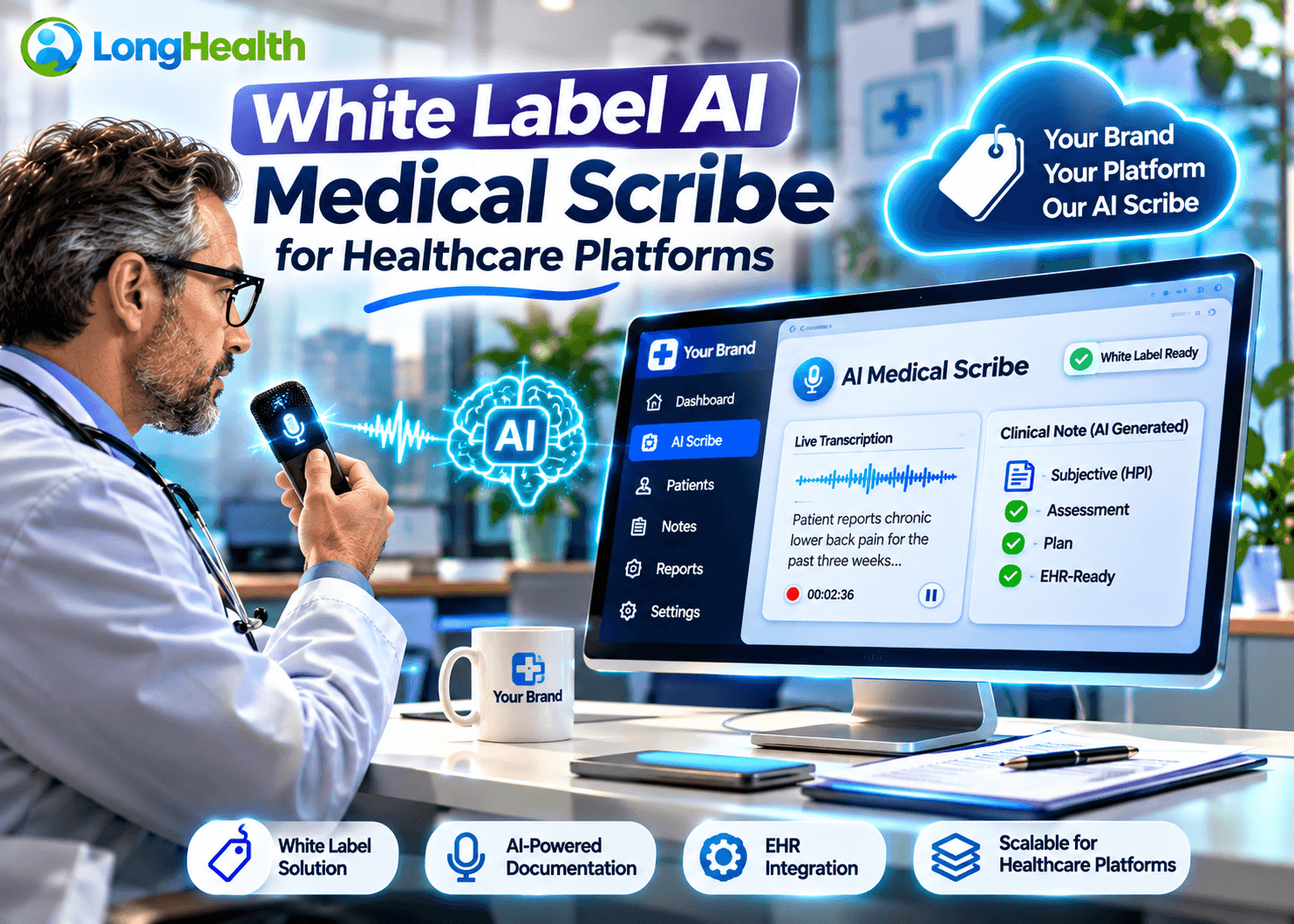
A white label AI medical scribe allows healthcare technology companies to offer AI-powered clinical documentation under their own brand rather than developing an entire medical scribing platform independently.
For healthcare SaaS companies, EHR providers, telehealth platforms, and digital health startups, this approach can provide a way to introduce automated medical transcription, clinical documentation, and structured SOAP note generation into an existing product offering.
However, choosing a White Label AI Medical Scribe in California involves more than selecting speech-to-text software. Businesses need to evaluate medical terminology recognition, clinical documentation quality, EHR integration, API availability, branding rights, data ownership, privacy safeguards, commercial licensing, and ongoing technical support.
A suitable technology partner should support the intended clinical workflow while allowing the healthcare company to maintain control over its customer experience and brand.
LongHealth offers an AI Scribe solution with documented capabilities that include multilingual transcription, SOAP note generation, clinical summaries, and healthcare documentation workflows. Organizations interested in a white-label arrangement should discuss licensing, branding, and integration possibilities directly with LongHealth.
What Is a White Label AI Medical Scribe in California?
A white label AI medical scribe is an AI-powered clinical documentation solution that a healthcare technology company can potentially offer under its own brand through an appropriate licensing or partnership agreement.
Instead of developing the complete technology independently, a business works with an AI scribe provider that supplies the underlying technology.
Depending on the agreement, the healthcare company may be able to customize:
- Product branding
- Logo and visual identity
- User interface
- Customer-facing experience
- Clinical documentation templates
- Workflow configurations
- Integration with existing software
- Subscription and pricing structure
- Customer onboarding experience
The precise level of customization depends on the provider's licensing model.
For example, an EHR company may want to add an AI medical scribe feature to its existing platform. Rather than creating speech recognition, medical language processing, and clinical documentation capabilities from the beginning, it may evaluate an established AI scribe provider.
The resulting solution could be presented to customers as part of the EHR company's own product, provided the commercial agreement explicitly permits white-label use.
How Does White Label AI Medical Scribe Software Work?
A typical white-label workflow involves several components.
1. Technology Provider
An AI medical scribe company supplies the underlying speech recognition, transcription, and clinical documentation technology.
2. Healthcare Platform
The technology is connected to an existing healthcare application, EHR, telehealth platform, or medical practice management system.
3. Branding and Customization
The customer-facing experience may be customized according to the agreed licensing and branding permissions.
4. Clinical Documentation
The AI system processes authorized audio or dictation and generates structured medical documentation.
5. Professional Review
A qualified clinician reviews, corrects, and approves the generated documentation before it becomes part of the official medical record.
6. Customer Delivery
The healthcare technology company provides the feature to its customers as part of its broader software offering.
The important distinction is that the healthcare business owns the customer relationship and product experience, while the technology provider supplies the agreed underlying capabilities.
Why Are Healthcare Technology Companies Exploring White Label AI Medical Scribes?
Healthcare software companies frequently face a product-development decision: build a new feature internally, purchase an existing product, or work with a technology provider.
AI medical scribing introduces additional technical and operational considerations because it involves speech recognition, medical terminology, clinical context, documentation structures, and sensitive patient information.
A white-label arrangement may be worth evaluating when a healthcare software company wants to expand its product offering without independently developing every underlying component.
1. Expand an Existing Healthcare Software Product
An EHR provider or healthcare SaaS company may already have established relationships with medical practices and healthcare organizations.
Adding AI-assisted documentation can expand its existing product offering.
For example, a practice management platform might introduce:
- Patient conversation transcription
- Automated clinical documentation
- SOAP note generation
- Medical history documentation
- Clinical encounter summaries
- Structured documentation exports
The feature can become part of the broader platform experience if the technology and commercial agreements support that model.
2. Avoid Building Every AI Component Independently
Developing an AI medical scribe requires more than connecting a microphone to a language model.
The development process can involve:
- Speech recognition
- Medical terminology handling
- Natural language processing
- Clinical information extraction
- Structured documentation
- Specialty-specific templates
- Data security
- Quality assurance
- EHR connectivity
- Ongoing model evaluation
Working with an established technology provider may reduce the amount of underlying infrastructure a business needs to develop itself.
It does not eliminate integration, validation, governance, or maintenance responsibilities.
3. Introduce New Revenue Opportunities
Healthcare software companies may explore AI scribing as:
- An additional subscription feature
- An enterprise software capability
- A paid documentation module
- A bundled service
- An optional upgrade
- A differentiated product feature
The actual commercial model depends on licensing, usage costs, support responsibilities, and customer demand.
Businesses should model their margins before committing to a reseller or white-label agreement.
4. Strengthen Product Differentiation
An AI scribe may help a healthcare platform offer a broader documentation experience.
For example, an existing telehealth platform could evaluate adding AI-assisted visit transcription and structured documentation.
An EHR provider might evaluate integrating SOAP note generation into its existing encounter workflow.
The objective is to make clinical documentation part of the existing software experience rather than requiring customers to manage multiple disconnected tools.
5. Focus Internal Resources on Core Products
Healthcare technology companies may prefer to focus internal engineering resources on their core product rather than building every supporting AI capability.
A partnership can potentially allow the business to concentrate on:
- Customer experience
- Healthcare workflows
- EHR integration
- Product development
- Customer acquisition
- Specialty-specific functionality
- Platform expansion
The benefit depends on the technical maturity and support model of the selected provider.
White Label AI Medical Scribe vs. Reseller vs. API Integration
These business arrangements are related, but they are not interchangeable.
Before choosing a provider, understand what each model actually permits.
| Model | How It Works | Branding Control | Typical Suitability |
|---|---|---|---|
| White label | Technology is offered under the customer's brand through an authorized agreement | Potentially extensive | Healthcare SaaS companies |
| Reseller | A business sells another provider's software under an authorized commercial arrangement | Usually limited or agreed | Healthcare distributors and technology vendors |
| Co-branded | Both companies' brands appear in the product experience | Shared | Strategic technology partnerships |
| API integration | A platform connects to another provider's functionality through an API | Depends on implementation and agreement | EHR and healthcare software developers |
| Direct subscription | Customers purchase and use the provider's own product | Provider-controlled | Individual medical practices |
Which Model Should a Healthcare Business Choose?
Choose white-label licensing when the company wants to deliver the technology as its own branded product and the provider offers the required branding and sublicensing rights.
Choose reseller licensing when the company wants to sell an existing solution to its customers under an authorized reseller agreement.
Choose co-branding when both organizations want visibility and a shared product experience.
Choose API integration when developers want to connect specific AI scribe capabilities to an existing healthcare application.
Choose direct subscription when the objective is simply to use an existing AI medical scribe internally.
A business should never assume that an ordinary software subscription includes resale, embedding, or white-label rights.
Essential Features of White Label AI Medical Scribe Software
Not every AI scribe is suitable for white-label deployment.
A healthcare technology company should evaluate whether the underlying solution supports the required documentation, integration, branding, and operational workflows.
1. Medical-Grade Speech Recognition
Speech recognition is a foundational component of an AI medical scribe.
The software should be evaluated on its ability to process:
- Physician dictation
- Patient conversations
- Medical terminology
- Clinical abbreviations
- Medication names
- Diagnostic terminology
- Specialty-specific vocabulary
A general-purpose transcription system may struggle with terminology that is common in healthcare.
Businesses should test the solution using realistic clinical conversations from their intended specialties.
2. Real-Time or Recorded Audio Processing
Depending on the product architecture, an AI scribe may support live conversation capture, recorded audio processing, or both.
Evaluate:
- Audio capture quality
- Recording controls
- Processing time
- Supported audio formats
- Background noise handling
- Speaker identification, if required
- Recording consent workflows
- Failure and recovery handling
Do not assume that all AI scribes support the same recording capabilities.
3. Automated SOAP Note Generation
SOAP notes organize clinical documentation into four sections:
| Section | Meaning | Documentation Purpose |
|---|---|---|
| Subjective | Patient-reported information | Symptoms and relevant history |
| Objective | Observations and documented findings | Examination and measurable information |
| Assessment | Clinical assessment | Clinician's documented assessment |
| Plan | Proposed plan | Documented follow-up and care plan |
An AI medical scribe can assist with organizing information into these sections.
However, the clinician must review the generated content and ensure it accurately reflects the encounter.
4. Clinical Documentation Templates
Different healthcare specialties may use different documentation structures.
A solution should be evaluated for its ability to support the required templates.
Potential requirements include:
- General practice notes
- Primary-care documentation
- Specialty-specific templates
- Follow-up notes
- Consultation notes
- Clinical encounter summaries
- Examination documentation
Template customization should be confirmed with the provider before implementation.
5. Multilingual Support
Multilingual capabilities can be relevant to healthcare organizations serving diverse patient populations.
A healthcare technology business should determine:
- Which languages are supported?
- Is speech recognition available in each language?
- Can multilingual conversations be processed?
- Can documentation be generated in English?
- How are translated medical terms handled?
- Can the clinician review the original and translated information?
LongHealth's publicly documented AI Scribe supports dictation and live conversations in more than 50 languages, along with multilingual-to-English structured documentation.
The precise supported language combinations should be confirmed during product evaluation.
6. Medical Data Extraction
An AI scribe may also extract relevant information from generated documentation.
Depending on the platform, this can include:
- Chief complaint
- Clinical history
- Medications
- Diagnoses
- Examination information
- Assessment
- Plan
- Encounter summaries
Businesses should confirm the available output structure and whether it can be mapped to their own application.
7. EHR Integration
Integration is one of the most important considerations for a healthcare software company.
An AI scribe that generates documentation but cannot transfer it into the intended workflow may create additional manual work.
Evaluate:
- API availability
- EHR compatibility
- Authentication
- Authorization
- Data mapping
- Patient matching
- Encounter matching
- Structured note export
- Error handling
- Audit logging
HL7 and FHIR may be relevant depending on the receiving system and integration requirements.
However, supporting a standard does not automatically guarantee compatibility with every EHR.
The actual interface, supported resources, workflows, and implementation requirements must be confirmed.
8. Branding and White-Label Customization
For a true white-label arrangement, branding rights need to be explicitly documented.
Ask whether the agreement permits:
- Custom logos
- Custom domain names
- Branded login screens
- Customized colors
- Custom application names
- Customer-specific interfaces
- Removal or modification of provider branding
- Custom email notifications
- Branded onboarding
- Customer-facing support under your brand
Not every provider offers all these capabilities.
How AI Medical Scribe Technology Works
Understanding the technical workflow helps healthcare companies evaluate the underlying technology.
A typical AI medical scribe workflow involves the following stages.
Stage 1: Audio Capture
The system receives authorized audio from a physician's dictation or patient encounter.
The application should provide appropriate recording controls and consent procedures.
Stage 2: Speech Recognition
Speech recognition converts the audio into text.
The system must be evaluated for its handling of medical terminology, accents, conversational speech, and background noise.
Stage 3: Natural Language Processing
Natural language processing helps organize the transcribed content into clinically relevant information.
For example, the system may identify symptoms, medication references, clinical history, and other documentation elements.
Stage 4: Structured Clinical Documentation
The AI organizes the information into a defined documentation format, such as a SOAP note.
The generated note should be editable and reviewable.
Stage 5: Clinical Review
The clinician reviews the output, corrects inaccuracies, and determines whether it accurately represents the encounter.
Stage 6: EHR Delivery
Depending on the integration, approved documentation may be exported, transferred, or entered into the appropriate EHR workflow.
Audio Capture → Speech Recognition → Medical NLP → Structured SOAP Notes → Clinician Review → EHR Documentation
The exact architecture varies between providers. Healthcare companies should request technical documentation before selecting a solution.
White Label AI Medical Scribe for Different Healthcare Businesses
Different businesses have different reasons for considering white-label AI scribe technology.
1. EHR Software Companies
EHR providers may evaluate AI scribing as an additional clinical documentation capability.
Potential use cases include:
- Encounter transcription
- SOAP note creation
- Clinical summaries
- Documentation export
- Physician dictation
The most important evaluation factor is how the technology fits into the existing patient chart and encounter workflow.
2. Telehealth Platforms
Telehealth companies may want to incorporate documentation support into virtual consultations.
An integrated AI scribe can potentially assist with capturing conversation details and preparing structured notes for clinician review.
Important considerations include audio quality, recording consent, session management, and integration with the telehealth platform.
3. Healthcare SaaS Startups
A healthcare startup developing a new platform may want to introduce AI-powered documentation without independently developing the entire scribe infrastructure.
A technology partnership can be evaluated against the startup's development roadmap, budget, customization requirements, and long-term product strategy.
4. Medical Practice Management Software
Practice management platforms may explore AI scribing as an additional feature alongside appointment scheduling, patient management, billing workflows, and documentation.
The business should establish how the new feature interacts with existing patient and encounter records.
5. Healthcare Technology Resellers
Healthcare technology distributors may evaluate authorized reseller agreements to add AI scribe products to their existing portfolio.
The agreement should clearly establish pricing, customer ownership, support responsibilities, marketing rights, and renewal terms.
6. Digital Health Companies
Digital health organizations may explore AI documentation to support clinician workflows across different healthcare settings.
The suitability of an AI scribe depends on its intended use, documentation requirements, integration architecture, and applicable regulatory obligations.
White Label AI Medical Scribe: Build vs. Buy vs. Partner
One of the biggest decisions for healthcare software companies is whether to develop the technology internally or work with an external provider.
| Factor | Build Internally | Buy Existing Software | Technology Partnership |
|---|---|---|---|
| Development control | High | Limited | Depends on agreement |
| Initial engineering effort | Usually substantial | Lower | Varies |
| Branding | Full control | Usually provider-controlled | Depends on licensing |
| Customization | High | Product-dependent | Agreement-dependent |
| Maintenance | Internal responsibility | Primarily provider | Shared or negotiated |
| Integration | Internal development | Available options vary | Scope-dependent |
| Time to launch | Depends on resources | Often simpler | Depends on implementation |
| Long-term dependency | Internal technology stack | Vendor dependency | Partner dependency |
When Should You Build?
Internal development may be appropriate when AI scribing is a core strategic product capability and the organization has the technical, clinical, security, and operational resources to maintain it.
When Should You Buy?
An existing subscription may be suitable when the organization simply wants to use AI scribing internally.
When Should You Partner?
A partnership may be appropriate when the company wants to introduce AI scribing into its existing product but does not want to independently develop every underlying component.
The right decision depends on the organization's product strategy and commercial requirements.
Security and HIPAA Considerations for White Label AI Scribes
Healthcare software companies must evaluate privacy and security before processing protected health information.
White-label branding does not change the underlying privacy responsibilities of the organizations involved.
If a technology provider creates, receives, maintains, or transmits electronic protected health information on behalf of a HIPAA-regulated organization, the business associate requirements may apply.
The U.S. Department of Health and Human Services explains that applicable business associate relationships require appropriate contractual arrangements and safeguards.
A white-label AI scribe evaluation should include the following.
1. Business Associate Agreement
Determine which parties are business associates and whether the necessary BAAs are in place.
The agreement should address permitted uses and disclosures of PHI, safeguards, subcontractors, and other applicable contractual requirements.
2. Encryption
Ask the provider to document how information is protected during transmission and storage.
3. Access Controls
Evaluate:
- Role-based access
- Authentication
- User permissions
- Administrative controls
- Session management
- Audit logging
4. Audio and Transcript Retention
Understand:
- Whether audio is stored
- How long recordings are retained
- Whether transcripts are retained
- Who can access recordings
- How deletion requests are handled
- Whether information is used for model training
5. Third-Party AI Providers
Identify all external service providers involved in transcription, language processing, hosting, and storage.
Determine whether subcontractor arrangements and applicable contractual safeguards are in place.
6. Security Documentation
Request relevant security policies, independent assessment reports, certifications where applicable, and supporting documentation.
A vendor's statement that a product is HIPAA-compliant should not replace the healthcare organization's own due diligence.
HHS also clarifies that a third-party certification alone does not replace the written business associate agreement required where the HIPAA business associate rules apply.
Questions to Ask Before Selecting a White Label AI Medical Scribe Provider
Before signing an agreement, healthcare technology businesses should conduct a structured vendor assessment.
| Evaluation Area | Questions to Ask |
|---|---|
| White-label rights | Can we legally offer the product under our brand? |
| Branding | Can logos, colors, domains, and interfaces be customized? |
| Licensing | Are resale and sublicensing rights explicitly included? |
| Speech recognition | How does the system handle medical terminology? |
| Languages | Which languages are supported? |
| SOAP notes | Can note templates be customized? |
| API | Is developer documentation available? |
| EHR integration | Which systems and interfaces are supported? |
| Data security | How is PHI protected? |
| HIPAA | Is an appropriate BAA available? |
| Data retention | How are audio and transcripts stored and deleted? |
| AI governance | How are generated notes reviewed and corrected? |
| Pricing | Is pricing based on users, encounters, minutes, or usage? |
| Support | Who handles customer support and technical issues? |
| Scalability | Can the infrastructure support expected usage? |
| Service levels | What uptime and incident-response commitments are offered? |
Understanding the Cost of White Label AI Medical Scribe Software
The cost of white-label AI medical scribe software depends on the licensing model, integration complexity, expected usage, and customization requirements.
There is no universal price that applies to every healthcare platform.
Common cost drivers include:
Licensing Fees: The commercial fee for using the underlying technology.
Usage Fees: Charges based on audio minutes, encounters, transcription volume, or active users.
Integration Costs: Engineering work required to connect the technology with the existing platform.
Customization Costs: Branding, templates, user interface changes, and specialty-specific configuration.
Infrastructure Costs: Hosting, storage, monitoring, and other technical requirements, depending on the architecture.
Support Costs: Implementation assistance, training, maintenance, and ongoing technical support.
Compliance and Security Costs: Due diligence, contractual reviews, security assessments, and operational controls.
Pricing Models to Evaluate
| Pricing Model | How It Works | Best Evaluated By |
|---|---|---|
| Per-user | Monthly or annual charge per user | Medical software platforms |
| Per-encounter | Charge for each documented encounter | High-volume practices |
| Per-minute | Charge based on processed audio | Variable usage platforms |
| Platform license | Fixed licensing arrangement | Enterprise software companies |
| Revenue share | Commercial revenue shared between partners | Strategic partnerships |
| Hybrid | Combination of licensing and usage fees | Customized enterprise arrangements |
Ask vendors to provide a transparent pricing structure before making a decision.
Common Mistakes When Choosing White Label AI Medical Scribe Software
Mistake 1: Choosing Based Only on Transcription Accuracy
Accurate transcription is important, but the final product also needs structured documentation, editing controls, and integration.
Mistake 2: Assuming Every AI Scribe Is White-Label Ready
A normal subscription does not automatically include commercial redistribution, embedding, or sublicensing rights.
Mistake 3: Ignoring EHR Integration
A documentation tool that operates separately from the main clinical workflow may create additional work for users.
Mistake 4: Overlooking Data Retention
Businesses should understand what happens to recordings, transcripts, and generated notes after processing.
Mistake 5: Treating AI-Generated Notes as Final
Generated documentation should be reviewed by the appropriate clinician before becoming part of the official medical record.
Mistake 6: Failing to Define Customer Support Responsibilities
The contract should establish who handles technical problems, customer complaints, downtime, and product updates.
Mistake 7: Ignoring Long-Term Vendor Dependency
A white-label partnership creates a technology dependency. Evaluate data portability, exit arrangements, continuity plans, and migration options before signing.
How LongHealth's AI Scribe Fits Healthcare Documentation Workflows
LongHealth provides an AI Scribe solution designed to support clinical documentation workflows.
Its publicly documented capabilities include:
- Live patient conversation and physician dictation capture
- Multilingual support across more than 50 languages
- AI-assisted medical transcription
- Structured SOAP note generation
- ICD-10-related documentation
- Clinical summaries
- Medical information extraction
- Smart Chat for questions about documented information
- CCDA generation
- EHR documentation and integration capabilities
The workflow can be understood as:
Patient Conversation or Dictation → AI-Powered Transcription → Clinical Information Processing → Structured SOAP Documentation → Clinician Review → Documentation Export or EHR Workflow
LongHealth also publicly documents HIPAA-related safeguards, encryption, and HITRUST Risk-Based, 2-Year (r2) certification on its AI Scribe page. Prospective enterprise partners should request current supporting documentation and confirm the precise scope applicable to their intended deployment.
Can LongHealth Provide a White Label AI Medical Scribe?
LongHealth publicly offers AI Scribe technology, but a white-label licensing or reseller program is not established by the public product information reviewed for this article.
There is an important contractual distinction.
LongHealth's publicly accessible platform terms state that ordinary service access is non-sublicensable and non-transferable, and that resale is not permitted without express written permission.
Therefore, healthcare companies should not assume that an ordinary LongHealth subscription authorizes white-label deployment.
Organizations interested in a potential partnership should contact LongHealth to discuss:
- White-label licensing availability
- OEM or reseller arrangements
- Branding permissions
- API and integration requirements
- Commercial licensing
- Customer ownership
- Data processing responsibilities
- Business Associate Agreement requirements
- Enterprise deployment options
Any permitted arrangement would need to be documented in an appropriate agreement.
Explore LongHealth AI Scribe
Implementation Roadmap for White Label AI Medical Scribe Software
Introducing AI scribing into an existing healthcare platform requires more than enabling an API.
A structured implementation process can help businesses evaluate technical and operational readiness.
Phase 1: Define Product Requirements
Identify:
- Target healthcare customers
- Intended clinical specialties
- Documentation workflows
- Supported languages
- Required note formats
- Expected encounter volume
- Integration requirements
- Branding requirements
Phase 2: Evaluate Technology Providers
Compare potential partners based on:
- Clinical documentation capabilities
- Speech recognition
- API availability
- Integration architecture
- White-label rights
- Security documentation
- Commercial licensing
- Support arrangements
Phase 3: Complete Security and Contractual Review
Review:
- Business associate relationships
- BAA requirements
- Data-processing arrangements
- Subcontractors
- Recording permissions
- Retention policies
- Incident response
- Data deletion
- Intellectual property
- Branding and resale rights
Phase 4: Design the Integration
Define how the AI scribe will connect to the existing platform.
Potential integration elements include:
- User authentication
- Patient identification
- Encounter identification
- Audio submission
- Transcription processing
- Structured note retrieval
- EHR write-back or export
- Error handling
- Audit logging
Phase 5: Configure the User Experience
Customize the product according to the approved commercial arrangement.
This may include branding, workflows, documentation templates, and customer onboarding.
Phase 6: Test the Clinical Workflow
Use an appropriately controlled testing environment.
Evaluate:
- Transcription quality
- Medical terminology
- Note structure
- Missing information
- Incorrect information
- Specialty-specific documentation
- User experience
- Integration reliability
Phase 7: Pilot Deployment
Start with a defined group of users and workflows.
Gather feedback from clinicians, administrators, and technical teams before expanding deployment.
Phase 8: Monitor and Improve
Establish ongoing processes for:
- Quality review
- User feedback
- System monitoring
- Security reviews
- Product updates
- Customer support
- Performance evaluation
This roadmap is a recommended implementation framework, not a guaranteed deployment timeline.
Frequently Asked Questions
What is a White Label AI Medical Scribe in California?
A White Label AI Medical Scribe in California is a clinical documentation technology solution that a healthcare company can offer under its own brand through an authorized commercial licensing agreement.
How does white label medical scribe software work?
The technology provider supplies AI-assisted speech recognition and clinical documentation capabilities. The healthcare company integrates the solution into its product and offers it to customers under the branding and licensing terms agreed with the provider.
Can I sell AI medical scribe software under my own brand?
Yes, when the underlying provider explicitly grants the necessary white-label, resale, or sublicensing rights. A standard software subscription does not automatically grant these permissions.
What features should a white label AI medical scribe include?
Important features to evaluate include medical speech recognition, clinical transcription, SOAP note generation, multilingual support, editable documentation, API integration, EHR compatibility, security controls, and branding customization.
Can AI medical scribes integrate with EHR systems?
Some AI scribe platforms support EHR integration through APIs, structured exports, or other interfaces. Compatibility depends on the specific EHR, available integration methods, and implementation requirements.
What is the difference between an AI medical scribe and medical transcription software?
Traditional medical transcription software primarily converts spoken words into text. An AI medical scribe may additionally organize clinical information into structured documentation, such as SOAP notes, for professional review.
Is white label AI medical scribe software HIPAA-compliant?
HIPAA applicability depends on the organizations, activities, and handling of protected health information. Businesses should evaluate the vendor's safeguards, applicable business associate agreements, subcontractors, and data-processing arrangements rather than relying only on a marketing claim.
Can AI medical scribe software generate SOAP notes automatically?
AI medical scribe systems can generate structured SOAP note drafts from authorized dictation or patient conversations. A clinician should review and correct the content before finalizing the medical record.
How much does white label AI medical scribe software cost?
Pricing varies according to licensing, customization, integration, usage volume, hosting, and support. Businesses should request a commercial proposal based on their expected deployment requirements.
Should a healthcare startup build or white-label an AI medical scribe?
A startup should compare development resources, time requirements, product control, integration needs, licensing rights, and long-term vendor dependency. White-label technology may be worth evaluating when rapid access to existing capabilities is important and the licensing model supports the intended business.
Does LongHealth offer AI medical scribe technology?
Yes. LongHealth publicly offers AI Scribe technology with multilingual transcription, SOAP note generation, clinical documentation, summaries, and related capabilities.
Can I use LongHealth AI Scribe as a white-label product?
White-label licensing is not confirmed by LongHealth's public product information. Its public platform terms restrict resale and sublicensing without express written permission. Businesses interested in a commercial partnership should contact LongHealth to discuss whether a separate authorized arrangement is available.
Conclusion
A White Label AI Medical Scribe in California can provide healthcare software companies with an opportunity to expand their product offerings through AI-assisted clinical documentation.
For EHR providers, telehealth platforms, healthcare SaaS businesses, and digital health startups, the right solution should combine medical speech recognition, structured documentation, SOAP note generation, integration capabilities, appropriate security safeguards, and a commercially workable licensing arrangement.
However, the most important decision is not simply choosing an AI transcription provider.
It is selecting a technology partner that understands healthcare workflows, supports the intended integration, provides transparent data-handling practices, and explicitly grants the commercial rights required for the planned deployment.
LongHealth's AI Scribe provides documented capabilities for multilingual transcription, SOAP note generation, clinical documentation, and healthcare workflow support.
If your organization is exploring AI medical scribing for an existing healthcare platform, discuss your technical requirements, integration needs, and potential commercial partnership options with LongHealth.
Contact LongHealth to discuss AI Scribe technology and your healthcare platform requirements.

HIPAA Compliant
We follow the highest standards of data protection, fully aligned with HIPAA regulations, to safeguard your medical records with uncompromising privacy and trust.

HITRUST
We are proud to be HITRUST Risk-Based, 2-Year (r2) Certified, demonstrating our commitment to the highest standards of data security and compliance.
Trusted Partners
Our trusted vendors are fully compliant with HIPAA and hold prestigious certifications.
Data Encryption
Longhealth secures your sensitive information with advanced encryption, safeguarding data both during transmission and while stored.
DxF - Data Exchange Framework
Improve care coordination, transparency, and access to real-time patient data across systems like EHRs, health plans, and providers.

Data Exchange Simplified

HIPAA Compliant