Medical Transcription Software for Accurate Clinical Documentation
3 November 2026
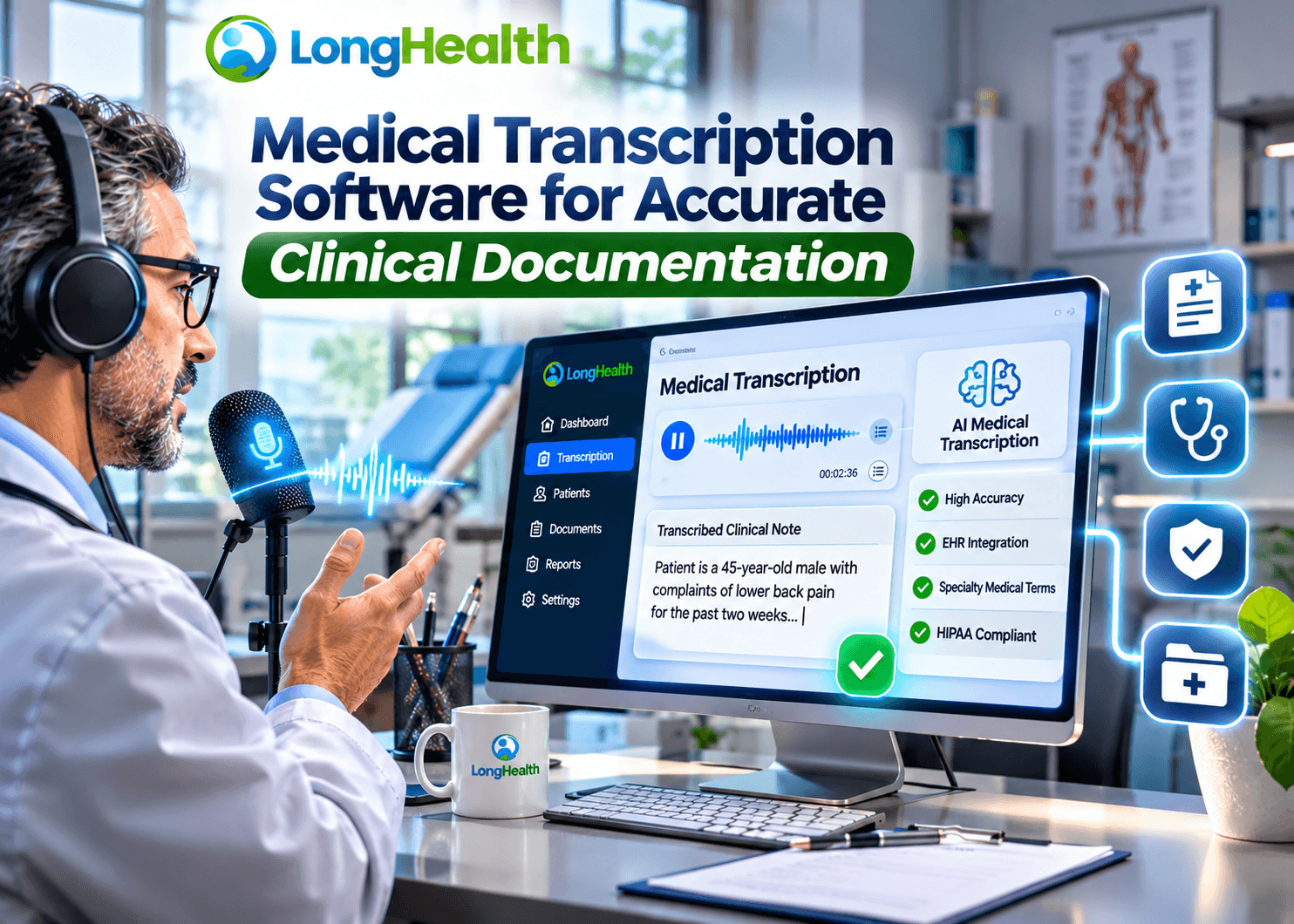
Medical documentation should not slow down the work of healthcare professionals.
Physicians regularly create clinical notes, patient histories, examination findings, assessments and treatment plans. Much of this information begins as spoken communication, yet converting it into organized medical records can require repetitive typing, transcription and formatting.
Medical transcription software in California helps healthcare organizations convert physician dictation and clinical conversations into written medical documentation using speech recognition, natural language processing and AI-assisted workflows.
Instead of manually transcribing every spoken word, healthcare professionals can use software to capture medical speech, generate written text, organize information into structured notes and review the resulting documentation.
LongHealth offers AI-powered medical transcription through its AI Scribe solution, supporting physician dictation, live conversations, multilingual transcription, SOAP note generation and clinical documentation workflows.
Whether you operate a physician practice, medical group, hospital or healthcare organization, choosing the right transcription software requires evaluating more than speech-to-text accuracy. Medical terminology, documentation quality, privacy, clinical review and integration with existing systems all matter.
What Is Medical Transcription Software?
Medical transcription software in California is technology that converts spoken medical information into written clinical documentation.
It allows healthcare professionals to dictate patient information, record authorized clinical conversations or process speech through voice recognition technology.
Depending on the software, the resulting text may be organized into medical notes, patient histories, examination reports, SOAP documentation and other clinical records.
Modern AI-powered medical transcription software can go beyond basic speech-to-text conversion.
It may also:
- Recognize medical terminology and clinical expressions.
- Convert physician dictation into written medical text.
- Transcribe patient-provider conversations.
- Organize information into structured clinical sections.
- Generate SOAP note drafts.
- Support multilingual transcription.
- Produce clinical summaries.
- Prepare documentation for review and EHR workflows.
The main purpose is to help healthcare organizations turn spoken clinical information into usable documentation while maintaining appropriate professional oversight.
How Does Medical Transcription Software Work?
Medical transcription software in California generally follows a process that converts audio into structured written information.
1. Capture Physician Dictation or Clinical Conversations
The process begins when a physician dictates medical information or an authorized patient-provider conversation is captured.
Depending on the software, users may speak directly into a microphone, use a mobile device or work with an ambient transcription workflow.
LongHealth AI Scribe supports both physician dictation and live patient conversations.
2. Convert Speech Into Written Text
Speech recognition technology processes the audio and converts spoken information into text.
Medical transcription requires attention to terminology that may not appear in everyday conversations.
Examples include:
- Medical conditions and diagnoses.
- Medication names.
- Anatomical terminology.
- Clinical abbreviations.
- Laboratory findings.
- Examination terminology.
- Treatment-related language.
The quality of transcription depends on factors such as audio clarity, pronunciation, background noise, vocabulary and the underlying speech recognition technology.
3. Process Medical Language
AI-assisted transcription can use natural language processing to interpret and organize medical language.
This can help transform spoken information into a more readable documentation format.
However, transcription and clinical interpretation are different tasks. Software should not invent missing clinical findings or treat ambiguous statements as confirmed facts.
4. Generate Structured Medical Documentation
Depending on the system, transcribed information can be organized into structured medical notes.
Common documentation formats include:
- Patient history.
- Chief complaint.
- Subjective information.
- Physical examination.
- Clinical assessment.
- Treatment and follow-up plans.
- Encounter summaries.
LongHealth AI Scribe supports structured SOAP note generation from physician dictation and live conversations.
5. Review and Correct the Transcription
AI-generated documentation should be reviewed before it is finalized.
A physician or authorized professional should check:
- Whether the transcription accurately reflects the source audio.
- Whether medical terminology is correct.
- Whether important details have been omitted.
- Whether information appears in the correct section.
- Whether unsupported statements have been introduced.
- Whether the final note is appropriate for the patient's record.
This review helps maintain the integrity of clinical documentation.
6. Export or Connect Documentation to Existing Workflows
The final documentation can be used within the organization's supported workflow.
Depending on the software, this may include downloadable documents, structured clinical files or integration with an EHR system.
LongHealth AI Scribe supports clinical documentation workflows that include SOAP note generation, CCDA document generation and EHR documentation support.
The precise import, write-back and compatibility requirements should be confirmed for the receiving EHR.
Types of Medical Transcription Software
Not all transcription software works in the same way.
Healthcare organizations should understand the different approaches before selecting a solution.
1. Traditional Medical Transcription Software
Traditional medical transcription software in California primarily converts dictated audio into written medical text.
The workflow may involve physicians recording dictation and transcriptionists or transcription systems preparing the corresponding documents.
This approach is commonly associated with:
- Physician dictation.
- Medical reports.
- Clinical notes.
- Examination documentation.
- Medical histories.
Traditional workflows may involve human transcription, automated speech recognition or a combination of both.
2. AI-Powered Medical Transcription Software
AI-powered medical transcription software uses speech recognition and AI technologies to convert spoken medical information into written text.
Depending on the product, it can also organize documentation into structured sections.
Potential capabilities include:
- Automated speech-to-text conversion.
- Medical terminology recognition.
- Natural language processing.
- Structured note generation.
- Clinical summaries.
- Multilingual transcription.
This approach can reduce the amount of repetitive manual transcription required, although the resulting documentation still needs appropriate review.
3. Ambient Clinical Documentation Software
Ambient documentation software captures authorized conversations between patients and healthcare professionals.
Rather than requiring physicians to dictate every section separately, the software processes the conversation and prepares a clinical documentation draft.
Typical capabilities may include:
- Live conversation capture.
- Speech recognition.
- Clinical information extraction.
- Structured note generation.
- SOAP documentation.
Organizations must evaluate recording permissions, patient notification, consent requirements and audio-data handling before implementing ambient workflows.
4. Medical Dictation Software
Medical dictation software allows physicians to speak directly into a system instead of typing medical documentation.
It is particularly relevant when a clinician prefers verbal documentation.
Common applications include:
- Patient histories.
- Examination notes.
- Clinical assessments.
- Medical reports.
- Follow-up documentation.
Dictation-based transcription and ambient transcription serve related but different workflows.
5. Integrated AI Medical Scribe Software
AI medical scribe software combines speech capture, transcription and clinical documentation generation.
Some solutions also support EHR integration and clinical information exchange.
This approach is useful for organizations looking to connect spoken clinical information with structured medical documentation rather than simply producing a raw transcript.
Medical Transcription Software vs. AI Medical Scribe Software
Although these terms are related, they do not describe exactly the same technology.
Medical transcription software in California focuses primarily on converting spoken information into written text.
An AI medical scribe generally adds another layer by organizing captured information into clinical documentation.
| Feature | Medical Transcription Software | AI Medical Scribe |
|---|---|---|
| Speech-to-text | Core capability | Core capability |
| Physician dictation | Common | Supported by many systems |
| Live conversation capture | Depends on software | Common in ambient solutions |
| Medical terminology recognition | Depends on software | Depends on underlying models |
| SOAP note generation | Not always included | Common capability |
| Clinical summaries | Additional feature | May be included |
| Structured documentation | Varies | Often included |
| EHR integration | Depends on platform | Depends on platform |
| Human review | Important | Essential |
For a healthcare organization, the right choice depends on whether it needs basic dictation transcription, structured medical documentation or a more comprehensive AI-assisted clinical workflow.
Essential Features to Look for in Medical Transcription Software
Selecting medical transcription software in California requires evaluating both technical capabilities and practical clinical requirements.
1. Medical Vocabulary Recognition
General-purpose speech recognition may not handle every clinical expression correctly.
Evaluate whether the software can process:
- Medical terminology.
- Medication names.
- Clinical abbreviations.
- Anatomical terms.
- Specialty-specific vocabulary.
- Complex physician dictation.
Test the software with representative clinical speech instead of relying solely on vendor demonstrations.
2. Accurate Voice-to-Text Conversion
Transcription quality is one of the most important evaluation criteria.
Consider testing different:
- Accents.
- Speaking speeds.
- Audio environments.
- Medical specialties.
- Dictation styles.
- Recording devices.
Measure not only overall transcription accuracy but also errors involving medication names, dosages, laterality, diagnoses and other clinically important information.
3. SOAP Note Generation
If your organization needs structured documentation, check whether the software can organize information into SOAP sections.
| SOAP Section | Documentation |
|---|---|
| Subjective | Patient-reported information |
| Objective | Examination findings and observations |
| Assessment | Clinician's assessment |
| Plan | Treatment and follow-up plan |
The system should make it easy for clinicians to review and correct generated information.
4. Multilingual Transcription
Healthcare organizations serve patients with different language preferences.
Multilingual transcription can help capture conversations involving different languages and prepare documentation in a consistent format.
LongHealth AI Scribe describes support for dictation and live conversations in more than 50 languages, including the ability to translate multilingual conversations into structured English.
When evaluating multilingual capabilities, test medical vocabulary, mixed-language conversations, accents and the accuracy of translated clinical meaning.
5. Clinical Documentation Summaries
A useful transcription workflow may include more than the complete transcript.
Clinical summaries can make important information easier to review.
For example, documentation may be organized around:
- Chief complaint.
- Relevant medical history.
- Examination findings.
- Assessment.
- Plan.
- Follow-up information.
Summaries should remain traceable to the original documentation and should not replace review of clinically important details.
6. EHR Compatibility
Medical transcription software should fit into the organization's existing clinical technology environment.
Evaluate whether the software supports the required:
- EHR interfaces.
- Document formats.
- APIs.
- HL7 interfaces.
- FHIR resources.
- CCDA workflows.
- Patient and encounter matching.
Not every platform supports every integration method.
Confirm the exact functionality available for your EHR before implementation.
7. Privacy and Security Controls
Medical transcription software may process protected health information (PHI).
Evaluate:
- Data encryption.
- User authentication.
- Role-based access.
- Audio retention policies.
- Data deletion procedures.
- Third-party processing.
- Audit logging.
- Incident response procedures.
- Business Associate Agreement availability where applicable.
A vendor's security claims should be evaluated against its actual policies, contracts and technical controls.
Benefits of AI-Powered Medical Transcription Software
AI-assisted transcription can improve how healthcare organizations capture and prepare clinical information.
Less Repetitive Manual Typing
Physicians can dictate information or use supported conversation-capture workflows rather than manually typing every word.
This may reduce repetitive documentation activities.
Actual time savings depend on transcription quality, workflow design and the amount of correction required.
More Consistent Documentation Structure
Structured templates can help organize information into predictable sections.
This is particularly useful when healthcare organizations want consistent documentation formats across different clinicians or workflows.
Faster Preparation of Medical Notes
Automated transcription can prepare a written draft from speech.
Instead of manually creating the initial text, the clinician can review and correct the generated documentation.
Support for Multilingual Workflows
Multilingual transcription and translation capabilities can help healthcare teams document conversations involving patients with different language preferences.
Translated documentation must still be checked to ensure that clinical meaning has been preserved.
Better Connection Between Speech and Clinical Documentation
Transcription becomes more useful when the resulting text can be organized into clinical notes, summaries and other documentation formats.
AI-assisted systems can connect these steps within one workflow.
Support for Digital Healthcare Workflows
Medical transcription software can support the broader digitization of clinical documentation.
When appropriately integrated, it can help connect dictation, structured notes, clinical records and existing healthcare technology systems.
LongHealth AI Scribe: Medical Transcription and Clinical Documentation
LongHealth offers AI-powered medical transcription through its AI Scribe solution.
The platform is designed to capture physician dictation and live patient conversations, convert spoken information into medical text and prepare structured clinical documentation.
Rather than stopping at basic transcription, LongHealth AI Scribe supports a workflow that connects speech capture with SOAP note generation, clinical summaries and documentation outputs.
Medical Dictation and Live Conversation Transcription
LongHealth AI Scribe supports both direct physician dictation and live patient conversations.
This provides two different ways to capture spoken clinical information.
A physician can dictate medical information directly or use a supported conversation-based workflow.
AI-Powered Speech Recognition
LongHealth uses voice recognition and natural language processing to convert spoken information into written medical text.
This provides a foundation for preparing clinical documentation from speech.
Multilingual Medical Transcription
LongHealth describes support for more than 50 languages.
Its platform can process multilingual conversations and translate them into structured English documentation.
This capability may be relevant to healthcare organizations serving diverse patient populations.
Structured SOAP Note Generation
LongHealth AI Scribe generates structured SOAP notes containing:
- Chief complaint.
- Subjective information.
- Physical examination.
- Assessment.
- Plan.
- ICD-10 code information.
Generated notes should be checked by the responsible clinician before finalization.
Clinical Summaries and Smart Chat
The platform also supports clinical summaries, information extraction and smart chat.
These features can help users retrieve information from processed documentation, including visit summaries, medications and abnormal findings.
CCDA Document Generation
LongHealth AI Scribe supports generating CCDA documents as part of its clinical documentation workflow.
CCDA provides a structured format for representing and exchanging clinical documents.
Receiving-system compatibility and the precise document import workflow should be confirmed before deployment.
EHR Documentation Support
LongHealth describes EHR integration capabilities designed to support clinical documentation workflows.
Its broader healthcare technology offerings also include interoperability solutions involving HL7, FHIR and custom APIs.
The exact EHR systems, available interfaces, direct write-back functionality and implementation requirements should be discussed with the LongHealth technical team.
Explore LongHealth AI Scribe
Medical Transcription Software for Different Healthcare Settings
Medical transcription requirements can differ depending on the healthcare environment.
Physician Practices
Independent physicians and small practices may need transcription software for patient histories, consultation notes, examination findings and follow-up documentation.
An AI-assisted workflow can help prepare structured documentation from dictation or authorized conversations.
Hospitals and Health Systems
Hospitals may need transcription technology that fits into established clinical documentation and information management processes.
Important considerations include EHR compatibility, user permissions, workflow consistency, security reviews and implementation at scale.
Specialty Clinics
Specialty practices may require software that handles domain-specific terminology.
Examples include:
- Cardiology.
- Orthopedics.
- Neurology.
- Dermatology.
- Internal medicine.
- Physical medicine and rehabilitation.
Each specialty should be evaluated using representative vocabulary and documentation examples.
Medical-Legal and Evaluation Workflows
Medical-legal professionals may use transcription to capture examination findings, physician dictation and relevant documentation.
LongHealth's EvalPath workflow includes AI-assisted examination documentation through physician dictation, patient encounters and examination measurements.
This is a specialized workflow and should not be confused with general-purpose medical transcription.
Medical Transcription Software Implementation: A Practical Framework
A successful implementation should begin with the organization's documentation requirements, not simply the selection of an AI tool.
Phase 1: Understand Existing Documentation Workflows
Identify:
- How physicians currently create medical notes.
- Which documentation is dictated.
- Which information is manually entered.
- What types of reports are generated.
- Where transcription delays occur.
- Which EHR system is currently used.
Document the existing process before introducing new software.
Phase 2: Define Technical Requirements
Establish:
- Required transcription formats.
- Supported languages.
- Clinical vocabulary requirements.
- EHR integration requirements.
- Document export options.
- Authentication and access controls.
- Data retention requirements.
Phase 3: Evaluate Transcription Quality
Use representative test audio.
Include different accents, speaking speeds, medical terminology and realistic clinical scenarios.
Review errors involving important clinical details instead of evaluating only whether the transcript appears readable.
Phase 4: Review Privacy and Compliance
Determine whether the software processes PHI and understand the responsibilities of the covered entity and vendor.
Review:
- BAA requirements.
- Data-processing arrangements.
- Security safeguards.
- Audio storage and retention.
- Third-party AI processing.
- Applicable recording and consent requirements.
Phase 5: Conduct a Controlled Pilot
Start with a representative clinical workflow.
Measure:
- Transcription accuracy.
- Time required for corrections.
- SOAP note quality.
- Clinician usability.
- Documentation completeness.
- Integration reliability.
Phase 6: Deploy and Monitor
After successful testing, introduce the software through an appropriate rollout plan.
Continue monitoring transcription quality, documentation corrections, user feedback and integration errors.
HIPAA and Medical Transcription Software: What Healthcare Organizations Need to Know
Medical transcription software may process protected health information, making privacy and security important parts of vendor evaluation.
The US Department of Health and Human Services explains that a transcription service provider or other vendor that creates, receives, maintains or transmits PHI on behalf of a covered entity may qualify as a business associate.
Where applicable, the healthcare organization must establish an appropriate Business Associate Agreement (BAA) and ensure that the relevant HIPAA requirements are addressed.
Healthcare organizations should evaluate the following areas before adopting transcription software.
Data Encryption
Understand how patient information is protected during transmission and storage.
Request information about the actual encryption controls and their implementation.
Access Management
Confirm that only authorized users can access clinical documentation and related patient information.
Audio Recording and Retention
Determine:
- Whether audio is recorded or temporarily processed.
- Where audio is stored.
- How long recordings are retained.
- Whether recordings are deleted automatically.
- Whether third-party services process the audio.
Third-Party AI Processing
If the software uses external AI or speech recognition providers, understand how patient information is shared and processed.
Review contractual safeguards, data retention and applicable business associate relationships.
Clinician Review
Establish procedures to review and correct generated documentation before it becomes part of the final medical record.
HIPAA compliance should not be assumed solely because a product uses encryption or advertises itself as secure.
Official guidance: HHS Guidance on HIPAA and Cloud Computing
Medical Transcription Software Evaluation Checklist
Before choosing a platform, use this checklist to compare available solutions.
| Evaluation Criteria | What to Verify |
|---|---|
| Speech recognition | Can it accurately capture representative clinical speech? |
| Medical terminology | Does it handle specialty-specific terminology? |
| Dictation | Can physicians dictate directly? |
| Ambient capture | Does it support authorized live conversations? |
| SOAP notes | Can it prepare structured clinical notes? |
| Languages | Which languages and translation workflows are supported? |
| Editing | Can clinicians correct generated text? |
| Summaries | Does it generate useful clinical summaries? |
| EHR compatibility | Does it support the required EHR workflow? |
| Data exchange | Are relevant API, HL7, FHIR or CCDA interfaces available? |
| Privacy | How is PHI processed and protected? |
| Implementation | What configuration and testing are required? |
| Pricing | What are the subscription, usage and implementation costs? |
| Support | What technical and onboarding assistance is available? |
A good evaluation should involve the actual physicians and IT professionals who will use or manage the system.
Frequently Asked Questions About Medical Transcription Software
1. What is the best medical transcription software?
The best solution depends on the healthcare organization's documentation needs, medical vocabulary, transcription accuracy, supported languages, security requirements and EHR compatibility.
Organizations should test software using realistic clinical dictation before making a decision.
2. How does medical transcription software work?
Medical transcription software captures spoken information and converts it into written medical text using speech recognition.
Advanced AI-powered solutions may also organize the text into structured clinical notes, generate SOAP documentation and prepare clinical summaries.
3. Can medical transcription software recognize medical terminology?
Many healthcare-focused transcription systems are designed to process medical terminology, but performance varies.
Organizations should test medication names, diagnoses, abbreviations and specialty-specific language using real-world examples.
4. What is the difference between medical dictation and medical transcription?
Medical dictation is the process of speaking clinical information into a recording or software system.
Medical transcription is the conversion of that spoken information into written documentation.
A transcription system can automate much of the conversion process.
5. Can AI transcribe patient-doctor conversations?
Yes. Ambient AI documentation systems can capture authorized patient-provider conversations and convert them into written clinical documentation.
The exact capabilities vary by platform, and organizations should establish appropriate consent, recording and privacy procedures.
6. Can medical transcription software generate SOAP notes?
Some AI-powered systems can organize transcribed information into Subjective, Objective, Assessment and Plan sections.
LongHealth AI Scribe supports structured SOAP note generation.
Physicians should review the generated documentation before approval.
7. Does medical transcription software support multiple languages?
Some systems support multilingual speech recognition and translation.
LongHealth AI Scribe describes support for dictation and live conversations in more than 50 languages, including translation into structured English.
8. Is medical transcription software HIPAA compliant?
HIPAA compliance depends on the service's actual data processing, safeguards, contractual arrangements and the responsibilities of the parties involved.
Healthcare organizations should review the vendor's security documentation and execute an appropriate BAA where required.
9. Can medical transcription software integrate with an EHR?
Some platforms support EHR integration through APIs, document exchange, structured clinical documents or other supported interfaces.
Compatibility and write-back functionality depend on the particular EHR and software configuration.
10. Does AI medical transcription replace human transcriptionists?
AI can automate parts of speech recognition and documentation preparation.
However, healthcare organizations should assess transcription quality, correction requirements, specialty needs and human oversight before changing existing staffing or documentation workflows.
11. Can physicians edit AI-generated medical transcripts?
An appropriate clinical documentation workflow should allow authorized professionals to review and correct generated information before finalization.
This is important for identifying omitted information, incorrect terminology and transcription errors.
12. What is the difference between medical transcription software and an EHR?
Medical transcription software converts spoken clinical information into written documentation.
An electronic health record system stores and manages patient health information and supports broader clinical and administrative workflows.
Transcription software may connect with an EHR, but it does not replace the entire EHR system.
13. How much does medical transcription software cost?
Pricing varies depending on the software, subscription model, number of users, transcription volume, supported features, integration requirements and implementation services.
Healthcare organizations should request pricing based on their actual usage and workflow requirements.
14. Does LongHealth offer AI medical transcription?
Yes. LongHealth provides medical transcription capabilities through its AI Scribe solution.
The platform supports physician dictation, live conversation transcription, multilingual workflows, structured SOAP notes, clinical summaries and CCDA generation.
Simplify Clinical Documentation With LongHealth AI Scribe
Medical transcription is more than converting speech into text.
Healthcare organizations need a documentation workflow that captures spoken information, processes medical terminology, organizes clinical content and allows professionals to review the resulting records.
LongHealth combines AI-powered transcription with structured SOAP note generation, multilingual conversation processing, clinical summaries and EHR documentation capabilities.
Whether your organization needs physician dictation support, multilingual transcription or a more structured approach to clinical documentation, LongHealth AI Scribe provides a solution worth evaluating.
Explore AI-Powered Medical Transcription With LongHealth
Discover how LongHealth can support your medical documentation workflows.
Visit: LongHealth AI Scribe
For product information, implementation discussions or technical requirements:
Final Thoughts
Medical transcription software can help healthcare organizations convert physician dictation and clinical conversations into written medical documentation.
Modern AI-powered systems go further by supporting structured SOAP notes, multilingual transcription, clinical summaries and connected documentation workflows.
However, transcription quality, clinical accuracy, privacy, EHR compatibility and professional review remain essential.
The right technology should fit the organization's existing documentation processes while helping clinicians prepare and manage medical information more effectively.
LongHealth brings together medical transcription, AI-assisted clinical documentation and healthcare interoperability capabilities to support a more connected approach to medical documentation.
HIPAA Compliant
We follow the highest standards of data protection, fully aligned with HIPAA regulations, to safeguard your medical records with uncompromising privacy and trust.
HITRUST
We are proud to be HITRUST Risk-Based, 2-Year (r2) Certified, demonstrating our commitment to the highest standards of data security and compliance.
Trusted Partners
Our trusted vendors are fully compliant with HIPAA and hold prestigious certifications.
Data Encryption
Longhealth secures your sensitive information with advanced encryption, safeguarding data both during transmission and while stored.
DxF - Data Exchange Framework
Improve care coordination, transparency, and access to real-time patient data across systems like EHRs, health plans, and providers.

Data Exchange Simplified
HIPAA Compliant