EHR Integrated AI Scribe: Simplify Clinical Documentation
3 November 2026
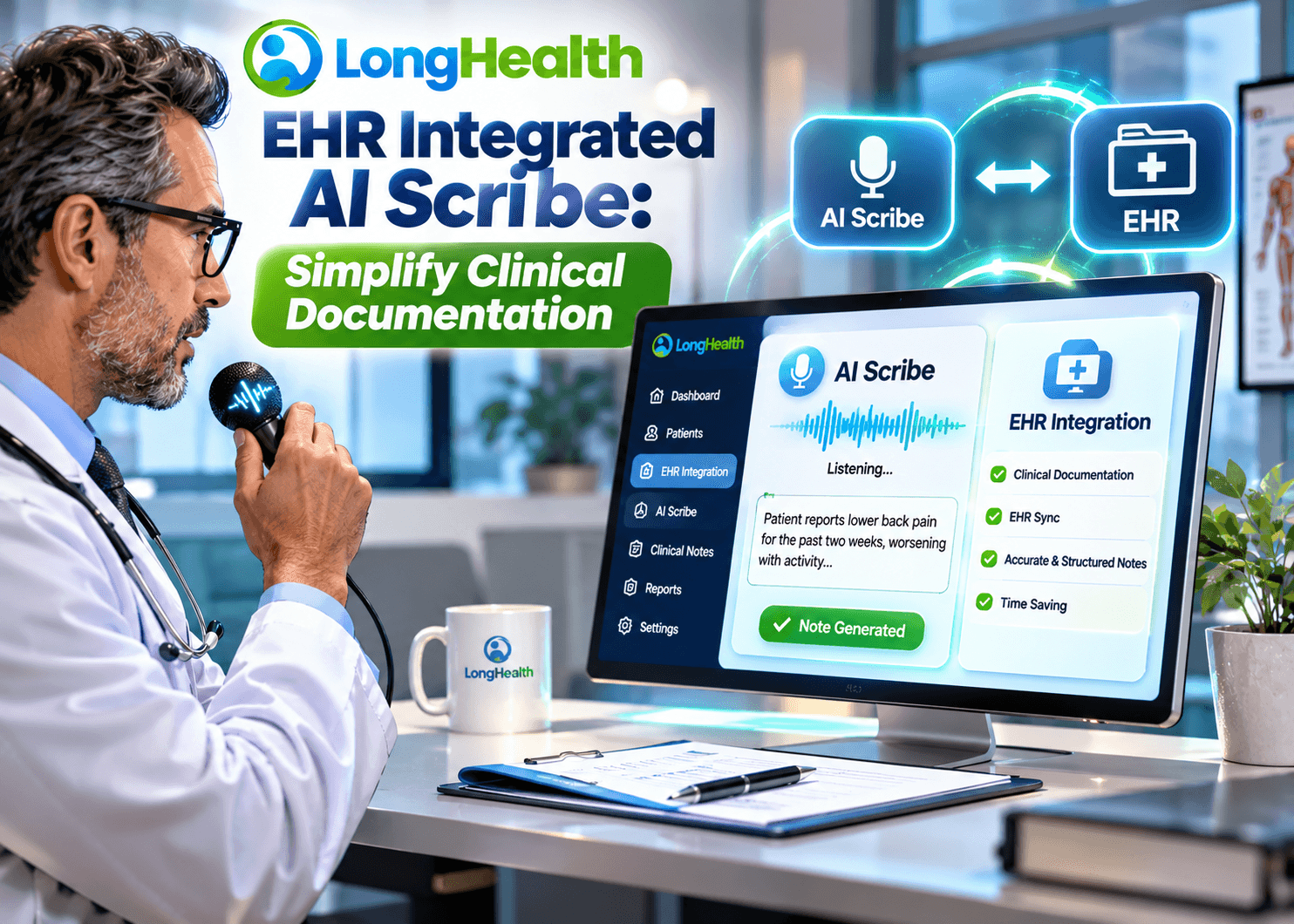
Clinical documentation should not require physicians to spend more time managing software than focusing on patient encounters.
An EHR integrated AI scribe in California helps healthcare organizations capture clinical conversations, convert spoken information into structured medical documentation, and connect documentation workflows with electronic health record systems.
Instead of manually creating every note from scratch, clinicians can use AI-assisted transcription and documentation to prepare structured SOAP notes, review clinical information, and move approved documentation into their existing workflows.
For healthcare organizations evaluating this technology, the important question is not simply whether an AI scribe can transcribe conversations. It is whether the solution can work with the organization's EHR environment, support accurate documentation, protect patient information, and preserve clinician control.
LongHealth provides AI Scribe capabilities designed around medical transcription, SOAP note generation, clinical summaries, and EHR documentation workflows.
What Is an EHR Integrated AI Scribe?
An EHR integrated AI scribe in California is an AI-powered clinical documentation solution that captures physician dictation or patient-provider conversations, converts speech into medical text, and prepares structured documentation for use within an electronic health record (EHR) workflow.
It combines two important capabilities:
- AI medical scribing: Capturing and processing clinical conversations and physician dictation.
- EHR integration: Connecting the resulting documentation with an organization's electronic health record environment.
A typical workflow may include:
- Capturing a patient encounter or physician dictation.
- Converting speech into text.
- Organizing information into clinical documentation.
- Generating structured SOAP notes.
- Reviewing and correcting the generated documentation.
- Transferring or entering approved information into the appropriate EHR workflow.
The exact integration process depends on the AI scribe, EHR vendor, available interfaces, and healthcare organization's technical requirements.
An AI scribe assists with documentation. It does not replace the physician's responsibility for reviewing, validating, and approving clinical records.
Why Healthcare Organizations Are Evaluating EHR Integrated AI Scribes
Clinical documentation is essential to healthcare delivery, but the process can involve repetitive administrative work.
Physicians may need to document:
- Patient complaints and medical histories.
- Symptoms and relevant examination findings.
- Clinical assessments.
- Treatment plans and follow-up instructions.
- Medications and relevant clinical information.
- Encounter summaries.
When documentation requires switching between multiple applications, manually entering information, or repeatedly formatting notes, it can create additional work.
An EHR integrated AI scribe in California addresses this workflow challenge by connecting AI-assisted documentation with the systems healthcare professionals already use.
1. Reduce Repetitive Documentation Work
AI-assisted transcription can convert physician dictation and patient conversations into text that can be organized into clinical notes.
Rather than starting with an empty document, clinicians can review an AI-generated draft and make the necessary corrections.
This can reduce repetitive typing and help streamline documentation workflows.
2. Generate Structured SOAP Notes
SOAP documentation organizes clinical information into four sections:
| Section | What It Contains |
|---|---|
| Subjective | Patient-reported symptoms, concerns and history |
| Objective | Examination findings and relevant observations |
| Assessment | Clinician's assessment of the patient's condition |
| Plan | Proposed care, treatment and follow-up plan |
An AI medical scribe can help organize captured information into these sections.
However, generated content must be checked for missing information, incorrect terminology, transcription errors and unsupported clinical statements.
3. Connect Documentation With Existing EHR Workflows
Healthcare organizations have already invested in electronic health record systems.
Replacing an established EHR simply to introduce AI documentation may not be practical.
An EHR-integrated approach aims to bring documentation assistance into the existing technology environment.
Depending on the integration configuration, this may involve structured data exchange, document generation, APIs, or other supported integration methods.
4. Support Multilingual Clinical Conversations
Healthcare organizations serve patients with different language preferences.
AI scribe platforms with multilingual transcription capabilities can help capture conversations involving multiple languages and prepare documentation in a consistent format.
LongHealth AI Scribe supports dictation and live conversations in more than 50 languages, according to its published product information.
Its multilingual capabilities can help healthcare teams working with diverse patient populations.
5. Improve Access to Organized Clinical Information
Documentation becomes more useful when important information can be reviewed and retrieved easily.
AI-assisted summaries and structured clinical information can help healthcare professionals locate relevant details without repeatedly navigating lengthy documentation.
The quality of the resulting information still depends on source accuracy and appropriate human review.
How Does an EHR Integrated AI Scribe Work?
The technology generally operates through a series of connected steps.
Step 1: Capture the Patient Encounter
The process begins when a physician dictates clinical information or captures an authorized patient-provider conversation.
An ambient AI scribe can process conversational speech, while a dictation-based system processes information spoken directly by the clinician.
Healthcare organizations should establish appropriate patient notification, consent and recording procedures before enabling audio capture.
Step 2: Convert Speech Into Medical Text
Speech recognition technology converts the captured audio into written text.
Medical terminology, medication names, abbreviations and clinical expressions require particular attention because transcription mistakes can affect documentation quality.
A suitable evaluation should test the system using realistic clinical language and different speaking conditions.
Step 3: Organize Clinical Information
AI processes the transcribed information and organizes relevant details into a structured documentation format.
Depending on the solution, this may include:
- Chief complaint.
- Patient-reported symptoms.
- Relevant history.
- Physical examination findings.
- Clinical assessment.
- Plan and follow-up information.
Step 4: Generate Structured SOAP Notes
The AI scribe prepares a draft SOAP note using the available encounter information.
Some systems may also support ICD-10 code suggestions or other structured clinical fields.
Code suggestions should be validated against the clinical documentation and applicable coding requirements before use.
Step 5: Review and Approve Documentation
The physician or authorized clinical professional reviews the generated documentation.
This is an essential step.
AI-generated notes may contain transcription errors, omit important context, misinterpret statements, or introduce information that was not explicitly established during the encounter.
The reviewing clinician remains responsible for ensuring the final record is accurate and appropriate.
Step 6: Connect With the EHR
After review, the approved documentation can be entered, exported, or transferred through the integration methods supported by the specific solution and EHR.
Depending on the implementation, this may involve an EHR interface, an API, a structured clinical document, or an approved workflow for importing information.
The exact process should be established during technical discovery and integration testing.
EHR Integration Methods: What Healthcare Organizations Should Understand
Not all AI scribe integrations work in the same way.
Before selecting a solution, healthcare IT teams should understand how clinical documentation moves between the scribe and the EHR.
API-Based EHR Integration
Application programming interfaces (APIs) allow software systems to exchange information through defined interfaces.
An API-based integration may support workflows such as:
- Retrieving authorized patient or encounter context.
- Sending structured documentation.
- Updating supported clinical information.
- Connecting authentication and authorization processes.
- Managing data exchange between systems.
The available operations depend on the EHR vendor's API capabilities, permissions and implementation requirements.
HL7 Integration
HL7 standards support the exchange of healthcare information between different systems.
Healthcare organizations may use HL7 interfaces to exchange patient, encounter and clinical information.
An integration team must determine which HL7 messages, versions, fields and workflows are supported by the systems involved.
FHIR Integration
Fast Healthcare Interoperability Resources (FHIR) is a standard for representing and exchanging healthcare information through defined resources and APIs.
Depending on the implementation, FHIR resources may support the exchange of information such as:
- Patient information.
- Encounter details.
- Clinical observations.
- Conditions.
- Medication information.
- Clinical documents.
FHIR does not automatically guarantee complete interoperability. Systems must still align on supported resources, profiles, terminology, authorization and data mapping.
CCDA Document Exchange
Consolidated Clinical Document Architecture (C-CDA) supports the representation and exchange of clinical documents.
For example, an organization may use structured clinical documents to share relevant patient information between systems.
LongHealth's AI Scribe product describes generating CCDA documents as part of its documentation workflow.
The receiving system's ability to import, interpret and map the document should be verified before deployment.
LongHealth AI Scribe for EHR Documentation Workflows
LongHealth provides AI-assisted clinical documentation capabilities designed to help healthcare professionals capture conversations, generate structured notes and work with clinical information.
Its AI Scribe combines speech transcription, medical documentation and EHR workflow support.
Medical Conversation and Dictation Capture
LongHealth AI Scribe supports physician dictation and live patient conversations.
The platform describes support for more than 50 languages, helping healthcare professionals work with multilingual conversations.
AI-Powered Medical Transcription
The platform uses voice recognition and natural language processing to convert spoken information into written medical text.
This provides a starting point for preparing structured clinical documentation.
Automated SOAP Note Generation
LongHealth AI Scribe generates structured SOAP notes containing relevant documentation sections.
Its published capabilities also include ICD-10 codes, chief complaints, physical examinations, assessments and plans.
Generated information should be reviewed by the appropriate clinician before being finalized.
CCDA Document Generation
LongHealth describes generating CCDA documents through its AI Scribe workflow.
This supports a structured approach to clinical documentation and information exchange.
The specific receiving-system compatibility and import workflow should be confirmed during implementation planning.
Clinical Summaries and Smart Chat
LongHealth AI Scribe also supports clinical summaries, information extraction and smart chat.
Healthcare professionals can use these capabilities to retrieve relevant information from processed documentation, including visit summaries, medications and abnormal findings.
EHR Integration Support
LongHealth describes EHR integration as part of its AI Scribe capabilities.
The company also provides healthcare interoperability solutions involving HL7, FHIR and custom APIs.
This broader technical focus is relevant to organizations evaluating how AI documentation and existing healthcare systems can work together.
The precise integration method, supported EHR systems, write-back functionality and deployment requirements should be confirmed with the LongHealth team before implementation.
Explore LongHealth AI Scribe
What Should You Evaluate Before Choosing an EHR Integrated AI Scribe?
Selecting an AI scribe is a technology and workflow decision.
Healthcare organizations should assess more than transcription quality or the number of features advertised by a vendor.
The following framework can help healthcare decision-makers compare solutions.
| Evaluation Area | Questions to Ask |
|---|---|
| EHR compatibility | Does the solution support your current EHR and required workflows? |
| Integration method | Does it use APIs, HL7, FHIR, CCDA or another supported method? |
| Clinical accuracy | How does it handle medical terminology, accents and complex conversations? |
| SOAP documentation | Can it organize information into appropriate clinical sections? |
| Human review | Can clinicians correct and approve notes before finalization? |
| Patient privacy | How are audio recordings and patient information processed? |
| HIPAA responsibilities | Is an appropriate Business Associate Agreement available where required? |
| Data security | What encryption, access controls and audit capabilities are implemented? |
| Implementation | What configuration, testing and training are required? |
| Scalability | Can the solution support the organization's expected clinical workflows? |
A strong vendor evaluation should include a practical demonstration using representative workflows, approved test data and the organization's actual integration requirements.
HIPAA and Patient Data Security Considerations
An EHR integrated AI scribe in California may process protected health information (PHI), including patient conversations, medical histories and clinical documentation.
Healthcare organizations should understand how that information is captured, transmitted, processed, stored and accessed.
HIPAA compliance is not established simply because a software provider advertises secure or encrypted technology.
The US Department of Health and Human Services explains that a cloud service provider creating, receiving, maintaining or transmitting electronic protected health information on behalf of a covered entity or business associate generally has business associate obligations.
Where applicable, the parties must enter into a HIPAA-compliant Business Associate Agreement (BAA) and satisfy the relevant HIPAA requirements.
Before adopting an AI scribe, evaluate:
- Whether a BAA is available and appropriate for the service.
- How audio recordings and transcriptions are processed.
- Whether third-party AI services receive patient information.
- Data retention and deletion policies.
- Encryption during transmission and storage.
- User authentication and access controls.
- Audit logging and incident response procedures.
- Patient notification and consent requirements.
- Applicable state privacy and recording laws.
Healthcare organizations should also review the vendor's subcontractors and data-processing arrangements.
LongHealth publishes information about its privacy and AI-assisted transcription practices in its privacy policy.
Read: LongHealth Privacy Policy
Common EHR AI Scribe Integration Challenges
Even a capable AI scribe can encounter implementation challenges if the technical and clinical workflows are not properly planned.
1. Incompatible EHR Interfaces
Different EHR systems support different interfaces, data structures and integration permissions.
What to do: Confirm the EHR vendor's supported interfaces and required integration access before selecting an implementation approach.
2. Inaccurate Clinical Transcription
Medical terminology, background noise, overlapping conversations and unfamiliar accents can affect transcription quality.
What to do: Evaluate transcription using representative clinical scenarios and establish a clinician review process.
3. Incorrect Patient or Encounter Matching
Clinical documentation must be associated with the correct patient and encounter.
What to do: Establish reliable patient identification, encounter matching and authorization checks before allowing documentation to enter production records.
4. Incomplete or Incorrect Structured Notes
An AI-generated note may omit context or place information in the wrong section.
What to do: Validate the generated SOAP structure, required fields and clinical content before final approval.
5. Unclear Data Governance
Healthcare organizations may not know which third-party services process recordings or how long information is retained.
What to do: Review data flows, contractual terms, retention policies, security controls and subcontractor arrangements.
6. Insufficient Clinical Adoption
A technically successful integration may still fail to deliver value if physicians find the workflow difficult to use.
What to do: Involve clinicians during pilot testing, collect feedback and refine the workflow before organization-wide deployment.
EHR Integrated AI Scribe Implementation Checklist
A structured implementation process can help healthcare organizations identify technical and operational issues before deployment.
Phase 1: Requirements Assessment
- Identify the existing EHR platform.
- Document clinical documentation workflows.
- Identify physician and administrator requirements.
- Define supported clinical note formats.
- Identify integration and data exchange requirements.
Phase 2: Technical Evaluation
- Confirm available APIs and integration interfaces.
- Assess HL7, FHIR or CCDA requirements where applicable.
- Define authentication and authorization.
- Establish patient and encounter matching.
- Review data mapping and validation requirements.
Phase 3: Privacy and Security Review
- Assess applicable HIPAA responsibilities.
- Review BAA requirements.
- Document third-party data processing.
- Evaluate encryption and access controls.
- Establish recording and patient consent procedures.
- Review retention and deletion policies.
Phase 4: Pilot Implementation
- Select a representative clinical workflow.
- Test dictation and conversation capture.
- Evaluate transcription quality.
- Review generated SOAP notes.
- Test document transfer and EHR compatibility.
- Record clinician feedback.
Phase 5: Deployment and Monitoring
- Train participating clinicians.
- Establish documentation review procedures.
- Monitor integration errors.
- Review data quality.
- Maintain a process for correcting documentation.
- Evaluate workflow performance over time.
The organization should establish acceptance criteria for every phase rather than assuming that successful transcription automatically means successful EHR integration.
AI Medical Scribe vs. Traditional Manual Documentation
| Comparison | Traditional Documentation | AI-Assisted EHR Documentation |
|---|---|---|
| Note creation | Primarily manual | AI-assisted transcription and drafting |
| Speech processing | Not inherent | Supported by AI scribe capabilities |
| SOAP organization | Manually prepared | Can be generated automatically |
| Clinical review | Required | Still required |
| EHR workflow | Existing EHR processes | Depends on available integration |
| Documentation control | Clinician-managed | Clinician review and approval remain essential |
| Implementation | Existing workflow | Requires technology and workflow assessment |
AI documentation is not a replacement for the EHR itself. It is a supporting technology that can improve how clinical information is captured and prepared for documentation.
Integrate AI-Assisted Documentation Into Your Healthcare Workflow With LongHealth
An AI scribe should do more than convert speech into text.
Healthcare organizations need documentation technology that supports clinical workflows, generates structured information, considers interoperability requirements and maintains appropriate human oversight.
LongHealth combines AI-assisted medical transcription with SOAP note generation, clinical summaries, CCDA document generation and EHR integration capabilities.
Whether your organization is evaluating an AI medical scribe for a physician practice, exploring documentation automation for a medical group, or assessing integration requirements across a healthcare technology environment, the first step is understanding how the solution fits your existing systems.
Discuss Your EHR Integration Requirements With LongHealth
Explore how LongHealth AI Scribe can support your clinical documentation workflow.
Visit: LongHealth AI Scribe
For integration discussions and product information:
Final Thoughts
An EHR integrated AI scribe can help healthcare organizations modernize clinical documentation by connecting speech recognition, AI-assisted note generation and existing EHR workflows.
However, successful adoption depends on more than transcription capabilities.
EHR compatibility, structured documentation, patient identification, data security, clinician review and implementation planning all matter.
Healthcare organizations that evaluate these requirements carefully can make more informed technology decisions and build documentation workflows that support clinicians without compromising the integrity of the medical record.
LongHealth brings together AI Scribe capabilities and healthcare interoperability expertise to help organizations explore a more connected approach to clinical documentation.
Frequently Asked Questions About EHR Integrated AI Scribes
1. What is the best EHR integrated AI scribe?
The right solution depends on EHR compatibility, transcription quality, clinical documentation capabilities, privacy controls, implementation requirements and clinician usability.
Healthcare organizations should compare vendors using their actual workflows rather than relying only on feature lists.
2. How does an AI scribe integrate with an EHR?
An AI scribe can connect with an EHR through supported APIs, HL7 interfaces, FHIR resources, CCDA documents or other approved integration methods.
The appropriate method depends on the capabilities of both systems.
3. Can an AI scribe automatically generate SOAP notes?
Yes. AI scribe platforms can convert captured conversations or dictation into structured SOAP note drafts.
The clinician should review and correct the content before approving it for the medical record.
4. Does an EHR integrated AI scribe replace medical transcriptionists?
AI scribes can automate parts of the transcription and documentation process. However, healthcare organizations must evaluate the solution's accuracy, workflow requirements and need for human review before changing existing staffing or documentation processes.
5. Are AI medical scribes HIPAA compliant?
HIPAA compliance depends on the actual service, data flows, safeguards, contractual arrangements and responsibilities of the parties involved.
Healthcare organizations should verify the vendor's security practices and execute appropriate BAAs where required.
6. What is the difference between an ambient AI scribe and a dictation-based AI scribe?
An ambient AI scribe captures an authorized conversation between a patient and clinician, while a dictation-based AI scribe processes information spoken directly by the clinician.
Both approaches can produce clinical documentation, but their recording, consent and workflow requirements may differ.
7. Can an AI scribe work with multiple EHR systems?
Potentially, yes. However, compatibility depends on each EHR's available interfaces, supported data formats, authorization requirements and integration configuration.
Organizations should request confirmation of the specific EHR systems and workflows they need.
8. Does an AI scribe automatically update the patient's EHR?
Not necessarily. Some solutions prepare documentation for review or export, while others support configured EHR write-back workflows.
Healthcare organizations should verify whether direct write-back is supported, which fields can be updated and whether clinician approval is required.
9. Does LongHealth AI Scribe support multilingual conversations?
Yes. LongHealth's published AI Scribe information describes support for dictation and live conversations in more than 50 languages.
It also describes multilingual conversation translation into structured English.
10. Does LongHealth AI Scribe generate CCDA documents?
Yes. LongHealth describes CCDA generation as part of its AI Scribe documentation workflow.
The compatibility and import process should be confirmed with the receiving EHR system.
11. Can physicians edit AI-generated clinical notes?
Clinical organizations should ensure their implementation provides an appropriate review and correction workflow. AI-generated documentation should not be treated as an automatically verified clinical record.
12. How long does EHR AI scribe integration take?
Implementation time varies based on EHR compatibility, interface availability, security reviews, workflow complexity, testing and organizational requirements.
A realistic timeline should be established after technical discovery.
HIPAA Compliant
We follow the highest standards of data protection, fully aligned with HIPAA regulations, to safeguard your medical records with uncompromising privacy and trust.
HITRUST
We are proud to be HITRUST Risk-Based, 2-Year (r2) Certified, demonstrating our commitment to the highest standards of data security and compliance.
Trusted Partners
Our trusted vendors are fully compliant with HIPAA and hold prestigious certifications.
Data Encryption
Longhealth secures your sensitive information with advanced encryption, safeguarding data both during transmission and while stored.
DxF - Data Exchange Framework
Improve care coordination, transparency, and access to real-time patient data across systems like EHRs, health plans, and providers.

Data Exchange Simplified

HIPAA Compliant