DxF QHIO: Understanding California's Data Exchange Framework and Healthcare Interoperability
16 November 2026
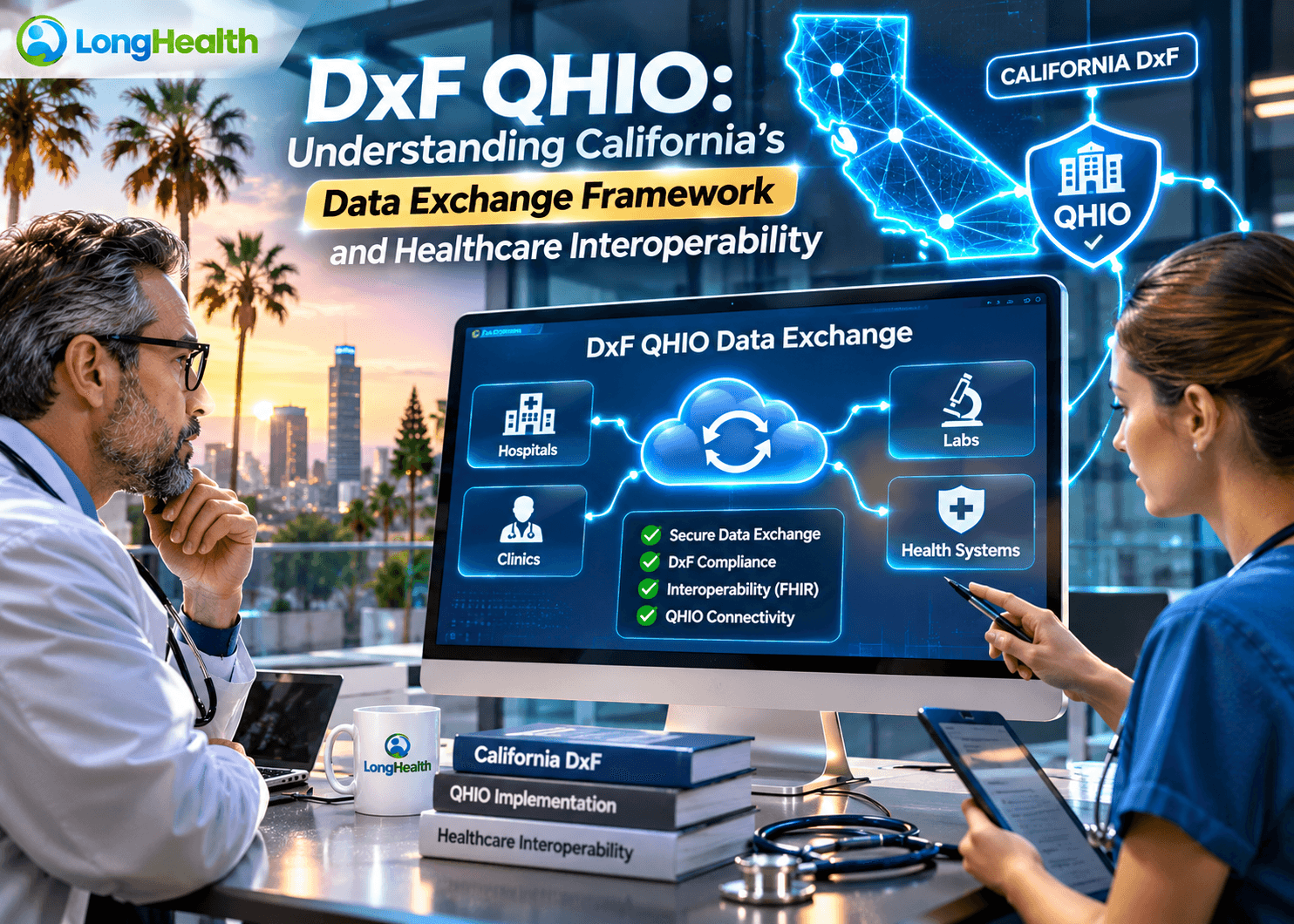
Healthcare organizations in California need more than an electronic health record system to exchange information effectively with other providers, hospitals, health plans and authorized organizations. They also need an appropriate approach to interoperability, data access, privacy, security and information-sharing workflows.
The California Data Exchange Framework (DxF) establishes a common structure for exchanging health and social services information. A Qualified Health Information Organization (QHIO) is one of the designated intermediary options that can help participating organizations carry out this exchange.
For healthcare organizations evaluating DxF QHIO services, the important question is not simply whether a QHIO is available. It is whether the selected intermediary can support the organization's data-exchange requirements, technical environment, operational workflows and applicable obligations.
LongHealth is a California-designated QHIO that provides healthcare interoperability infrastructure and related services for authorized organizations. This guide explains how DxF and QHIOs work, what healthcare organizations should understand before implementation, and what to evaluate when selecting a data-exchange partner.
What Is a DxF QHIO?
A DxF QHIO is a Qualified Health Information Organization designated under California's Data Exchange Framework program.
A QHIO is an intermediary that meets the requirements of the California QHIO program and provides services or functions to help participating organizations exchange Health and Social Services Information (HSSI).
A QHIO may support activities such as:
- Facilitating authorized electronic health information exchange.
- Connecting participating healthcare organizations.
- Supporting information requests and responses.
- Facilitating the exchange of health and social services information.
- Supporting data-exchange workflows and interoperability.
- Helping participating organizations access appropriate exchange infrastructure.
The California Department of Health Care Access and Information (HCAI) oversees the Data Exchange Framework program. Its official guidance describes a QHIO as a DxF-designated intermediary that meets the exchange requirements of the QHIO program.
In simple terms: DxF establishes the framework and shared rules for information exchange, while a QHIO is one of the intermediary options that can help healthcare organizations exchange information under those rules.
Organizations should not assume that every health information exchange, technology vendor or nationwide network is automatically a QHIO. QHIO designation is a specific California program status.
Official reference: California Data Exchange Framework – How to Join.
What Is California's Data Exchange Framework (DxF)?
The California Data Exchange Framework is a statewide initiative established through Assembly Bill 133 (AB 133), signed in 2021.
Its purpose is to establish a common structure for exchanging health and social services information among participating healthcare entities, social services organizations and government agencies in California.
The framework includes two central components:
- Data Sharing Agreement (DSA): The agreement that establishes common terms, conditions and obligations for participating organizations.
- Policies and Procedures (P&Ps): The policies that govern how information is accessed, exchanged, protected and used.
The framework is intended to support secure, timely and coordinated information sharing rather than operate as a single statewide electronic health record or centralized data repository.
The distinction matters. DxF is not a software platform that every healthcare organization logs into. It establishes the shared framework and requirements that organizations must follow when exchanging applicable information.
The California Department of Health Care Access and Information explains that administration of the DxF transitioned to HCAI in August 2025. HCAI now oversees ongoing program implementation.
Source: HCAI – Data Exchange Framework.
How Are DxF, QHIO, HIE and the DSA Different?
These terms are related, but they describe different parts of healthcare data exchange.
| Term | Meaning | Role |
|---|---|---|
| DxF | California Data Exchange Framework | Establishes the common framework, agreement and policies for applicable information exchange |
| QHIO | Qualified Health Information Organization | A California-designated intermediary that meets QHIO program requirements |
| HIE | Health Information Exchange | Describes the electronic exchange of health information and can also refer to organizations or networks facilitating that exchange |
| DSA | Data Sharing Agreement | Establishes the shared terms, conditions and obligations for DxF participants |
| P&Ps | Policies and Procedures | Define the operational, technical, privacy and other requirements for exchange |
A healthcare organization may participate in the DxF and use a QHIO to support its exchange workflows. Another organization may use a different compliant intermediary, a nationwide network or its own technology.
The correct approach depends on the organization's obligations, technical capabilities, exchange requirements and operational needs.
Is Using a QHIO Mandatory Under the California DxF?
No. Using a Qualified Health Information Organization is not mandatory for every DxF participant.
California's official DxF guidance allows participants to exchange Health and Social Services Information through a QHIO, a nationwide network or framework, another compliant intermediary, point-to-point technology, or a combination of approaches.
However, the chosen method must adhere to the applicable DxF Data Sharing Agreement and Policies and Procedures.
This distinction is important when evaluating vendors. A healthcare organization should not select a QHIO simply because it assumes that the state requires every participant to use one.
Instead, it should determine:
- Whether the organization is required to sign the DxF DSA.
- What information it must make accessible or exchange.
- Which technical requirements apply to its use cases.
- Whether its existing network or technology meets those requirements.
- Whether an intermediary is needed to support the required exchange.
- Whether the selected partner can support the organization's actual workflows.
A QHIO can provide an established pathway for participating in data exchange, but it is not the only permitted pathway.
Source: California DxF FAQs – QHIO and exchange options.
Who Needs to Understand the DxF QHIO Program?
The DxF and QHIO program are particularly relevant to organizations that maintain, access or exchange health and social services information in California.
Potentially relevant organizations include:
1. Hospitals and Health Systems
Hospitals exchange information with other healthcare providers, health plans, laboratories and care organizations.
A suitable data-exchange approach can help support authorized information sharing, care transitions and coordination between participating organizations.
2. Physician Organizations and Medical Groups
Medical groups and physician organizations may need to assess their DSA obligations, electronic information exchange capabilities and relationships with intermediaries.
Their implementation considerations may include existing EHR systems, participating practices, data access workflows and organizational responsibilities.
3. Health Plans
Applicable health plans need to consider the information they are required to make available or exchange, the systems involved and the technical and policy requirements governing those activities.
4. Clinical Laboratories
Clinical laboratories may need to evaluate how their systems support applicable information exchange and how they connect with participating healthcare organizations.
5. Skilled Nursing Facilities
Facilities maintaining electronic health records may need to assess applicable DxF participation and exchange requirements, including their ability to connect with other participating organizations.
6. Social Services Organizations
The framework also covers relevant social services organizations and information-sharing relationships. These exchanges require careful consideration of authorization, permitted purposes and applicable privacy requirements.
The exact legal obligations depend on the organization's classification and circumstances. Organizations should review the current HCAI guidance and obtain legal advice where necessary.
Who Is Required to Sign the DxF Data Sharing Agreement?
The Data Sharing Agreement applies to organization types identified in California Health and Safety Code section 130290(f), as reflected in the current HCAI FAQs.
The categories include:
- General acute care hospitals.
- Physician organizations and medical groups within the statutory definitions.
- Skilled nursing facilities that maintain electronic health records.
- Specified health plans and disability insurers.
- Clinical laboratories regulated by the California Department of Public Health.
- Acute psychiatric hospitals.
- Certain emergency medical services entities under the newer program provisions.
The law and current guidance also identify entities that are encouraged, but not necessarily required, to sign the agreement.
The distinction between required and encouraged participants matters. An organization should not assume that every healthcare provider, vendor or social services organization has identical obligations.
Important DxF Updates for 2026
California's Senate Bill 660 (SB 660), signed in October 2025, introduced additional provisions and clarified parts of the DxF program.
The current HCAI FAQ identifies, among other changes:
- Additional organization types and clarified signatory categories.
- Emergency medical services participation requirements.
- July 1, 2026 deadlines for specified newly covered entities, including emergency medical services and certain medical foundations.
- January 1, 2027 publication of known entities that HCAI deems noncompliant with the requirement to execute the DSA.
The applicable deadlines vary by organization type. For example, HCAI's current FAQ identifies January 31, 2026 as the exchange-start deadline for several hospital and physician-organization categories, while other categories have different dates.
These details should be checked against the current official FAQ before an organization makes an implementation or compliance decision.
Official source: HCAI DxF FAQs – Signatory categories and deadlines.
How Does a QHIO Work?
A QHIO functions as an intermediary between authorized organizations that need to exchange health and social services information.
A simplified exchange workflow may look like this:
- Organization participation: The healthcare organization determines its DxF participation status and applicable responsibilities.
- Technology selection: The organization identifies an appropriate QHIO, network, intermediary or technology approach.
- Connectivity and onboarding: The organization establishes the technical and contractual arrangements needed for the selected exchange method.
- Authorization and access: Requests and exchanges are evaluated under applicable laws, agreements, permitted purposes and access controls.
- Information exchange: Authorized information is requested, located, routed, received or shared according to the applicable exchange workflow.
- Operational oversight: The organization maintains its own policies, procedures, privacy safeguards and responsibilities.
A QHIO does not automatically make every record available to every participant. Information access depends on the applicable legal authority, permitted purpose, source systems, agreements and technical arrangements.
Example: Information Exchange Between Healthcare Organizations
Consider a patient receiving care from more than one healthcare organization.
One organization may need relevant information maintained by another organization to support an authorized care-related workflow.
An appropriate exchange intermediary can help facilitate the request and exchange of information between connected organizations, subject to applicable permissions and requirements.
The receiving organization remains responsible for using the information appropriately and complying with its own legal and operational obligations.
This is one reason why interoperability infrastructure is important: the ability to exchange information depends not only on connectivity, but also on identity, authorization, data availability, routing and governance.
What Services Should Healthcare Organizations Evaluate in a QHIO?
Not every QHIO or intermediary offers the same service scope. Organizations should evaluate actual capabilities rather than relying only on a designation or marketing description.
The following areas are useful when comparing potential providers.
1. Health Information Exchange Connectivity
Evaluate whether the provider can support the organization's required exchange relationships and use cases.
Questions to ask:
- Which types of healthcare organizations can participate?
- Which exchange workflows are supported?
- How are participating organizations connected?
- What types of information can be exchanged?
- What limitations apply to the service?
2. Information Requests and Routing
An intermediary may support the processes required to request, locate, route, send or receive information.
Understand how these functions operate in practice and which parts are included in the proposed service.
3. Patient Matching
Patient matching is an important consideration when information is exchanged between organizations.
Ask how the provider identifies and matches individuals, what information is used, how potential mismatches are handled and what procedures exist for resolving exceptions.
4. EHR and Healthcare Technology Integration
Interoperability must work within the organization's existing technology environment.
Review:
- Existing EHR systems.
- Available integration methods.
- Interface requirements.
- Data mapping and transformation.
- Supported exchange standards.
- Authentication and authorization.
- Testing and validation.
- Ongoing integration maintenance.
Do not assume that a QHIO automatically integrates with every EHR or healthcare application. Confirm compatibility and implementation scope with the provider.
5. Data Availability and Exchange Scope
Organizations should understand what information is available through the proposed service.
Ask whether the provider supports the required clinical, behavioral health, emergency medical services, public health or social services information workflows.
Also clarify which information types are not included.
6. Privacy and Security
Healthcare information exchange involves sensitive data and requires appropriate safeguards.
Organizations should assess:
- Identity and access management.
- Role-based access controls.
- Authentication.
- Encryption.
- Audit logging.
- Security monitoring.
- Incident response.
- Vendor and subcontractor oversight.
- Business continuity and disaster recovery.
- Applicable contractual and privacy requirements.
The provider's security documentation should be reviewed alongside the organization's own policies and risk assessments.
7. Implementation and Support
A technically suitable solution still needs an achievable implementation plan.
Discuss:
- Onboarding requirements.
- Technical dependencies.
- Data-flow mapping.
- Testing and validation.
- Staff responsibilities.
- Training.
- Support arrangements.
- Change management.
- Ongoing service reviews.
A provider should be able to explain what it is responsible for and what remains the responsibility of the participating organization.
Does Using a QHIO Automatically Make an Organization DxF Compliant?
No. Contracting with a QHIO does not automatically guarantee that an organization meets every DxF requirement.
The California DxF FAQ explicitly clarifies that participation through a QHIO may help an organization meet applicable exchange requirements, but the participant remains responsible for its own obligations under the DSA and Policies and Procedures.
Those responsibilities can include:
- Permitted, required and prohibited purposes for information exchange.
- Privacy standards and security safeguards.
- Required data elements.
- Technical exchange requirements.
- Real-time exchange requirements.
- Applicable state and federal laws.
- Internal policies and operating practices.
A QHIO may provide technical connectivity and exchange services, but it generally cannot determine whether every internal process of a participant satisfies all applicable obligations.
This means healthcare organizations should evaluate both the intermediary's services and their own operational readiness.
Official source: HCAI DxF FAQ – QHIO services and compliance responsibilities.
What Technical Considerations Matter When Implementing a QHIO?
A successful data-exchange implementation requires more than establishing a network connection.
Healthcare IT and interoperability teams should examine the full information flow.
Data Exchange Standards
The California DxF Technical Requirements for Exchange identifies technical standards and profiles that participants must support as applicable.
The HCAI FAQ explains that the framework references IHE profiles found in eHealth Exchange, Carequality and the Trusted Exchange Framework and Common Agreement (TEFCA) QHIN Technical Framework.
FHIR is optional but encouraged under the cited DxF technical guidance. Organizations should verify the current technical policy and their specific requirements rather than assume that FHIR alone satisfies every exchange obligation.
Data Mapping and Normalization
Information from different healthcare systems may use different formats, terminology and data structures.
Implementation teams should assess:
- Source-system data structures.
- Field mapping.
- Data normalization.
- Document formats.
- Clinical terminology.
- Required data elements.
- Validation and exception handling.
Patient Identity and Matching
Matching information to the correct individual is a critical part of exchange.
Organizations should understand the matching approach, available identity attributes, exception workflows and safeguards against incorrect associations.
Authentication and Authorization
A data-exchange connection should not be treated as unrestricted access.
The organization must understand how users, systems and organizations are authenticated and how authorization is determined for each relevant exchange purpose.
Monitoring and Auditability
Operational teams should establish how they will review exchange activity, identify failures, investigate exceptions and maintain appropriate records.
The specific monitoring and audit requirements should be confirmed against the applicable policies, contracts and technical implementation.
DxF QHIO vs. Other Healthcare Data Exchange Options
A QHIO is one possible way for a California DxF participant to support information exchange. Other options may be suitable depending on the organization's existing infrastructure and requirements.
| Exchange approach | What it means | What to evaluate |
|---|---|---|
| QHIO | California-designated DxF intermediary | QHIO services, connectivity, participating organizations and scope |
| Nationwide network or framework | A network or framework with nationwide scope that includes California coverage | Applicable participation rules, available exchange use cases and DxF alignment |
| Other intermediary | An HIE, HIO or technology provider supporting exchange | Whether its services meet applicable DxF policies and requirements |
| Point-to-point technology | Direct exchange between organizations using their own technology | Technical standards, security, scalability and operational support |
| Combined approach | Multiple methods used together | Responsibility boundaries, consistency, governance and integration complexity |
The California framework does not require participants to select only one method. A participant may use a combination of compliant exchange approaches.
The most appropriate option depends on the organization's technical environment, exchange partners, required workflows and ability to meet the applicable policies.
How to Choose the Right DxF QHIO Provider
Selecting a QHIO should be treated as a healthcare technology and operational decision.
Use the following checklist before entering into a service agreement.
QHIO Provider Evaluation Checklist
Program and service scope
- Is the organization currently designated as a QHIO?
- Does it explain its role under the California DxF?
- Which participant types does it serve?
- What services are included?
- Are there limitations on the information or workflows supported?
Technical capabilities
- Which exchange standards and profiles are supported?
- What EHR and system integration options are available?
- How does patient matching work?
- How are information requests and responses handled?
- What testing and validation processes are included?
Privacy and security
- What privacy and security documentation is available?
- How are access permissions managed?
- What authentication and audit controls are implemented?
- How are incidents handled?
- Which subcontractors or service providers may process information?
Implementation
- What onboarding steps are required?
- What information must the organization provide?
- What technical resources are needed?
- What is included in implementation support?
- How are issues and ongoing changes managed?
Contractual and operational responsibilities
- Which responsibilities belong to the QHIO?
- Which responsibilities remain with the participant?
- Is a Business Associate Agreement required?
- What participation or service agreements apply?
- What happens when an organization changes its exchange requirements?
A useful evaluation should document the answers rather than rely on verbal assurances.
How LongHealth Supports DxF QHIO and Healthcare Interoperability
LongHealth provides healthcare interoperability infrastructure and related services for authorized organizations participating in health information exchange.
LongHealth's published QHIO Privacy Policy describes its role in facilitating electronic exchange of Health and Social Services Information on behalf of healthcare providers, health plans, medical groups, hospitals, clinics, laboratories, social services organizations and other authorized participants.
The policy describes functions that enable authorized organizations to:
- Request health and social services information.
- Receive information.
- Send information.
- Route information.
- Locate information.
- Match information.
- Exchange information through applicable services.
LongHealth may act as a QHIO, an intermediary under the DxF, a HIPAA Business Associate where applicable, or a technology and interoperability service provider, depending on the service and relationship involved.
This distinction is important because the role and responsibilities can vary according to the service being provided and the agreements governing the exchange.
Supporting Healthcare Data Exchange
Healthcare organizations need an approach that considers both technology and operational requirements.
LongHealth's QHIO services are intended to support authorized information exchange while operating within applicable legal requirements, the DxF DSA and relevant Policies and Procedures.
Privacy and Security Considerations
LongHealth's published QHIO Privacy Policy describes safeguards that include:
- Identity and access management.
- Role-based access controls.
- Multifactor authentication.
- Encryption of information in transit and at rest where appropriate.
- Network and endpoint security controls.
- Vulnerability management.
- Security monitoring and audit logging.
- Workforce security and training.
- Incident response procedures.
- Business continuity and disaster recovery controls.
- Risk assessments and vendor oversight.
The policy also states that LongHealth maintains security controls consistent with applicable QHIO Program requirements, including applicable HITRUST certification requirements.
Organizations should review the current policy, applicable certification documentation and contractual terms as part of their own vendor assessment.
Read the LongHealth QHIO Privacy Policy.
A Practical Conversation About Your Interoperability Requirements
A healthcare organization considering a QHIO should begin with its actual information-sharing needs.
For example, a hospital, medical group, health plan and social services organization may have different data sources, workflows, exchange partners and operational constraints.
LongHealth can discuss the organization's requirements, its existing technology environment and the potential fit of LongHealth's interoperability services.
Contact LongHealth to discuss your healthcare data-exchange requirements.
Common Challenges in DxF QHIO Implementation
Understanding potential implementation challenges before selecting a provider can help organizations plan more effectively.
1. Treating the DxF as a Software Product
The DxF is a framework of agreements and policies, not a single software application or statewide repository.
Organizations need to select an appropriate technical approach to carry out their exchange responsibilities.
2. Assuming a QHIO Guarantees Compliance
A QHIO can support exchange, but the participating organization remains responsible for its own policies, legal obligations and operational practices.
3. Overlooking Existing EHR Infrastructure
An organization may already have interfaces, data exchange connections or vendor relationships.
These should be assessed before selecting an additional intermediary.
4. Ignoring Patient Matching and Data Quality
An exchange connection is useful only when information can be appropriately associated with the correct individual and handled reliably.
Patient matching, data quality and exception management should be part of the implementation plan.
5. Underestimating Privacy and Security Responsibilities
Organizations must understand which laws and policies apply to the information being exchanged, the purpose of the exchange and the organizations involved.
A vendor relationship does not remove the participant's own responsibilities.
6. Failing to Define Operational Ownership
The QHIO, healthcare organization, EHR vendor and other technology providers may each have different responsibilities.
Documenting ownership for onboarding, access, support, incidents and ongoing maintenance helps prevent operational gaps.
Conclusion: Choosing a Suitable DxF QHIO and Interoperability Approach
The California Data Exchange Framework establishes a shared structure for exchanging health and social services information. A Qualified Health Information Organization is one of the intermediary options available to organizations seeking to support their exchange workflows.
However, selecting a QHIO requires more than confirming its designation. Healthcare organizations should understand their DSA responsibilities, applicable Policies and Procedures, technical requirements, information-sharing use cases, privacy safeguards and operational needs.
The right approach should fit the organization's existing systems and support its authorized exchange activities without confusing connectivity with complete regulatory compliance.
LongHealth provides QHIO and healthcare interoperability services for authorized organizations. Healthcare providers, medical groups, hospitals, health plans and other relevant organizations can discuss their requirements with LongHealth to evaluate a suitable approach to healthcare data exchange.
Discuss your DxF QHIO and healthcare interoperability requirements with LongHealth.
Frequently Asked Questions About DxF QHIO
1. What does DxF QHIO stand for?
DxF refers to California's Data Exchange Framework. QHIO stands for Qualified Health Information Organization. A QHIO is an intermediary designated under the California framework to support health and social services information exchange.
2. What is the purpose of a QHIO?
A QHIO provides services and functions that help authorized organizations exchange health and social services information under applicable DxF requirements.
3. Is a QHIO mandatory for California healthcare organizations?
No. California DxF participants may use a QHIO, a nationwide network or framework, another compliant intermediary, point-to-point technology or a combination of exchange methods.
4. What is the difference between DxF and QHIO?
DxF is the statewide framework containing the Data Sharing Agreement and common Policies and Procedures. A QHIO is a designated intermediary that can help participants exchange information under the framework.
5. Does a QHIO store all patient medical records in one central database?
No. The DxF is not designed as a single centralized information repository. Information is exchanged through participating organizations and the networks, intermediaries or technologies they use.
6. Does signing a contract with a QHIO guarantee DxF compliance?
No. Using a QHIO may support an organization's exchange requirements, but the organization remains responsible for its obligations under the DSA, Policies and Procedures and applicable laws.
7. Can organizations use a nationwide network instead of a QHIO?
Yes. California's official guidance allows participants to use a nationwide network or framework if the chosen approach adheres to applicable DxF requirements.
8. What is the Data Sharing Agreement?
The DSA is the common agreement that establishes the terms, conditions and obligations for participating organizations exchanging health and social services information under the DxF.
9. What are DxF Policies and Procedures?
The P&Ps provide the operational and technical rules governing information exchange, including requirements related to permitted purposes, privacy, security, data elements and technical exchange.
10. What should an organization check before selecting a QHIO?
It should review the provider's designation, service scope, participating organization types, technical capabilities, EHR integration options, patient matching, privacy and security controls, implementation support and contractual responsibilities.
11. Does the DxF apply outside California?
The DxF is a California state framework, not a nationwide QHIO regulation. However, its DSA and Policies and Procedures can apply when two DxF participants exchange HSSI for an individual, regardless of that individual's residency. Other states have their own healthcare data-sharing laws and requirements.
12. How can an organization discuss QHIO services with LongHealth?
Healthcare organizations can contact LongHealth to discuss their data-exchange requirements, technology environment, implementation considerations and potential interoperability needs through the LongHealth contact page.
HIPAA Compliant
We follow the highest standards of data protection, fully aligned with HIPAA regulations, to safeguard your medical records with uncompromising privacy and trust.
HITRUST
We are proud to be HITRUST Risk-Based, 2-Year (r2) Certified, demonstrating our commitment to the highest standards of data security and compliance.
Trusted Partners
Our trusted vendors are fully compliant with HIPAA and hold prestigious certifications.
Data Encryption
Longhealth secures your sensitive information with advanced encryption, safeguarding data both during transmission and while stored.
DxF - Data Exchange Framework
Improve care coordination, transparency, and access to real-time patient data across systems like EHRs, health plans, and providers.

Data Exchange Simplified
HIPAA Compliant