AI QME Software for Medical-Legal Evaluation Workflows
13 November 2026
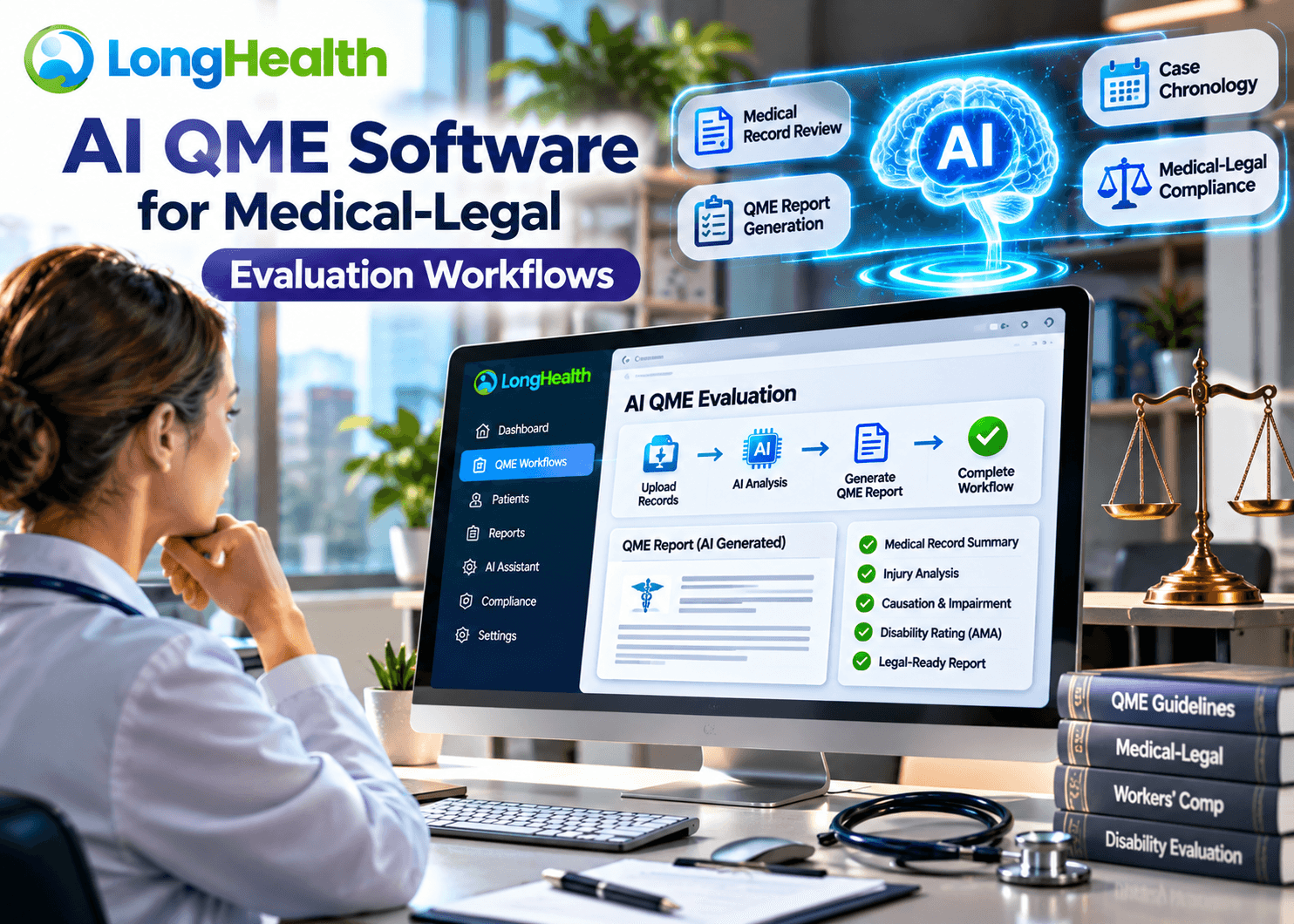
AI QME software uses artificial intelligence to assist Qualified Medical Evaluators with medical-record review, clinical chronology, examination documentation, impairment-rating support, and medical-legal report preparation.
For physicians and medical-legal organizations, the challenge is not simply writing a report. A QME evaluation may involve reviewing extensive medical records, identifying relevant clinical events, documenting examination findings, organizing impairment-related information, and preparing a detailed medical-legal report.
Traditional workflows can involve substantial manual information-processing and documentation work.
AI-powered QME software aims to support these activities through medical-record intelligence, automated information extraction, clinical chronology generation, AI-assisted transcription, and physician-editable report preparation.
However, AI should support the evaluator rather than replace professional judgment.
For medical-legal organizations evaluating AI QME software in the United States, the important consideration is whether the technology can connect the complete evaluation workflow while maintaining source traceability, accuracy, security, and physician oversight.
LongHealth's EvalPath is designed around this type of medical-legal workflow, bringing together AI-assisted medical-record review, clinical chronology, examination documentation, impairment-rating support, and report preparation.
What Is AI QME Software?
AI QME software in California is a technology platform that uses artificial intelligence to assist Qualified Medical Evaluators with tasks associated with medical-legal evaluations.
It can support information-processing and documentation activities that would otherwise require significant manual effort.
Depending on the platform, capabilities may include:
- AI-assisted medical-record review
- Clinical information extraction
- Medical-record summarization
- Clinical chronology generation
- Medical document organization
- AI-assisted examination documentation
- Physician dictation transcription
- Impairment-rating support
- Medical-legal report drafting
- Editable report templates
- Voice-assisted report editing
- Source-linked information retrieval
The objective is to help physicians work with complex medical documentation more efficiently.
AI QME software should not be confused with a general-purpose AI chatbot or ordinary medical transcription software. A medical-legal evaluation requires a connected workflow that supports record review, examination documentation, professional analysis, and report preparation.
Who Uses AI QME Software?
Potential users include:
- Qualified Medical Evaluators
- Medical-legal physicians
- Independent medical evaluation practices
- Physician groups
- Medical-legal organizations
- Workers' compensation evaluation organizations
- Medical practice administrators
- Clinical documentation teams
- Healthcare technology decision-makers
Although the target market for this technology can include organizations across the United States, QME is a specific designation within California's workers' compensation system. Other states may use different medical-legal evaluation terminology and processes.
California's Division of Workers' Compensation administers the QME program and provides official information about evaluator qualifications and reporting responsibilities.
Why Are Physicians Evaluating AI QME Software?
Medical-legal evaluations can involve extensive documentation from multiple healthcare providers.
A physician may need to review:
- Initial medical evaluations
- Treatment records
- Specialist consultations
- Diagnostic imaging
- Laboratory reports
- Surgical documentation
- Medication histories
- Follow-up visits
- Previous examinations
- Other relevant medical documentation
The information may be distributed across hundreds or thousands of pages, depending on the case.
The physician needs to understand what happened, when it happened, which provider documented it, and how the information relates to the evaluation.
AI-assisted software can help organize this information into structured, reviewable outputs.
Common Workflow Challenges
| Workflow Challenge | How AI-Assisted Software Can Help |
|---|---|
| Large medical records | Process and organize documentation |
| Repetitive information extraction | Identify relevant clinical information |
| Chronology preparation | Organize events into timelines |
| Manual documentation | Assist with transcription and structuring |
| Report preparation | Generate editable draft content |
| Information retrieval | Make relevant details easier to locate |
| Report corrections | Support voice and manual editing |
These are potential workflow improvements. Actual results depend on the software, record quality, case complexity, and implementation.
Essential Features of AI QME Software
Not every AI platform is designed for medical-legal evaluation workflows.
When evaluating a solution, focus on the following capabilities.
1. AI Medical Record Review
Medical-record review is one of the most important stages of a QME evaluation.
AI-assisted record review can help identify information such as:
- Diagnoses
- Treatments
- Medications
- Procedures
- Imaging
- Laboratory results
- Clinical encounters
- Examination findings
- Relevant dates
- Provider information
Instead of navigating every document manually to locate a particular event, the physician can work with structured information generated from the records.
A good medical-record review workflow should allow the physician to verify extracted information against the original documentation.
What to evaluate:
- Supported file formats
- Processing of scanned documents
- Information extraction capabilities
- Search functionality
- Handling of duplicate records
- Source-document access
- Editing and correction controls
2. AI Medical Chronology Generation
Clinical chronology is particularly valuable when medical records contain information from multiple providers and different periods.
AI can help arrange documented medical events into a chronological structure.
For example:
| Date | Medical Event | Information to Review |
|---|---|---|
| January 10 | Initial evaluation | Reported symptoms and documented findings |
| January 18 | Imaging | Imaging findings in the source report |
| February 5 | Follow-up | Treatment and clinical documentation |
| March 12 | Procedure | Procedure documentation |
| April 20 | Subsequent evaluation | Follow-up findings |
A structured chronology can help physicians understand the sequence of documented events.
However, chronology generation should not be treated as independent medical interpretation.
Physicians should be able to trace important entries to their underlying source records.
3. Source-Linked Medical Information
Source traceability is a critical feature when evaluating AI medical-legal software.
Suppose AI extracts a diagnosis from a medical record.
The physician should be able to identify:
- The original document
- The relevant date
- The provider who documented the information
- The supporting passage or record entry
- Whether the extracted information accurately represents the source
This is particularly important when information will be used in a consequential medical-legal report.
A practical verification process is:
Medical Records → AI Extraction → Structured Information → Source Verification → Physician Review
AI-generated content should never automatically become an accepted medical-legal finding.
4. AI Medical Scribe for Examination Documentation
AI scribing can support the documentation portion of a medical-legal evaluation.
Depending on the platform, it may capture:
- Physician dictation
- Examination-related documentation
- Patient encounter conversations
- Examination measurements
- Relevant clinical observations
AI-powered transcription can convert spoken information into structured text for professional review.
The physician should retain the ability to:
- Review the transcription
- Correct errors
- Edit documentation
- Add missing information
- Approve the final content
AI scribing is a documentation capability. It is not the same as AI medical-record review or autonomous clinical decision-making.
5. AMA Guides-Based Impairment-Rating Support
Impairment-related documentation can be an important component of medical-legal evaluations.
Some AI QME platforms provide tools that assist with impairment-rating workflows.
LongHealth's EvalPath documentation describes generating AMA Guides-based impairment ratings using medical records and physician examination findings.
When evaluating this capability, organizations should examine:
- Which AMA Guides edition and applicable methodology are supported
- How relevant medical information is used
- How examination findings are incorporated
- Whether calculations can be reviewed
- How assumptions and inputs are presented
- Whether physicians can correct or modify the output
- How final professional conclusions are documented
An impairment-rating calculation is not automatically equivalent to a complete professional impairment opinion.
The evaluator remains responsible for verifying the methodology, information, calculations, and final conclusions.
6. AI Medical-Legal Report Preparation
AI-assisted report preparation can help organize information into an editable report structure.
A practical workflow may include:
- Case information
- Relevant medical history
- Records reviewed
- Clinical chronology
- Examination documentation
- Relevant findings
- Impairment-related information
- Medical-legal discussion
- Draft report
- Professional review and finalization
The exact structure should reflect the applicable report requirements and the physician's workflow.
Look for software that supports editable content and allows the physician to control the final report.
7. Voice-Assisted Report Editing
Physicians may prefer to dictate corrections rather than manually rewrite every section.
Voice-assisted editing can support this process by allowing physicians to make changes through spoken instructions, where supported.
Manual editing should also remain available.
The objective is to provide flexible documentation workflows without removing professional control.
How Does AI QME Software Work?
A connected AI-powered medical-legal workflow can be divided into several stages.
Stage 1: Medical Record Intake
The relevant medical records and case documents are collected.
The platform should support the document formats and record volumes used by the organization.
Stage 2: AI Document Processing
The system processes available documentation and identifies relevant clinical information.
Depending on the platform, this may involve OCR, document classification, information extraction, and AI-assisted summarization.
Stage 3: Clinical Chronology
Relevant events are organized chronologically.
Physicians can use the chronology to navigate the documented medical history.
Stage 4: Source Verification
The physician reviews important extracted information against the original medical records.
Stage 5: Examination Documentation
Examination information and physician dictation can be captured through AI-assisted documentation tools.
Stage 6: Impairment-Related Support
Where supported, the platform assists with relevant impairment-rating calculations and documentation.
Stage 7: Report Drafting
Reviewed information can be organized into physician-editable medical-legal report content.
Stage 8: Physician Review and Finalization
The physician reviews the report, makes corrections, applies professional judgment, and finalizes the document.
Complete workflow:
Medical Records → AI Review → Clinical Chronology → Examination Documentation → Impairment Support → Report Draft → Physician Review → Final Report.
AI QME Software vs. Generic AI Tools
Not all AI healthcare tools are suitable for medical-legal evaluation.
A general-purpose AI tool may summarize a document or generate text, but a QME workflow requires more specialized capabilities.
| Evaluation Area | General-Purpose AI | QME-Oriented AI Workflow |
|---|---|---|
| Document summarization | May support | Relevant |
| Medical-record extraction | Depends on tool | Important |
| Clinical chronology | May require additional configuration | Core workflow consideration |
| Source traceability | Must be verified | Important |
| Examination documentation | General transcription may be available | Medical-legal workflow support |
| Impairment support | Not necessarily available | Relevant where supported |
| Medical-legal report preparation | Generic drafting | Physician-editable workflow |
| Professional review | User-dependent | Essential |
| Case workflow | General-purpose | Medical-legal focused |
The important difference is workflow specialization.
An AI writing tool may produce a paragraph.
A QME-oriented platform should help organize the information and documentation that support the evaluator's work.
AI QME Software vs. Traditional QME Software
Traditional QME software may focus on case management, document storage, templates, and administrative workflows.
AI-powered platforms can add capabilities such as medical-record extraction, chronology generation, transcription, and draft preparation.
| Feature | Traditional Software | AI-Assisted QME Software |
|---|---|---|
| Case organization | Software-dependent | Software-dependent |
| Document storage | Common capability | Common capability |
| Medical-record extraction | May require manual work | Can be AI-assisted |
| Medical chronology | May be manual | Can be AI-assisted |
| Dictation | May require separate tools | May include AI scribing |
| Impairment support | Depends on platform | Depends on platform |
| Report preparation | Templates and manual drafting | May include AI-assisted drafting |
| Human review | Required | Required |
AI capabilities should be evaluated individually rather than assuming that every product advertised as AI-powered provides the same functionality.
How LongHealth's EvalPath Supports AI-Assisted QME Workflows
LongHealth's EvalPath is designed around medical-legal evaluation workflows.
Rather than focusing only on document generation, its documented approach connects several stages of the evaluation process.
AI-Assisted Medical Record Review
EvalPath helps physicians review medical records and case files to identify relevant clinical information, diagnoses, treatments, procedures, and other details.
Clinical Chronology
The platform organizes injuries, diagnoses, treatments, procedures, imaging, and other medical events into a clinical chronology with source-linked references.
This gives physicians a structured way to review the underlying evidence.
AI Scribe
EvalPath supports AI-assisted transcription of patient encounters, physician dictation, and examination measurements.
The resulting structured documentation can be reviewed and used in medical-legal report preparation.
Impairment-Rating Support
EvalPath documents AMA Guides-based impairment-rating support using medical records and physician examination findings.
This assists physicians with documenting impairment calculations for inclusion in the medical-legal evaluation.
Physician-Editable Report Preparation
EvalPath supports preparation of physician-editable medical-legal report content.
The physician can review and modify the generated content before finalization.
Voice and Manual Review
The workflow includes voice-assisted and manual editing, allowing physicians to review and correct the report before completing it.
Explore LongHealth EvalPath to understand how these capabilities fit into the medical-legal evaluation process.
What AI QME Software Does Not Replace
AI QME software in California is designed to support professional workflows.
It does not replace:
- The Qualified Medical Evaluator
- Physical examination
- Professional medical judgment
- Review of original medical records
- Interpretation of clinical information
- Applicable medical-legal responsibilities
- Final approval of the report
AI-generated information can contain inaccuracies, omissions, or incorrect interpretations.
Medical records may also contain conflicting dates, incomplete histories, duplicate documentation, and ambiguous terminology.
For this reason, the physician must remain involved in reviewing and validating the information.
The appropriate model is:
AI-assisted information processing + professional verification + physician judgment.
Security and Privacy Considerations When Choosing AI QME Software
AI QME platforms may process sensitive medical information.
Before adopting a solution, medical-legal organizations should evaluate how the vendor handles electronic protected health information.
Important areas include:
| Security Area | What to Evaluate |
|---|---|
| Data encryption | Protection of information in transit and at rest |
| Access controls | Who can access medical records and reports |
| Authentication | How users establish their identities |
| Authorization | How user permissions are assigned |
| Auditability | Whether access and relevant activities can be reviewed |
| Data retention | How long information is retained |
| Data deletion | How information is removed when appropriate |
| Vendor agreements | Applicable business associate agreements |
| AI data handling | Whether customer data is used for model training |
| Incident response | How security incidents are managed |
The HIPAA Security Rule establishes administrative, physical, and technical safeguards for electronic protected health information handled by covered entities and business associates.
Official guidance is available from the U.S. Department of Health and Human Services.
Organizations should assess the vendor's actual security documentation and contractual commitments. Do not assume that an AI feature or a general HIPAA-related statement automatically establishes compliance for every use case.
How to Choose the Right AI QME Software
Selecting a platform should begin with the organization's existing medical-legal workflow.
A useful evaluation framework includes the following areas.
1. Medical Record Processing
Determine whether the software supports your actual document types, scanned records, and expected case volumes.
2. AI Extraction Accuracy
Test whether the platform correctly identifies diagnoses, treatments, procedures, dates, and other relevant information.
Use representative records rather than relying exclusively on demonstrations.
3. Clinical Chronology
Determine whether the platform can create a useful chronology and connect individual entries to supporting source documents.
4. AI Scribing
Evaluate transcription quality, editing controls, documentation structure, and the physician's ability to correct generated text.
5. Impairment-Related Workflows
Determine which calculations and methodologies are supported, how inputs are handled, and how results can be reviewed.
6. Medical-Legal Report Preparation
Check whether the software supports your preferred report templates and physician-editable content.
7. Human Oversight
Understand where the physician reviews generated information and how corrections are handled.
8. Security and Data Governance
Review data storage, access controls, encryption, retention, vendor agreements, and AI data-use policies.
9. Implementation and Usability
Evaluate onboarding, training, workflow fit, support, and the amount of process change required.
10. Scalability
Consider whether the platform can support your expected case volume and organizational requirements.
AI QME Software Vendor Evaluation Checklist
Use this checklist before selecting a solution.
| Requirement | Evaluation Question |
|---|---|
| Medical records | Can it process our typical medical records? |
| OCR | Can it handle scanned documentation? |
| AI extraction | What clinical information can it identify? |
| Chronology | Can it create structured medical timelines? |
| Source traceability | Can we verify extracted information? |
| AI scribing | Can it capture physician dictation? |
| Impairment support | Which methodologies and calculations are supported? |
| Report preparation | Can physicians edit generated content? |
| Templates | Can we use our preferred report formats? |
| Voice editing | Can physicians correct content through voice? |
| Security | What safeguards protect sensitive information? |
| AI governance | How are generated outputs reviewed? |
| Integration | Can it fit our existing systems? |
| Implementation | What onboarding and support are available? |
A structured evaluation helps organizations select software based on actual workflow requirements instead of marketing claims.
Implementation Considerations for Medical-Legal Organizations
Introducing AI into a medical-legal workflow requires more than purchasing software.
Organizations should establish a clear implementation process.
Step 1: Map the existing workflow
Document how records are received, reviewed, organized, and used for report preparation.
Step 2: Identify repetitive tasks
Determine which activities involve repeated information extraction, chronology creation, transcription, and report formatting.
Step 3: Define AI responsibilities
Specify which tasks AI can assist with and which require direct professional judgment.
Step 4: Establish verification procedures
Define how physicians and authorized staff will verify generated information against original records.
Step 5: Evaluate security
Review vendor documentation, data handling, access controls, retention, and contractual obligations.
Step 6: Conduct a controlled evaluation
Test the platform using representative records and realistic workflows.
Step 7: Train users
Provide guidance on AI limitations, editing controls, source verification, and professional responsibilities.
Step 8: Monitor workflow performance
Evaluate usability, output quality, correction requirements, and operational fit.
This approach helps organizations introduce AI with appropriate oversight.
AI QME Software and the California Medical-Legal System
Although the broader target audience for medical-legal technology may be located across the United States, QME has a specific regulatory meaning in California.
The California Division of Workers' Compensation defines Qualified Medical Evaluators as qualified physicians certified by its Medical Unit to examine injured workers, evaluate disability, and prepare medical-legal reports.
The DWC provides official information about:
- QME certification
- Medical-legal evaluations
- Report-writing resources
- QME forms
- Applicable regulations
- Evaluator education
Organizations using AI QME software in California should ensure that their workflows reflect the requirements applicable to their evaluations.
Relevant official resources:
Software should support the applicable professional workflow rather than being treated as a substitute for regulatory guidance.
Conclusion: Evaluate AI QME Software Beyond Report Generation
AI QME software should be evaluated as a complete medical-legal workflow solution rather than simply an AI report-writing tool.
For physicians and medical-legal organizations, the practical value lies in connecting the major stages of the evaluation process:
- Medical-record processing
- AI-assisted information extraction
- Clinical chronology
- Source verification
- Examination documentation
- Impairment-rating support
- Medical-legal report preparation
- Physician review and finalization
The technology should make relevant information easier to process, organize, and review while maintaining professional control over the evaluation.
LongHealth's EvalPath brings these capabilities together in a workflow designed for medical-legal evaluations.
If your organization is evaluating AI QME software, compare the platform against your current record-review process, documentation requirements, report templates, security expectations, and physician oversight procedures.
Explore LongHealth EvalPath to see how AI-assisted medical-legal workflows can support your organization's evaluation process.
Frequently Asked Questions About AI QME Software
What is AI QME software?
AI QME software uses artificial intelligence to assist Qualified Medical Evaluators with medical-record review, clinical chronology, examination documentation, impairment-related workflows, and medical-legal report preparation.
Can AI QME software review medical records?
Yes. Depending on the platform, AI can assist with processing medical records, identifying relevant diagnoses and treatments, extracting clinical information, and organizing documentation for physician review.
Can AI generate a medical chronology for QME cases?
AI-assisted software can organize documented clinical events into chronological timelines. Physicians should be able to verify important entries against the original records.
Can AI QME software prepare medical-legal reports?
Some platforms support physician-editable medical-legal report preparation. Generated content should be reviewed, corrected, and finalized by the responsible physician.
Can AI assist with AMA Guides impairment ratings?
Some specialized platforms provide impairment-rating support. LongHealth's EvalPath documentation describes AMA Guides-based impairment-rating support using medical records and physician examination findings. The evaluator remains responsible for verifying the methodology, inputs, calculations, and professional conclusions.
Does AI QME software replace the physician?
No. AI supports information processing and documentation. It does not replace the physician's examination, medical judgment, or professional responsibilities.
What is the difference between AI QME software and AI medical scribe software?
AI medical scribe software primarily assists with capturing and structuring spoken clinical documentation. AI QME software can support a broader medical-legal workflow, potentially including medical-record review, chronology, examination documentation, impairment support, and report preparation.
Is AI QME software only relevant to California?
QME is a designation within California's workers' compensation medical-legal system. Organizations elsewhere in the United States may have related medical-legal evaluation needs, but they should use the terminology and requirements applicable to their jurisdiction.
Is AI-generated medical information always accurate?
No. AI-generated information can contain omissions, incorrect dates, misinterpretations, and other errors. Source verification and professional review are necessary before relying on generated information for consequential work.
What should I consider before purchasing AI QME software?
Evaluate medical-record processing, chronology, source traceability, transcription, impairment-related support, report preparation, security, AI governance, implementation, and physician editing controls.
Does LongHealth offer AI QME software?
LongHealth's EvalPath is designed to support medical-legal evaluation workflows through AI-assisted medical-record review, clinical chronology, AI scribing, AMA Guides-based impairment-rating support, and physician-editable report preparation.

HIPAA Compliant
We follow the highest standards of data protection, fully aligned with HIPAA regulations, to safeguard your medical records with uncompromising privacy and trust.

HITRUST
We are proud to be HITRUST Risk-Based, 2-Year (r2) Certified, demonstrating our commitment to the highest standards of data security and compliance.
Trusted Partners
Our trusted vendors are fully compliant with HIPAA and hold prestigious certifications.
Data Encryption
Longhealth secures your sensitive information with advanced encryption, safeguarding data both during transmission and while stored.
DxF - Data Exchange Framework
Improve care coordination, transparency, and access to real-time patient data across systems like EHRs, health plans, and providers.

Data Exchange Simplified

HIPAA Compliant