AI Medical Legal Software: Features, Benefits and How to Choose
17 November 2026
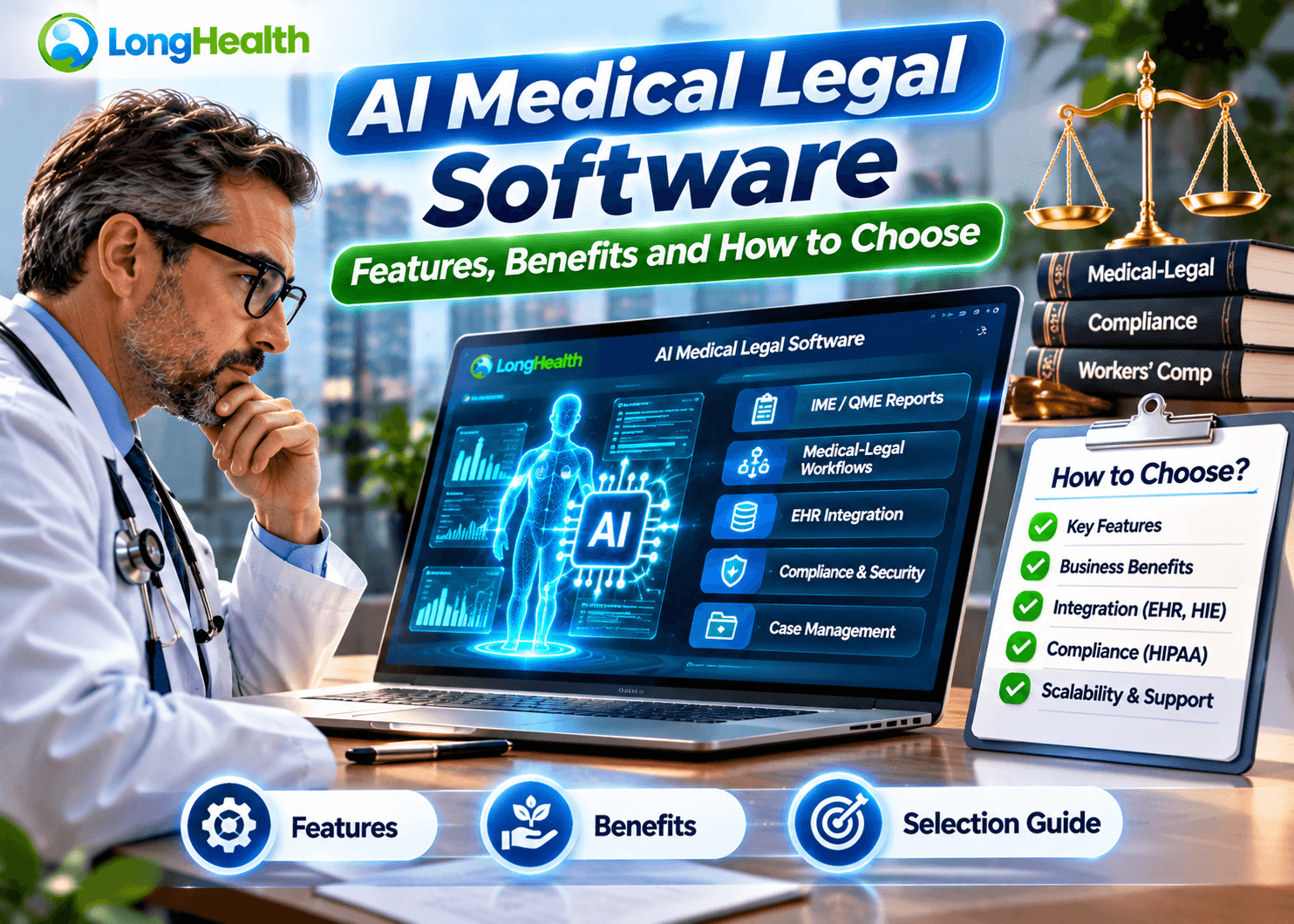
Medical-legal evaluations often require professionals to review extensive medical records, reconstruct treatment histories, document examination findings, analyze relevant medical information, and prepare detailed reports. When these activities rely heavily on manual processes, teams can face fragmented information, repetitive administrative work, and challenges maintaining a clear connection between report statements and their original sources.
AI medical legal software uses artificial intelligence to support medical-record review, clinical chronology preparation, information extraction, examination documentation, and medical-legal report workflows. It can help organize complex information and prepare structured drafts, while the responsible physician or qualified professional remains accountable for reviewing the evidence, applying professional judgment, and finalizing the work product.
For IME and QME physicians, medical-legal organizations, workers' compensation evaluation teams, and other professionals involved in medical-legal work, selecting the right software requires more than checking whether a platform includes AI. Buyers should evaluate its ability to support the complete workflow, preserve source traceability, protect sensitive information, and fit the organization's existing review and reporting processes.
This guide explains how AI medical-legal software works, which features matter, how to evaluate vendors, and what to consider before implementation.
What Is AI Medical Legal Software?
AI medical legal software in California is a technology platform that uses artificial intelligence and document-processing capabilities to assist professionals with tasks involved in medical-legal evaluations and related record-review workflows.
Depending on the platform, it may support:
- Medical-record ingestion and organization
- Extraction of relevant clinical information
- Medical-record summaries
- Clinical chronology generation
- Identification of diagnoses, treatments, procedures, and examination details
- Physician dictation transcription
- Examination documentation
- Impairment-related calculations or analysis
- Medical-legal report drafting
- Report templates and document generation
- Search and retrieval of information from case records
The purpose is to make information easier to review, organize, and incorporate into professional work product.
AI medical-legal software does not independently establish medical causation, determine legal responsibility, make a final impairment determination, or replace the judgment of a qualified professional. Its role is to support information processing and documentation within a human-controlled workflow.
Who Uses AI Medical Legal Software?
The software can support different organizations and professionals who work with medical records for evaluations, claims, litigation, disability reviews, or other medical-legal purposes.
1. Independent Medical Examination (IME) physicians
IME physicians may need to review medical records, understand the history of an injury or condition, document examination findings, and prepare an independent medical evaluation report.
AI-assisted tools can help organize the records and prepare structured documentation for professional review.
2. Qualified Medical Evaluators (QMEs)
In California, Qualified Medical Evaluators perform evaluations within the state's workers' compensation system. Their work may involve reviewing medical records, documenting examinations, considering impairment-related information, and preparing medical-legal reports.
Software designed for QME workflows should account for the specific documentation and review requirements relevant to the evaluator's work.
3. Medical-legal organizations
Organizations coordinating multiple evaluations may need consistent processes for case creation, document management, record review, report preparation, and quality control.
A workflow-oriented platform can help bring these activities into a more structured process.
4. Workers' compensation evaluation teams
Workers' compensation medical-legal workflows can involve extensive treatment histories, multiple providers, diagnostic reports, examination findings, and supporting documentation.
AI-assisted record organization and chronology preparation can help professionals navigate this information.
5. Legal nurse consultants and medical record reviewers
Legal nurse consultants and other qualified reviewers may examine medical records to identify relevant events, summarize treatment histories, and organize information for attorneys, physicians, or claims professionals.
AI tools can support document organization and information retrieval, but reviewers must verify important findings against the original records.
6. Claims and insurance organizations
Claims teams may work with medical documentation when coordinating evaluations, reviewing records, or managing supporting information. Software suitability depends on the organization's specific role, permissions, workflow, and applicable legal requirements.
How Does AI Medical Legal Software Work?
A useful platform connects multiple stages of the evaluation process instead of treating each task as an isolated activity.
A typical workflow may look like this:
Medical records → Document processing → AI-assisted review → Clinical chronology → Examination documentation → Professional analysis → Report preparation → Human verification → Final report
The exact workflow varies by vendor and configuration.
Step 1: Upload and organize medical records
The process begins with collecting and organizing the records associated with a case.
Depending on the platform, supported documents may include:
- PDF medical records
- Scanned documents
- Images
- Physician notes
- Diagnostic reports
- Treatment records
- Discharge summaries
- Other supporting case documents
Buyers should confirm supported formats, file-size limits, document-volume limits, and whether scanned or image-based records can be processed.
Step 2: Extract relevant medical information
AI-assisted document processing can help identify information such as:
- Dates of medical visits
- Healthcare providers and facilities
- Diagnoses documented in the records
- Treatments and procedures
- Imaging and diagnostic findings
- Medication information
- Reported symptoms
- Examination findings
- Relevant medical history
Extraction quality must be evaluated carefully. Poor scans, handwriting, inconsistent terminology, missing pages, and conflicting dates can affect the information produced.
Step 3: Generate a medical chronology
A medical chronology organizes relevant events in chronological order.
For example, a chronology may contain:
| Date | Event | Information to verify |
|---|---|---|
| January 12 | Initial medical visit | Presenting complaint and documented findings |
| January 20 | Diagnostic imaging | Imaging report and interpretation |
| February 3 | Follow-up appointment | Treatment plan and recorded progress |
| March 15 | Specialist consultation | Specialist findings and recommendations |
The purpose is to make the sequence of documented events easier to understand.
A chronology should not be treated as a substitute for the underlying records. Professionals should be able to locate the original source for important dates, statements, findings, and conclusions.
Step 4: Document the examination
Some medical-legal platforms also support examination documentation through dictation, transcription, structured forms, or AI-assisted clinical documentation.
The physician should verify that the recorded information accurately reflects the examination performed and the findings documented.
Step 5: Support impairment-related workflows
Depending on the software, tools may assist with organizing impairment-related information or calculations.
Buyers should determine which methodology, reference materials, and calculation workflows the software supports. They should also verify whether the system displays its inputs and calculation steps clearly enough for professional review.
An AI-generated calculation or suggested rating should never be accepted without checking the applicable methodology, source information, and professional requirements.
Step 6: Prepare the medical-legal report
A platform may use organized records, chronology information, examination documentation, and templates to prepare draft report sections.
The draft should remain editable and subject to professional review. The responsible physician or other qualified professional must verify the facts, analysis, opinions, and final report.
Step 7: Review and finalize
Before a report is finalized, the responsible professional should check:
- Whether the relevant records were included
- Whether dates and provider details are correct
- Whether summaries reflect the source documents
- Whether important findings have been omitted
- Whether conflicting information has been identified
- Whether examination details are accurate
- Whether calculations follow the applicable methodology
- Whether conclusions reflect independent professional judgment
Essential Features to Look for in AI Medical Legal Software
Not every product marketed as medical AI software is designed for medical-legal evaluations. A general-purpose chatbot, medical transcription application, or EHR documentation tool may not provide the workflow support needed for this type of work.
Use the following feature framework when assessing a platform.
1. AI-assisted medical-record review
The software should help professionals process and organize medical records.
Evaluate whether it can:
- Process the file formats used by your organization
- Handle scanned and image-based records
- Identify relevant clinical information
- Organize documents into a usable structure
- Surface information for further review
- Make it easy to return to the original document
2. Medical chronology generation
Chronology functionality is important when a case involves records from multiple providers over an extended period.
Ask whether the platform can organize:
- Treatment dates
- Provider visits
- Diagnoses
- Procedures
- Imaging
- Hospital encounters
- Relevant examination findings
Also ask how it handles conflicting dates, duplicate documents, missing information, and events that appear out of chronological order.
3. Source traceability
Source traceability is one of the most important evaluation criteria.
A summary may appear accurate but still be unsuitable if a reviewer cannot identify where the information originated.
Look for functionality that allows reviewers to inspect the original record supporting an extracted fact, chronology entry, or AI-generated statement.
4. AI-powered medical summarization
Summarization can help professionals navigate large record collections.
However, a useful summary should preserve important context and distinguish documented facts from interpretations. It should not remove information simply because it appears repetitive or less prominent.
Ask vendors how they handle conflicting documentation, uncertainty, missing records, and information that may be relevant to the evaluation.
5. Medical dictation and transcription
Physician dictation can be a useful part of the documentation workflow.
Evaluate:
- Medical terminology recognition
- Support for physician dictation
- Editing and correction options
- Structured note generation
- Speaker or encounter handling, where applicable
- Review before information enters a final report
Transcription accuracy should be tested using representative clinical language and real-world recording conditions approved for testing.
6. Impairment-related workflow support
If your organization performs impairment evaluations, examine whether the software supports the relevant calculation and documentation workflow.
Ask:
- Which reference methodology does it support?
- Can users inspect the inputs?
- Are calculations editable or reviewable?
- How are missing inputs handled?
- Can the professional document the reasoning?
- Does the system distinguish suggested information from a final professional determination?
7. Medical-legal report templates
Different organizations may use different report formats and documentation requirements.
Evaluate whether the software supports:
- Editable templates
- Structured report sections
- Draft generation
- Manual corrections
- Document export
- Review and approval workflows
Do not assume that a vendor supports a particular jurisdiction's report format without confirming it directly.
8. Case and document management
The platform should fit the way your team manages cases.
Depending on organizational needs, assess:
- Case creation
- Document organization
- User permissions
- Case status tracking
- Search and retrieval
- File management
- Export and retention options
9. Security and privacy controls
Medical-legal records can contain sensitive health information and other confidential case material.
Before adopting a platform, review its security documentation, data-handling practices, access controls, retention policies, subcontractors, and contractual responsibilities.
HIPAA applicability depends on the parties and the way protected health information is created, received, maintained, or transmitted. A vendor's marketing statement alone is not sufficient to establish that a particular deployment meets an organization's obligations.
10. Human review and accountability
AI should assist professionals rather than replace them.
A suitable workflow should allow qualified users to inspect, correct, edit, and approve AI-generated content before it becomes final professional work product.
AI Medical Legal Software vs. Traditional Medical-Legal Processes
The distinction is not simply between manual work and automation. It is about how information is processed, reviewed, and incorporated into the final evaluation.
| Workflow area | Traditional process | AI-assisted process |
|---|---|---|
| Document organization | Manual sorting and filing | AI-assisted classification and organization |
| Medical-record review | Manual reading and note-taking | AI-assisted extraction and summarization |
| Chronology | Manually assembled timeline | AI-generated chronology for verification |
| Information retrieval | Manual searching through records | AI-assisted search and retrieval |
| Dictation | Traditional transcription workflow | AI-assisted speech-to-text documentation |
| Report preparation | Manual drafting and template completion | Draft preparation using structured information |
| Final review | Professional review | Professional review remains essential |
AI-assisted software may reduce repetitive information-processing work, but actual performance depends on document quality, system capabilities, case complexity, and the organization's review process.
AI Medical Legal Software vs. AI Medical Scribe Software
These technologies are related, but they solve different problems.
| Area | AI medical legal software | AI medical scribe software |
|---|---|---|
| Primary purpose | Support medical-legal evaluation workflows | Support clinical encounter documentation |
| Main information source | Existing medical records and evaluation documentation | Clinical conversations and physician dictation |
| Typical output | Chronologies, record summaries, examination documentation, report drafts | Clinical notes, SOAP notes, and encounter documentation |
| Main users | IME/QME physicians and medical-legal professionals | Physicians and clinical teams |
| Workflow focus | Record review, evaluation, and medical-legal reporting | Clinical documentation and EHR workflows |
| Professional review | Required | Required |
An AI medical scribe may be one component of a broader medical-legal workflow, but transcription alone does not provide the full functionality of medical-legal evaluation software.
Benefits of AI Medical Legal Software
The value of a platform depends on how well it addresses an organization's actual workflow.
More structured medical-record review
AI-assisted organization and summarization can make large document collections easier to navigate.
Easier chronology preparation
Chronology tools can help organize medical events and make the sequence of documented treatment easier to inspect.
Improved information retrieval
Search and AI-assisted question-answering tools may help users locate relevant information without repeatedly navigating entire files manually.
More connected documentation workflows
Combining record review, examination documentation, and report preparation can reduce the need to move information between disconnected processes.
More consistent report preparation
Structured templates and draft-generation workflows can help teams follow a defined documentation process. The final content still requires professional verification.
Better visibility into the case record
When AI-generated information is linked to source documents, reviewers can more easily inspect the underlying evidence and investigate discrepancies.
HIPAA, Security, and Data Privacy: What Buyers Should Verify
Security should be evaluated before uploading sensitive medical records into any AI-powered platform.
The U.S. Department of Health and Human Services explains that a cloud service provider that creates, receives, maintains, or transmits electronic protected health information on behalf of a covered entity or business associate may qualify as a business associate. A business associate agreement is required where the HIPAA Rules apply to that relationship.
Relevant official guidance:
Before selecting software, ask vendors the following questions.
Is a Business Associate Agreement available?
Determine whether the vendor will act as a business associate for your specific use case and whether an appropriate BAA can be executed before protected health information is processed.
How is information protected?
Request documentation covering:
- Encryption in transit and at rest
- Authentication and access management
- User permissions
- Audit logging
- Data backup and recovery
- Incident response
- Data retention and deletion
- Subcontractor access
How is information used by AI systems?
Ask whether submitted records or generated outputs are used for model training, product improvement, or other purposes. Review the contractual terms and privacy documentation rather than relying only on verbal assurances.
Where is data processed and stored?
Understand the hosting environment, processing locations, subprocessors, and any relevant data residency commitments.
Can your organization conduct a risk assessment?
HHS emphasizes that organizations must assess risks to electronic protected health information and implement appropriate safeguards. A vendor's certification or security statement does not eliminate the organization's responsibility to evaluate its own environment and obligations.
How to Choose the Right AI medical legal software in California
Use this practical evaluation framework before selecting a provider.
| Evaluation area | Questions to ask | What to look for |
|---|---|---|
| Record processing | Which formats and document types are supported? | Compatibility with actual case files |
| Record review | Can the system identify relevant information? | Clear, reviewable extraction |
| Chronology | Can it organize events by date and source? | Accurate, traceable timelines |
| Source references | Can users open the original record behind a result? | Direct source verification |
| Transcription | Does it support medical dictation? | Editable and reviewable transcripts |
| Report preparation | Can it populate templates or prepare drafts? | Flexible, physician-editable outputs |
| Impairment workflow | Which methodologies and calculations are supported? | Transparent inputs and review |
| Security | What controls and agreements are available? | Documented safeguards and contractual clarity |
| Usability | Can professionals use it within their existing workflow? | Practical onboarding and navigation |
| Scalability | Can it support expected case volumes and users? | Performance validated with representative workloads |
Test the platform with representative records
A vendor demonstration is useful, but it should not be the only basis for a purchasing decision.
Where permitted, conduct a controlled pilot using representative, appropriately authorized records. Include different document types, scan qualities, record lengths, and case complexities.
Measure:
- Whether relevant information is captured.
- Whether important events are omitted.
- Whether chronology entries match the source records.
- Whether the system identifies conflicting information.
- Whether report drafts are editable.
- How much professional correction is required.
- Whether users can complete the workflow efficiently.
- Whether the system meets the organization's security and contractual requirements.
A structured pilot gives decision-makers a more realistic view of the platform than a feature checklist alone.
Common Mistakes When Selecting Medical-Legal AI Software
Choosing a tool based only on AI features
A platform may have impressive summarization capabilities but lack examination documentation, report workflows, or the source verification needed for medical-legal work.
Evaluate the entire workflow rather than a single feature.
Assuming AI-generated summaries are complete
A summary may omit an important event, misinterpret a date, or fail to represent conflicting documentation.
Review the output against the source records.
Ignoring source traceability
If a reviewer cannot locate the original evidence behind an AI-generated statement, verification becomes more difficult.
Treating AI calculations as final decisions
Calculations and suggested analysis should be checked against the applicable methodology and professional requirements.
Overlooking privacy and contractual requirements
Do not upload sensitive records until the organization has assessed the vendor's data handling, applicable HIPAA responsibilities, contractual terms, and security controls.
Failing to test real-world workloads
A system that performs well on a short sample may behave differently with large, mixed-quality case files. Test the types of records your team actually handles.
How LongHealth Supports Medical-Legal Workflows with EvalPath
LongHealth offers EvalPath, a technology platform designed to support medical-legal evaluation workflows.
Its publicly described workflow brings together several activities that are often handled separately:
- AI-assisted medical-record review: Helps review medical records and identify relevant clinical information, diagnoses, treatments, and procedures.
- Clinical chronology: Organizes documented injuries, diagnoses, treatments, procedures, imaging, and key events into a chronology with source-linked references for physician review.
- AI-assisted examination documentation: Supports capture of patient encounters, physician dictation, and examination measurements through AI-powered transcription.
- Impairment-rating support: Supports AMA Guides-based impairment-rating workflows using medical records and physician examination findings.
- Medical-legal report preparation: Supports physician-editable report content and templates.
- Review and finalization: Supports voice or manual editing so the responsible professional can review and finalize the report.
These capabilities are intended to support the evaluation process, not to replace the physician or other professional responsible for the final work product.
For organizations evaluating medical-legal software, the important next step is to determine whether the platform fits their case types, documentation requirements, record volumes, review processes, and security expectations.
Explore LongHealth EvalPath to learn more about its medical-legal workflow capabilities.
Frequently Asked Questions About AI Medical Legal Software
1. What is AI medical legal software?
AI medical legal software in California uses artificial intelligence to support tasks such as medical-record review, clinical chronology generation, information extraction, examination documentation, and medical-legal report preparation. It assists qualified professionals but does not replace their judgment.
2. Who needs AI medical legal software?
Potential users include IME and QME physicians, medical-legal organizations, physician groups, workers' compensation evaluation teams, claims organizations, and legal nurse consultants who work with medical records and evaluation documentation.
3. Can AI medical legal software review large medical records?
Some platforms support AI-assisted processing, summarization, and organization of extensive medical records. Actual capacity depends on the product, file formats, document quality, and case-volume limits. Organizations should test the platform using representative records before adoption.
4. Can AI generate a medical-legal report?
Some platforms can prepare draft report sections or populate templates using organized case information. The responsible professional must verify the facts, analysis, calculations, and conclusions before approving or signing the final report.
5. Does AI medical legal software replace an IME or QME physician?
No. AI can assist with information processing and documentation, but it does not replace the physician's examination, independent analysis, professional judgment, or responsibility for the final evaluation.
6. What is the difference between medical chronology software and medical-legal software?
Medical chronology software focuses primarily on organizing medical events into a timeline. Medical-legal software may include chronology as one part of a broader workflow that also supports record review, examination documentation, impairment-related processes, and report preparation.
7. Is AI medical legal software the same as AI medical scribe software?
No. AI medical scribe software primarily supports clinical encounter transcription and documentation. Medical-legal software is designed around evaluation-related workflows, which may include reviewing existing records, building chronologies, documenting examinations, and preparing medical-legal reports.
8. Is AI medical legal software HIPAA compliant?
HIPAA applicability depends on the organizations involved and how protected health information is handled. Buyers should review the vendor's security documentation, business associate arrangements where applicable, privacy terms, and safeguards. A general marketing claim is not a substitute for evaluating the actual deployment.
9. What features should I prioritize when choosing medical-legal software?
Prioritize medical-record processing, source-linked chronology, accurate information extraction, examination documentation, editable report templates, professional review, security controls, and fit with your organization's workflow.
10. Can AI medical legal software support workers' compensation evaluations?
It may support documentation and information-processing activities involved in workers' compensation medical-legal workflows. Buyers should verify that the software supports the relevant jurisdiction, evaluation type, reporting requirements, and professional review process.
11. What is EvalPath by LongHealth?
EvalPath is LongHealth's medical-legal workflow platform. Its publicly described capabilities include AI-assisted record review, clinical chronology, examination documentation, impairment-rating support, and physician-editable report preparation.
12. How can an organization evaluate LongHealth EvalPath?
An organization can review the documented workflow and discuss its case types, record volumes, reporting templates, user requirements, and security or contractual needs with LongHealth. A workflow discussion can help determine whether the platform is appropriate for the organization's intended use.
Final Thoughts: Choose Software That Supports the Entire Medical-Legal Workflow
AI medical legal software can help professionals organize complex records, prepare clinical chronologies, retrieve relevant information, document examinations, and develop structured report drafts.
However, the value of the technology depends on more than automation. Source traceability, document accuracy, transparent workflows, security, professional oversight, and practical implementation all matter when the output may contribute to a consequential medical-legal evaluation.
For organizations evaluating a platform, the best approach is to map the existing workflow, identify the most time-consuming information-processing tasks, and test software against representative records before making a decision.
Looking to improve your medical-legal evaluation workflow? Explore LongHealth EvalPath or contact LongHealth to discuss your organization's requirements.

HIPAA Compliant
We follow the highest standards of data protection, fully aligned with HIPAA regulations, to safeguard your medical records with uncompromising privacy and trust.

HITRUST
We are proud to be HITRUST Risk-Based, 2-Year (r2) Certified, demonstrating our commitment to the highest standards of data security and compliance.
Trusted Partners
Our trusted vendors are fully compliant with HIPAA and hold prestigious certifications.
Data Encryption
Longhealth secures your sensitive information with advanced encryption, safeguarding data both during transmission and while stored.
DxF - Data Exchange Framework
Improve care coordination, transparency, and access to real-time patient data across systems like EHRs, health plans, and providers.

Data Exchange Simplified

HIPAA Compliant